Scale of the large | Scale of the universe | Cosmology & Astronomy | Khan Academy
TL;DR
Our brains struggle to comprehend the immense size of the universe, as we are minuscule in comparison to even the small objects within it.
Transcript
The purpose of this video is to just begin to appreciate how vast and enormous the universe is. And frankly, our brains really can't grasp it. What we'll see in this video is that we can't even grasp things that are actually super small compared to the size of the universe. And we actually don't even know what the entire size of the universe is. Bu... Read More
Key Insights
- 🧠 The video highlights the immense scale of the universe and how our brains struggle to comprehend it.
- 🫵 It demonstrates that even objects like skyscrapers and cities become difficult to grasp when viewed in comparison to the vastness of the universe.
- 🤩 The video emphasizes the sparsity of stars within galaxies, showing that most of the volume is empty space.
Install to Summarize YouTube Videos and Get Transcripts
Explore YouTube Video Summarizer or Get YouTube Transcript Extractor
Questions & Answers
Q: How does the video emphasize the difficulty our brains face in understanding the vastness of the universe?
The video uses a series of size comparisons, starting from a human and gradually expanding to skyscrapers, large cities, and even the diameter of the Earth, demonstrating how these objects become increasingly difficult for our minds to comprehend.
Q: What is the significance of the distance between the Earth and the Sun?
The distance between the Earth and the Sun is already remarkably vast, being 100 times the diameter of the Sun. This serves as a basis for understanding even larger distances within our solar system and beyond.
Q: How does the video illustrate the sparsity of stars in our galaxy?
By comparing the size of the Sun to a basketball, and then visualizing a handful of basketball-sized stars in a volume the size of the Earth, the video demonstrates that the vast majority of the galaxy is empty space.
Q: What is the scale of the observable universe?
The observable universe has a diameter of about 93 billion light years, which is far beyond what our minds can comprehend. This size is continuously expanding due to the expansion of space itself.
Summary & Key Takeaways
-
The video illustrates the concept of scale, starting from the size of a human to comparing it with an 18-wheeler, a skyscraper, the Golden Gate Bridge, and a large city.
-
The scale is further expanded to show the vastness of the San Francisco Bay Area, a big part of the Western United States, and the diameter of the Earth, Jupiter, and the Sun.
-
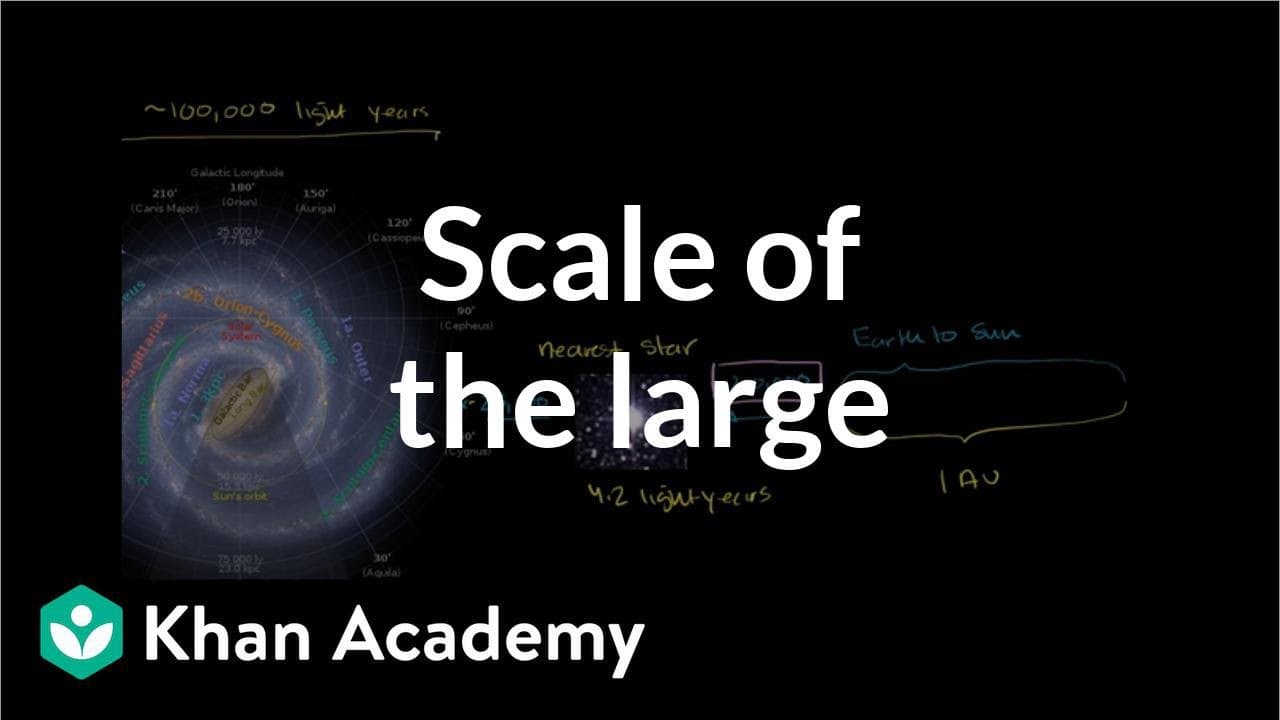
Finally, it highlights the mind-boggling distances between celestial objects, including the nearest star, our galaxy, and the observable universe.
Read in Other Languages (beta)
Share This Summary 📚
Summarize YouTube Videos and Get Video Transcripts with 1-Click
Try YouTube Summary with ChatGPT & Claude or YouTube Transcript Generator
Explore More Summaries from Khan Academy 📚



Summarize YouTube Videos and Get Video Transcripts with 1-Click
Try YouTube Summary with ChatGPT & Claude or YouTube Transcript Generator