Pressure at a depth in a fluid | Fluids | Physics | Khan Academy
TL;DR
This video discusses the concept of internal pressure in liquids and how it is affected by depth and density.
Transcript
In the last video, we showed that any external pressure on a liquid in a container is distributed evenly through the liquid. But that only applied to-- and that was called Pascal's principle-- external pressure. Let's think a little bit about what the internal pressure is within a liquid. We're all familiar, I think, with the notion of the deeper y... Read More
Key Insights
- 🫗 Pascal's principle applies to external pressure on liquids, while internal pressure in liquids depends on depth.
- 😥 The weight of the liquid above a certain point determines the force acting on a floating object at that depth.
- 🤩 Density, height, and gravitational acceleration are key factors in determining internal pressure within a liquid.
- 🫗 The pressure in liquids increases with depth due to the increasing weight of the liquid above.
Install to Summarize YouTube Videos and Get Transcripts
Explore YouTube Video Summarizer or Get YouTube Transcript Extractor
Questions & Answers
Q: What is Pascal's principle?
Pascal's principle states that external pressure on a liquid is distributed equally throughout the entire liquid, regardless of its shape or size. This principle explains how hydraulic systems work.
Q: How does internal pressure in a liquid change with depth?
The internal pressure within a liquid increases with depth. This is due to the weight of the liquid above a given point, which exerts a force on objects at lower depths.
Q: What factors determine the force acting on a floating object in a liquid?
The force acting on a floating object in a liquid depends on the density of the liquid, the height of the liquid above the object, and the acceleration due to gravity.
Q: How is pressure calculated at a certain depth in a liquid?
The pressure at a certain depth in a liquid can be calculated by multiplying the density of the liquid, the depth, and the gravitational acceleration. This equation allows us to determine the pressure at different depths within a liquid.
Summary & Key Takeaways
-
The previous video explained Pascal's principle, which states that external pressure on a liquid is distributed evenly. This video focuses on understanding internal pressure within a liquid, especially at various depths.
-
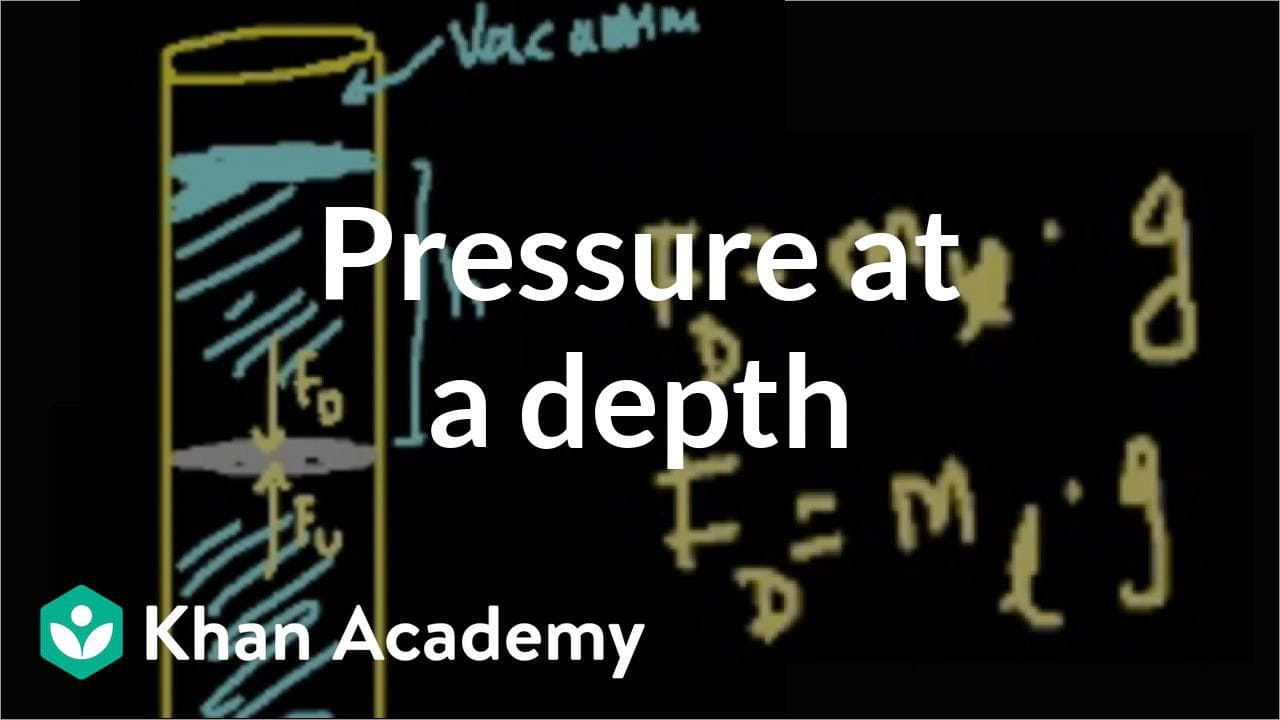
The concept is demonstrated using a cylinder with a floating foil and assuming a vacuum above the liquid. The force acting on the foil is equal to the weight of the liquid above it, which depends on the density and height of the liquid.
-
The video concludes by calculating the pressure at a depth of 10 meters under the water, showing that it is roughly 98,000 pascals.
Read in Other Languages (beta)
Share This Summary 📚
Summarize YouTube Videos and Get Video Transcripts with 1-Click
Try YouTube Summary with ChatGPT & Claude or YouTube Transcript Generator
Explore More Summaries from Khan Academy 📚



Summarize YouTube Videos and Get Video Transcripts with 1-Click
Try YouTube Summary with ChatGPT & Claude or YouTube Transcript Generator