GMAT: Data sufficiency 31 | Data sufficiency | GMAT | Khan Academy
TL;DR
The content includes explanations and solutions for GMAT practice problems related to integer divisibility, exponents, and inequalities.
Transcript
All right, we're on problem 125 on page 288. If r and s are positive integers, is r/s an integer? Is r/s an integer? So that's really just another way of saying, is s divisible into r? So let's see what the statements are. Statement 1. Every factor of s is also a factor of r. That answers our question. Every factor of s is factor of r. Well, let me... Read More
Key Insights
- ❓ Some GMAT problems can be solved by evaluating each statement independently, while others require combining multiple statements.
- 🧑🏭 Understanding the definitions and properties of factors, prime factors, and integers is crucial in solving problems related to divisibility.
- 🪡 Exponents can have multiple solutions, and restrictions or additional conditions may be needed to narrow down the possibilities.
Install to Summarize YouTube Videos and Get Transcripts
Explore YouTube Video Summarizer or Get YouTube Transcript Extractor
Questions & Answers
Q: What is the significance of every factor of s being a factor of r in problem 125?
Every factor of s being a factor of r means that s is divisible into r, making r/s an integer.
Q: Can the second statement in problem 125 determine if r/s is an integer?
No, the second statement which states that every prime factor of s is also a prime factor of r does not guarantee r/s to be an integer, as demonstrated by the counterexample.
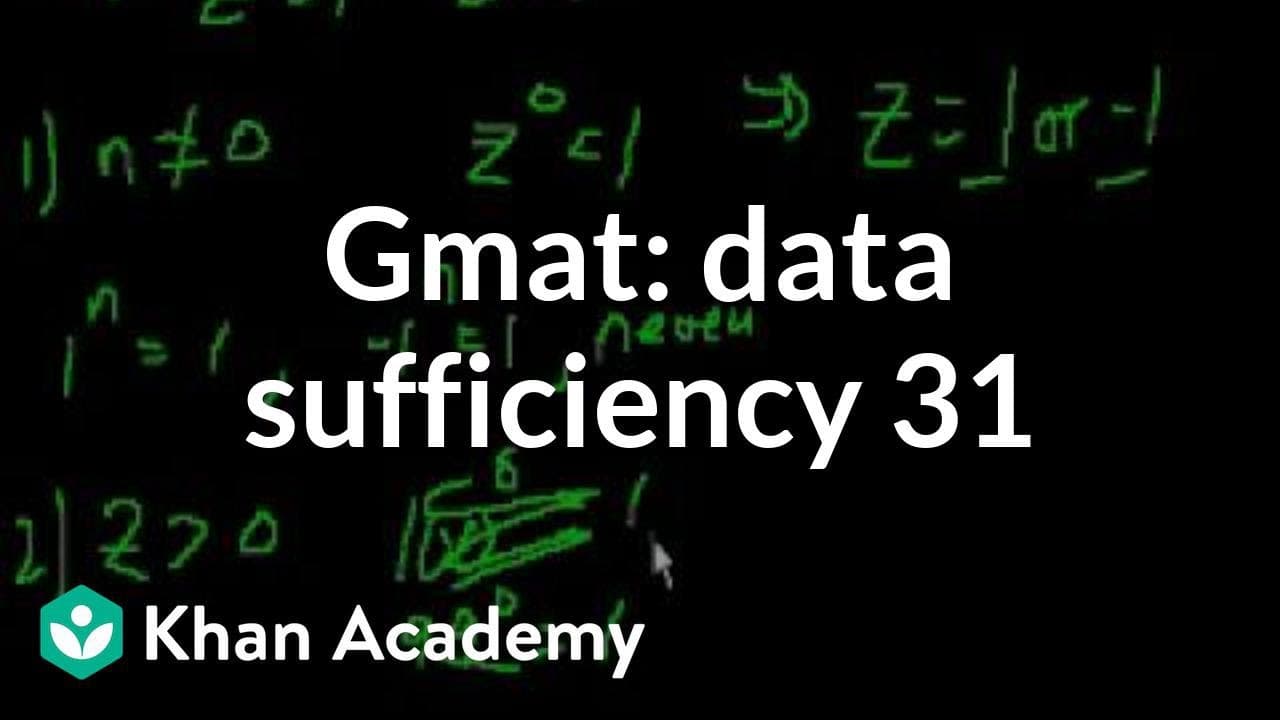
Q: How does the first statement in problem 126 help in narrowing down the possible values of z?
The first statement (n is a nonzero integer) helps in narrowing down the options for z to 1 and -1, as these are the only values that satisfy the condition of z^n = 1.
Q: Why is the second statement in problem 126 useless on its own?
The second statement (z is greater than 0) alone does not provide enough information to determine the value of z because any positive number raised to the power of 0 equals 1.
Q: How can the first statement in problem 127 determine the value of s?
The first statement (x = 2n) allows us to substitute the value of x into the expression for s, resulting in s = 12/5.
Q: Does the second statement in problem 127 provide sufficient information to determine the value of s?
No, the second statement (n = 1/2) is not helpful on its own as it does not provide any information about x, which is required to calculate s.
Q: Can the first statement in problem 128 determine if x * |x| < 2x?
No, the first statement (x < 0) alone is not sufficient to determine the inequality, as it is possible to find counterexamples that do not satisfy it.
Q: Does the second statement in problem 128 provide enough information to prove the inequality x * |x| < 2x?
Yes, the second statement (x = -10) alone is sufficient to prove the inequality, as substituting the value of x into the expression confirms it.
Summary & Key Takeaways
-
In problem 125, the first statement alone is sufficient to prove that r/s is an integer, while the second statement is inconclusive.
-
In problem 126, the first statement alone narrows down the possible values of z to 1 and -1, while the second statement is not helpful on its own.
-
In problem 127, the first statement alone (x = 2n) is sufficient to determine the value of s, while the second statement alone (n = 1/2) is useless.
-
In problem 128, neither statement alone is sufficient to prove if x * |x| < 2x, as both statements have counterexamples.
Read in Other Languages (beta)
Share This Summary 📚
Summarize YouTube Videos and Get Video Transcripts with 1-Click
Try YouTube Summary with ChatGPT & Claude or YouTube Transcript Generator
Explore More Summaries from Khan Academy 📚



Summarize YouTube Videos and Get Video Transcripts with 1-Click
Try YouTube Summary with ChatGPT & Claude or YouTube Transcript Generator