Z-statistics vs. T-statistics | Inferential statistics | Probability and Statistics | Khan Academy
TL;DR
The video explains the difference between a Z-statistic and a T-statistic, and when to use each of them.
Transcript
I want to use this video to kind of make sure we intuitively and otherwise and understand the difference between a Z-statistic-- something I have trouble saying-- and a T-statistic. So in a lot of what we're doing in this inferential statistics, we're trying to figure out what is the probability of getting a certain sample mean. So what we've been ... Read More
Key Insights
- ❓ Inferential statistics involves calculating the probability of obtaining a certain sample mean.
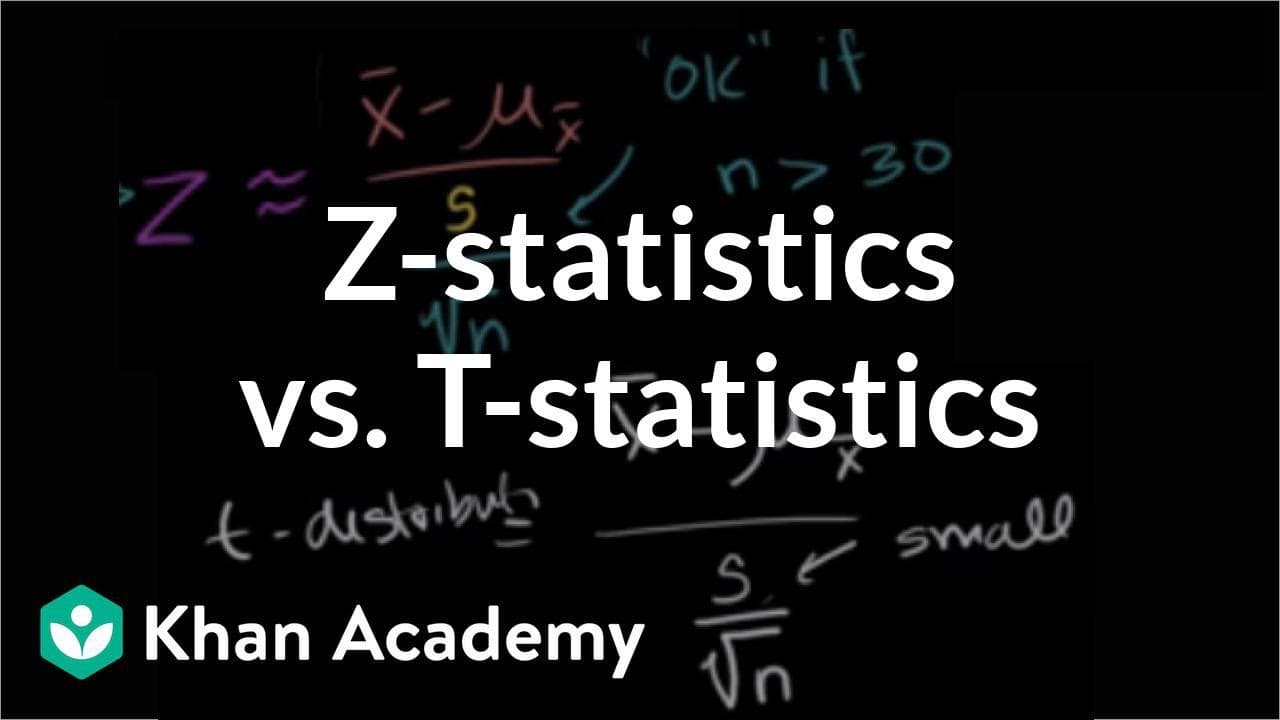
- 💤 The Z-statistic is used for large sample sizes, while the T-statistic is used for small sample sizes.
- 🦖 The Z-statistic follows a normal distribution, while the T-statistic follows a T-distribution.
- 🌥️ The normal distribution is used for approximation when the sample size is large.
- 🦖 The T-distribution is used when the sample size is small and has a mean of 0.
- 🛩️ The sample standard deviation is used to estimate the population standard deviation in small sample sizes.
- 🤐 A Z-table is used to determine the probability of obtaining a certain Z-value, while a T-table is used for T-values.
Install to Summarize YouTube Videos and Get Transcripts
Explore YouTube Video Summarizer or Get YouTube Transcript Extractor
Questions & Answers
Q: What is the purpose of the Z-statistic and the T-statistic?
The Z-statistic is used to calculate the probability of obtaining a certain sample mean when the sample size is large, while the T-statistic is used for small sample sizes to estimate the probability of obtaining a specific T-value.
Q: How do we calculate the Z-statistic?
The Z-statistic is calculated by subtracting the population mean from the sample mean, dividing it by the standard deviation of the sampling distribution, and then dividing it by the square root of the sample size.
Q: When do we use the T-distribution instead of the normal distribution?
The T-distribution is used when the sample size is small, typically less than 30. In this case, the T-statistic is used to estimate the probability of obtaining a specific T-value.
Q: How do we approximate the standard deviation of the population in the case of small sample sizes?
When the sample size is small, we estimate the population standard deviation using the sample standard deviation, which allows us to use the T-distribution for approximate calculations.
Summary & Key Takeaways
-
The video discusses how in inferential statistics, we calculate the probability of obtaining a certain sample mean.
-
For large sample sizes, we use the Z-statistic, which measures how many standard deviations our sample mean is from the population mean.
-
If the sample size is small (less than 30), we use the T-statistic, which follows a T-distribution instead of a normal distribution.
Read in Other Languages (beta)
Share This Summary 📚
Summarize YouTube Videos and Get Video Transcripts with 1-Click
Try YouTube Summary with ChatGPT & Claude or YouTube Transcript Generator
Explore More Summaries from Khan Academy 📚


Summarize YouTube Videos and Get Video Transcripts with 1-Click
Try YouTube Summary with ChatGPT & Claude or YouTube Transcript Generator