Worked example: limit comparison test | Series | AP Calculus BC | Khan Academy
TL;DR
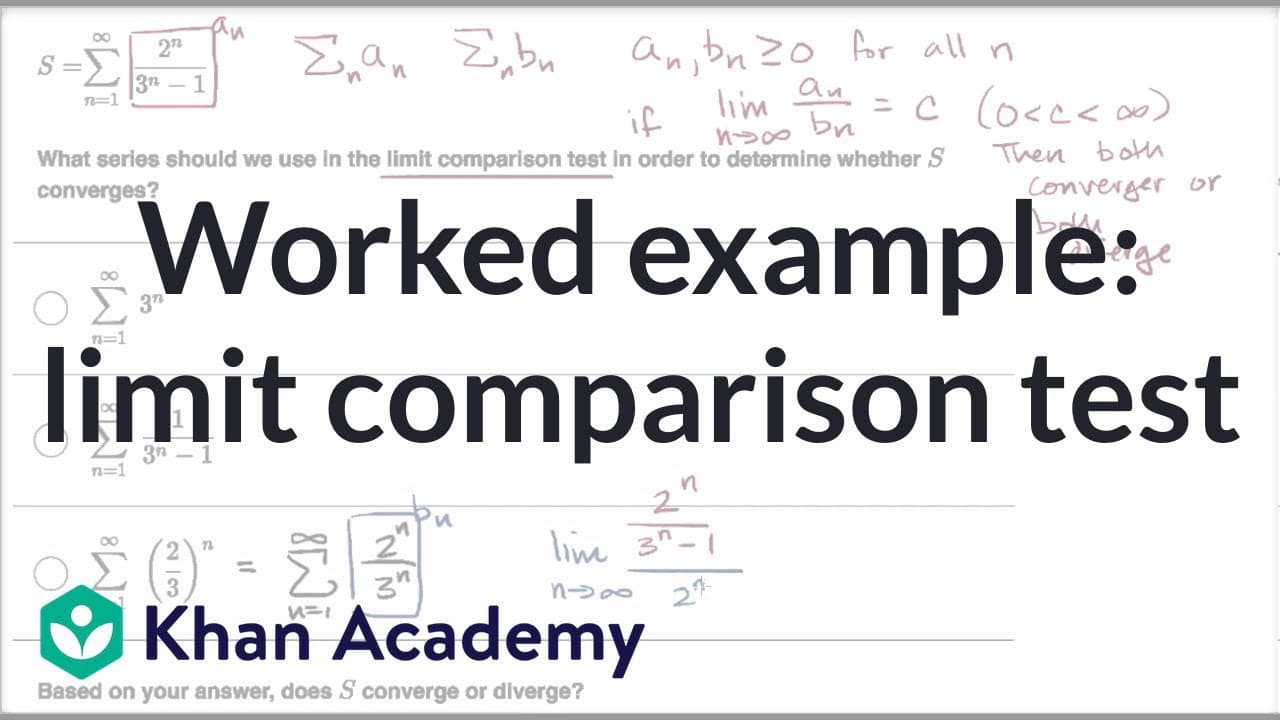
The original series converges because it can be compared with the geometric series whose terms are 2^n/3^n. Their term ratio simplifies to 1/(1 − 1/3^n), which approaches the positive constant 1 as n approaches infinity. Since the comparison series has a common ratio less than 1, it converges, so the limit comparison test establishes that the original series also converges; read on for each algebraic step.
Transcript
- [Instructor] So we're given a series here, and they say, "What series should we use "in the limit comparison test?" Let me underline that, "The limit comparison test, "in order to determine whether S converges?" So let's just remind ourselves about the limit comparison test. If we say, if we say that we have two series, and I'll just use this not... Read More
Key Insights
- 🏆 The limit comparison test is a useful tool in determining the convergence of a series by comparing it to another series with similar behavior.
- 🍉 The behavior of the terms in a series as n approaches infinity can indicate whether both series will either converge or diverge.
- ⛔ The limit comparison test relies on the concept of a positive constant limit for the ratio of terms between two series.
Install to Summarize YouTube Videos and Get Transcripts
Explore YouTube Video Summarizer or Get YouTube Transcript Extractor
Questions & Answers
Q: How does the limit comparison test determine whether a series converges or diverges?
Take two series with terms a_n and b_n that are nonnegative for all n, then evaluate the limit of a_n/b_n as n approaches infinity. If that limit is a positive constant between zero and infinity, the two series either both converge or both diverge.
Q: Which comparison series should be used for the original series?
Use the series whose terms are 2^n/3^n. It differs from the original term 2^n/(3^n − 1) only by the minus one in the denominator, so their behavior becomes similar for large n.
Q: Why are the nonnegative-term conditions satisfied in this example?
Both a_n = 2^n/(3^n − 1) and b_n = 2^n/3^n are greater than or equal to zero for the relevant values of n. Therefore, they meet the limit comparison test’s initial constraints.
Q: What ratio is evaluated in the limit comparison test?
The ratio is [2^n/(3^n − 1)] divided by [2^n/3^n]. After canceling 2^n, it becomes 3^n/(3^n − 1).
Q: How does the ratio simplify before taking the limit?
Dividing the numerator and denominator of 3^n/(3^n − 1) by 3^n gives 1/(1 − 1/3^n). This form makes its behavior as n approaches infinity clear.
Q: What is the limit of the ratio as n approaches infinity?
As n approaches infinity, 1/3^n approaches zero. Therefore, 1/(1 − 1/3^n) approaches 1, which is a positive constant between zero and infinity.
Q: Why does the comparison series converge?
The comparison series with terms 2^n/3^n is a geometric series. Its common ratio is less than one, so the series converges.
Q: What does the limit comparison test conclude about the original series?
The ratio limit is 1, so the original series and the geometric comparison series share the same convergence behavior. Because the geometric series converges, the original series also converges.
Summary & Key Takeaways
-
The limit comparison test can be used to determine convergence of a series by comparing it to another series with similar behavior.
-
If the limit of the ratio of terms between the two series is a positive constant, then both series either converge or diverge.
-
By applying the limit comparison test to a given series, it is determined that the series converges.
Read in Other Languages (beta)
Share This Summary 📚
Summarize YouTube Videos and Get Video Transcripts with 1-Click
Try YouTube Summary with ChatGPT & Claude or YouTube Transcript Generator
Explore More Summaries from Khan Academy 📚



Summarize YouTube Videos and Get Video Transcripts with 1-Click
Try YouTube Summary with ChatGPT & Claude or YouTube Transcript Generator