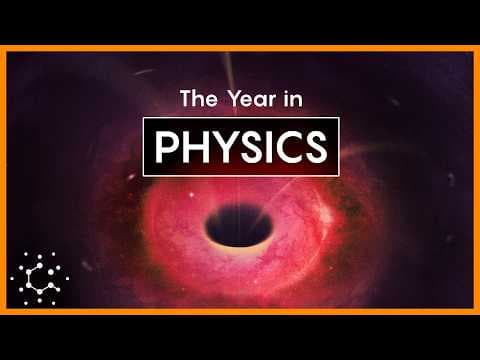
2023's Biggest Breakthroughs in Physics
TL;DR
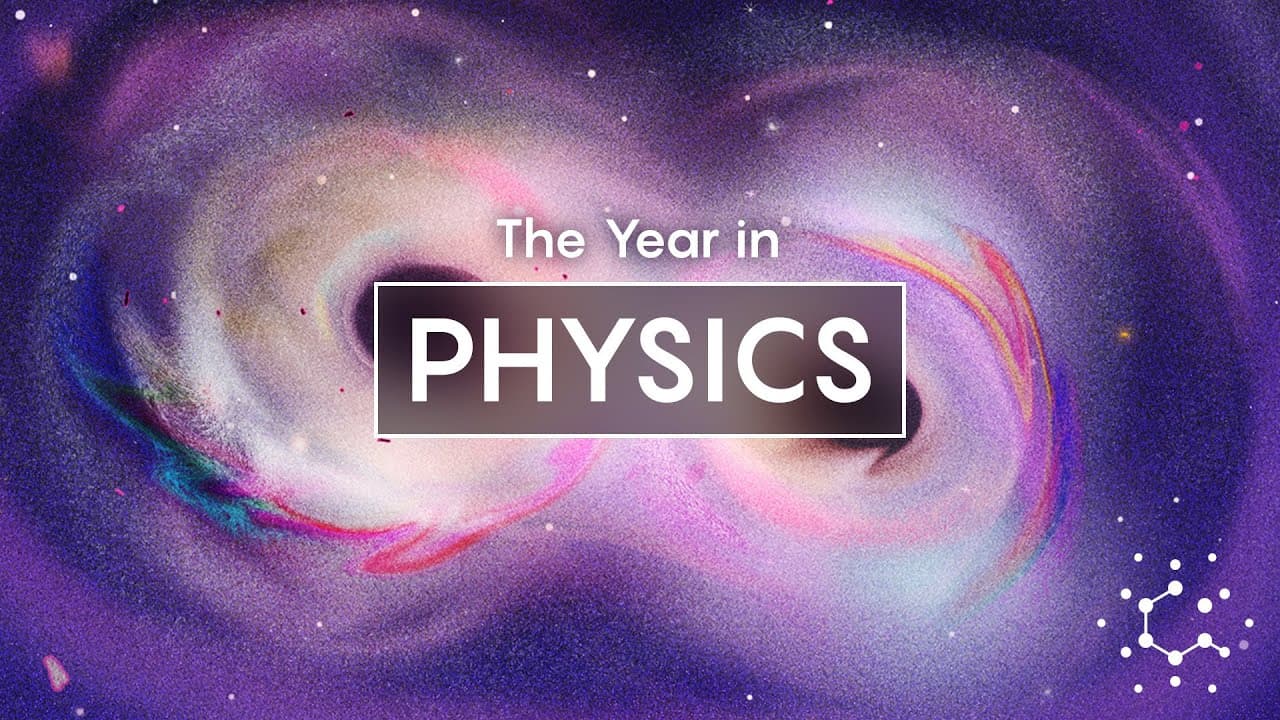
Scientists detect gravitational waves, achieve quantum teleportation, and make groundbreaking discoveries about early galaxies challenging our understanding of the universe.
Transcript
this is one of the most mysterious sounds in the universe a billion years ago two black holes collided at nearly the speed of light the violent explosion distorted the fabric of SpaceTime with ripples called gravitational waves a gravitational wave is literally the stretching and compressing of SpaceTime um as predicted by Einstein over a 100 years... Read More
Key Insights
- 🤔 Gravitational waves, once thought to be undetectable, were observed in 2015, providing crucial insights into extreme cosmic events and black hole collisions.
- 💨 Pulsar timing arrays offer a way to measure gravitational waves at low frequencies, revealing a background hum of waves throughout the universe.
- 💁 Quantum teleportation experiments have demonstrated the transfer of information without using energy, unlocking the potential for applications in technology and basic science.
- 🖤 The JWST has revolutionized our understanding of the early universe, revealing unexpected objects and phenomena, such as supermassive galaxies and black holes forming earlier than anticipated.
- ✴️ Further studies with the JWST and other telescopes will provide more insights into the formation and evolution of galaxies, supermassive black holes, and the first generation of stars.
Install to Summarize YouTube Videos and Get Transcripts
Explore YouTube Video Summarizer or Get YouTube Transcript Extractor
Questions & Answers
Q: What are gravitational waves, and how are they detected?
Gravitational waves are ripples in spacetime caused by extreme cosmic events. Scientists detect them using observatories like LIGO and pulsar timing arrays, which measure the stretching and compressing of spacetime.
Q: How do pulsar timing arrays detect gravitational waves?
Pulsar timing arrays use the precise timing of pulses emitted by rapidly rotating pulsars. Gravitational waves passing through spacetime cause subtle changes in the timing of these pulses, allowing scientists to indirectly detect the waves.
Q: What is quantum teleportation, and how does it work?
Quantum teleportation is a protocol that enables the transfer of information without using energy. It exploits the entanglement of quantum fields, allowing measurement of one entangled particle to provide information about another, effectively teleporting the information.
Q: What groundbreaking discoveries have been made by the James Webb Space Telescope?
The James Webb Space Telescope (JWST) has revealed unexpectedly massive and bright red objects, supermassive galaxies, and early formation of supermassive black holes. These findings challenge our understanding of cosmic object formation and the early universe.
Summary & Key Takeaways
-
Gravitational waves, predicted by Einstein, were detected by scientists at the LIGO Observatory in 2015, providing evidence of the violent collisions of black holes and other extreme objects in the universe.
-
Pulsar timing arrays, like the Nanograph project, use pulsars to indirectly detect gravitational waves at low frequencies, revealing a background hum of gravitational waves that pervades the universe.
-
Quantum teleportation, demonstrated in recent experiments, allows for the transfer of information without using energy, utilizing entangled quantum fields.
Read in Other Languages (beta)
Share This Summary 📚
Summarize YouTube Videos and Get Video Transcripts with 1-Click
Try YouTube Summary with ChatGPT & Claude or YouTube Transcript Generator
Explore More Summaries from Quanta Magazine 📚
Summarize YouTube Videos and Get Video Transcripts with 1-Click
Try YouTube Summary with ChatGPT & Claude or YouTube Transcript Generator