How to Simplify Parametric Equations to Graph Ellipses
TL;DR
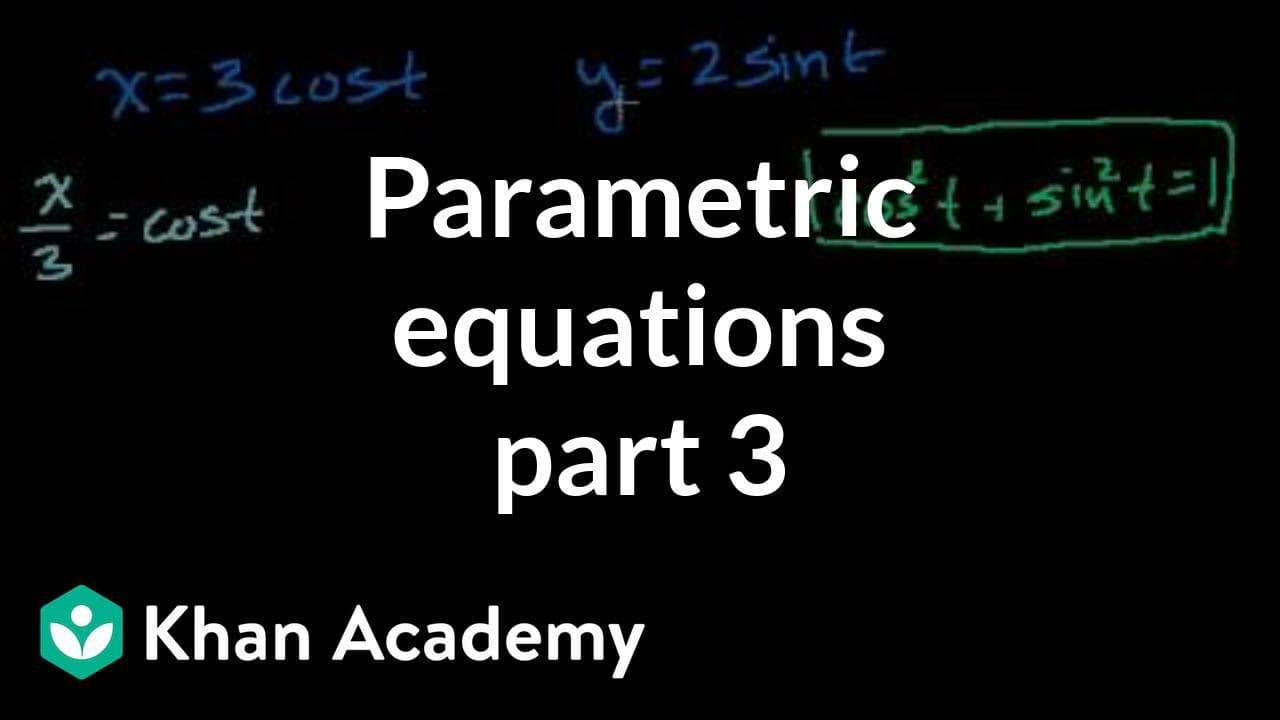
To simplify parametric equations like x = 3cos(t) and y = 2sin(t), use the identity cos²(t) + sin²(t) = 1. Rewriting these equations leads to x²/9 + y²/4 = 1, which represents an ellipse, making it easier to graph and understand relationships between x and y.
Transcript
Let's see if we can remove the parameter t from a slightly more interesting example. So let's say that x is equal to 3 times the cosine of t. And y is equal to 2 times the sine of t. We can try to remove the parameter the same way we did in the previous video, where we can solve for t in terms of either x or y and then substitute back in. And I'll ... Read More
Key Insights
- 😑 Parametric equations can be simplified and expressed in terms of x and y by eliminating the parameter t.
- ❣️ Solving for t in terms of x or y can lead to complex and non-intuitive equations.
- ❎ Using trigonometric identities, such as the cosine-squared plus sine-squared identity, can simplify parametric equations and yield familiar shapes, such as ellipses.
Install to Summarize YouTube Videos and Get Transcripts
Explore YouTube Video Summarizer or Get YouTube Transcript Extractor
Questions & Answers
Q: How do we simplify the parametric equations x = 3cos(t) and y = 2sin(t)?
To simplify the parametric equations, we can use the trigonometric identity cos^2(t) + sin^2(t) = 1. By replacing cos(t) and sin(t) with x/3 and y/2 respectively, we obtain x^2/9 + y^2/4 = 1 representing an ellipse.
Q: What is the significance of solving for t in terms of x or y?
Solving for t in terms of x or y allows us to eliminate the parameter and express the equations solely in terms of x and y. However, this approach leads to complex and non-intuitive equations.
Q: What is the alternative approach to removing the parameter t?
The video introduces the use of the trigonometric identity and shows how to rewrite the parametric equations as an equation of an ellipse. This approach simplifies the equations and provides a more intuitive understanding of the graph.
Q: How can we determine the direction of motion in the parametric equations?
By plotting points corresponding to different values of t, we can determine the direction of motion. In this case, as t increases from 0 to pi/2 to pi, the motion is counterclockwise along the ellipse.
Summary & Key Takeaways
-
The video discusses removing the parameter t from parametric equations x = 3cos(t) and y = 2sin(t) by solving for t in terms of x or y and substituting it back into the equations.
-
Solving for t leads to a complex and unintuitive equation, which is not the purpose of the video.
-
The video introduces a trick using the trigonometric identity cos^2(t) + sin^2(t) = 1 to rewrite the parametric equations as x^2/9 + y^2/4 = 1, which represents an ellipse.
Read in Other Languages (beta)
Share This Summary 📚
Summarize YouTube Videos and Get Video Transcripts with 1-Click
Try YouTube Summary with ChatGPT & Claude or YouTube Transcript Generator
Explore More Summaries from Khan Academy 📚



Summarize YouTube Videos and Get Video Transcripts with 1-Click
Try YouTube Summary with ChatGPT & Claude or YouTube Transcript Generator