Stanford EE259 I 2023 I Lecture 12 (Extra Session)
TL;DR
This analysis provides an overview of radar systems, including different types, waveforms, and antenna configurations, as well as the role of signal processing in estimating range and velocity.
Transcript
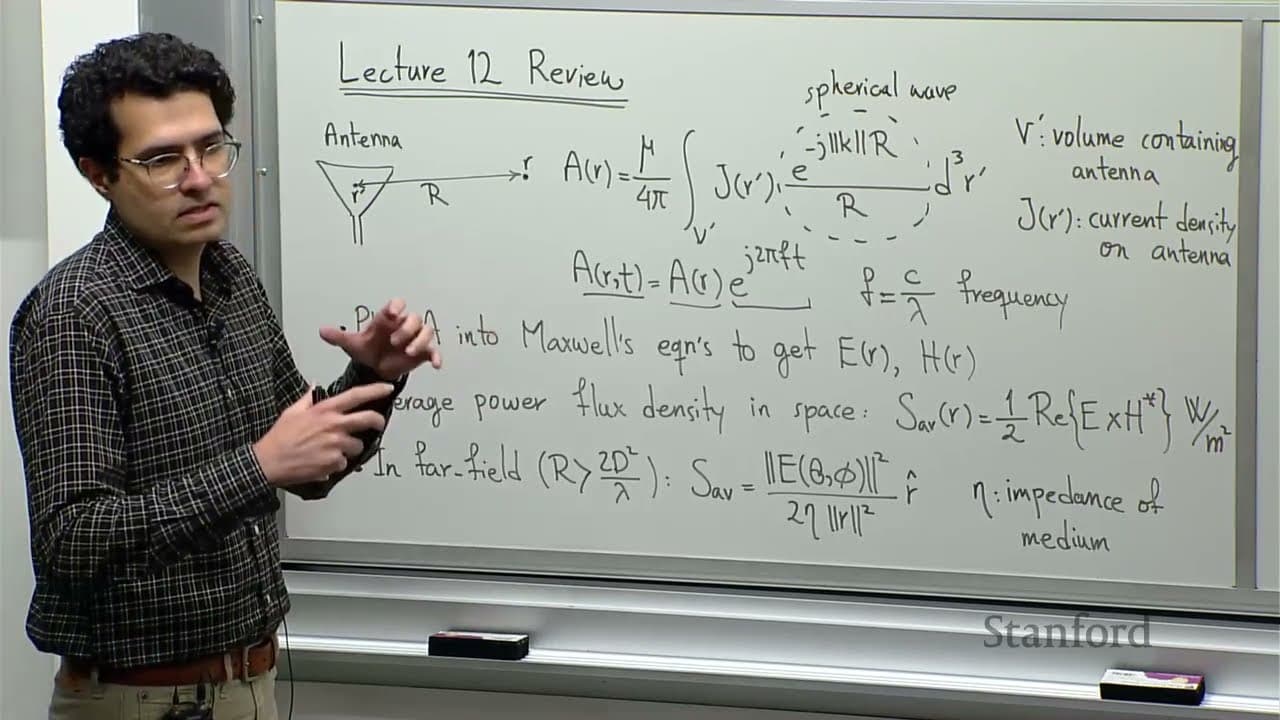
so let's just do a quick review to make sure you know things make sense so we started from Maxwell's equations and then we said that uh basically for any uh antenna or more generally for any uh current distribution and space we can find the electric and magnetic fields and the way it works is let's say you have some antenna with some geometry it ca... Read More
Key Insights
- 💗 Radar systems can be categorized based on waveform types (pulse and CW) and antenna configurations (SISO and MIMO).
- 🔸 FMCW radar systems are commonly used in robotics due to their high range and resolution, small size, and low power consumption.
- 🧡 The performance of radar systems can vary based on factors such as range, resolution, velocity estimation, and power consumption.
- 😒 FMCW radar systems use linear frequency chips, while PMCW radar systems use phase modulation with PRN codes.
Install to Summarize YouTube Videos and Get Transcripts
Explore YouTube Video Summarizer or Get YouTube Transcript Extractor
Questions & Answers
Q: What are the main types of radar systems?
There are two main types of radar systems: pulse radar and continuous wave (CW) radar. Pulse radar transmits short pulses and is often used in military and aviation applications. CW radar continuously transmits waveforms and is popular in robotics and autonomous systems.
Q: How do MIMO radar systems differ from single input single output (SISO) radar systems?
MIMO radar systems have multiple transmit and receive antennas, enabling them to perform direction of arrival estimation without physical scanning. SISO radar systems typically use a single antenna and rely on physical scanning for direction of arrival estimation.
Q: What are the advantages of FMCW radar systems?
FMCW radar systems offer high range, angular resolution, and direction of arrival estimation capabilities. They can have small form factors and low power consumption, making them suitable for robotics applications.
Q: How does FMCW radar estimate range and velocity?
FMCW radar estimates range by analyzing the delay between the transmitted waveform and the received echo. Velocity estimation is based on the Doppler shift observed in the received signal. Signal processing algorithms are used to extract range and velocity information from the radar signals.
Summary & Key Takeaways
-
Radar systems can be categorized into pulse radar and continuous wave (CW) radar, with different waveforms and capabilities.
-
MIMO (multiple input multiple output) radar systems, particularly FMCW (frequency-modulated continuous wave) radar, are well-suited for robotics applications due to their high range, angular resolution, and small form factor.
-
FMCW radar systems use linear frequency chips, while PMCW (phase-modulated continuous wave) radar systems use phase modulation.
-
The performance of radar systems can vary in terms of range, resolution, velocity estimation, and power consumption, depending on the specific application.
Read in Other Languages (beta)
Share This Summary 📚
Summarize YouTube Videos and Get Video Transcripts with 1-Click
Try YouTube Summary with ChatGPT & Claude or YouTube Transcript Generator
Explore More Summaries from Stanford Online 📚




Summarize YouTube Videos and Get Video Transcripts with 1-Click
Try YouTube Summary with ChatGPT & Claude or YouTube Transcript Generator