The last video on javascript promises you'll ever need to watch
TL;DR
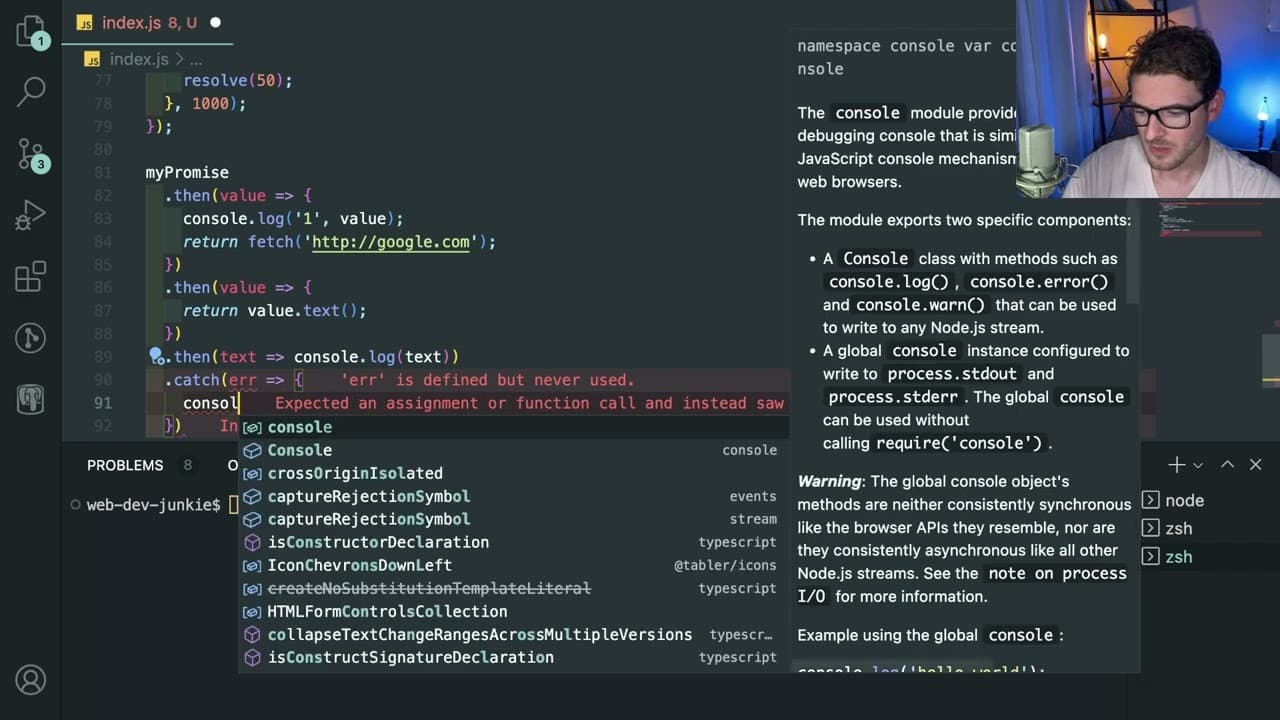
JavaScript promises simplify asynchronous code and avoid callback hell.
Transcript
all right so i wanted to have a talk about promises and kind of walk you through like what is a promise how do you use a promise someone on my discord asked me if i can kind of just like give a good overview of promises because he's still kind of confused about them and it is kind of a confusing concept to kind of understand when you first learn ja... Read More
Key Insights
- ❓ Promises encapsulate asynchronous operations, helping manage their results and errors consistently.
- 🥺 Mixing synchronous and asynchronous code can lead to confusion, making promises a cleaner option.
- 💗 The evolution from callbacks to promises to
async/awaitreflects the growing need for clearer and more maintainable code. - 🤙 Real-world scenarios, like API calls, greatly benefit from promises, as they often involve waiting for responses.
- 🍧 Having only one
thenorcatchmethod per chain keeps the logic linear and easier to follow. - 👨💻 Understanding the state of a promise (pending, fulfilled, rejected) is fundamental for debugging asynchronous code.
- 👻 Utilities like
Promise.allandPromise.raceenhance the power of promises, allowing for concurrent operations and their management.
Install to Summarize YouTube Videos and Get Transcripts
Explore YouTube Video Summarizer or Get YouTube Transcript Extractor
Questions & Answers
Q: What is the primary purpose of JavaScript promises?
The primary purpose of JavaScript promises is to handle asynchronous operations more effectively. Promises allow developers to write cleaner, more manageable code compared to the traditional callback approach, which can lead to "callback hell." By facilitating chaining of operations and providing methods to manage results and errors, promises enhance code readability and maintainability.
Q: How do you construct a promise in JavaScript?
A promise is constructed in JavaScript by creating a new instance of the Promise class. The constructor takes a callback function that has two parameters: resolve and reject. The asynchronous operation is executed within this callback, and when it completes, resolve is called to indicate success or reject is called to indicate failure, transitioning the promise to either fulfilled or rejected states.
Q: What is the significance of the then and catch methods in promises?
The then method is invoked when a promise is fulfilled, allowing developers to specify what to do with the resulting value. The catch method is used to handle any errors that occur during the promise's execution. Together, they provide a way to manage the success and failure of asynchronous operations, making it easier to write clean and effective error-handling logic.
Q: How does promise chaining work, and why is it beneficial?
Promise chaining allows developers to link multiple asynchronous operations together using the then method. When a promise resolves, the result is passed to the next then in the chain, facilitating the execution of dependent asynchronous tasks. This approach reduces the complexity of nested callbacks and enhances readability, allowing for a more straightforward flow of asynchronous logic.
Q: What does async/await provide that promises alone do not?
Async/await simplifies the syntax of working with promises by enabling developers to write asynchronous code that looks synchronous. By using the await keyword in front of a promise, the execution can pause until the promise resolves, eliminating the need for explicit chaining with then. This leads to cleaner and more intuitive code, allowing for easier comprehension and debugging.
Q: What are some common methods related to promises, aside from then and catch?
Common methods related to promises include Promise.all, which takes an array of promises and returns a single promise that resolves when all the included promises are resolved, and Promise.race, which resolves as soon as one of the promises in the array resolves. Additionally, Promise.resolve and Promise.reject create promises that are immediately fulfilled or rejected, respectively, which can be useful for testing or mock purposes.
Q: Why is it essential to understand promises before learning async/await?
Understanding promises is crucial before learning async/await because async/await is built on top of promises. The await keyword only works with promises, and without a solid grasp of promise behavior, developers might struggle to understand how async/await simplifies asynchronous programming. A foundational knowledge of promises allows for a better transition to using async/await effectively.
Summary & Key Takeaways
-
Promises are JavaScript objects that manage asynchronous operations, offering methods like
thenandcatchto handle results and errors. -
They help avoid "callback hell," where extensive nested callbacks can make code difficult to read and maintain, promoting a flatter structure.
-
The introduction of
async/awaitallows for clearer syntax when working with promises, making asynchronous code behave like synchronous code.
Read in Other Languages (beta)
Share This Summary 📚
Summarize YouTube Videos and Get Video Transcripts with 1-Click
Try YouTube Summary with ChatGPT & Claude or YouTube Transcript Generator
Explore More Summaries from Web Dev Cody 📚

Summarize YouTube Videos and Get Video Transcripts with 1-Click
Try YouTube Summary with ChatGPT & Claude or YouTube Transcript Generator