LC natural response derivation 4
TL;DR
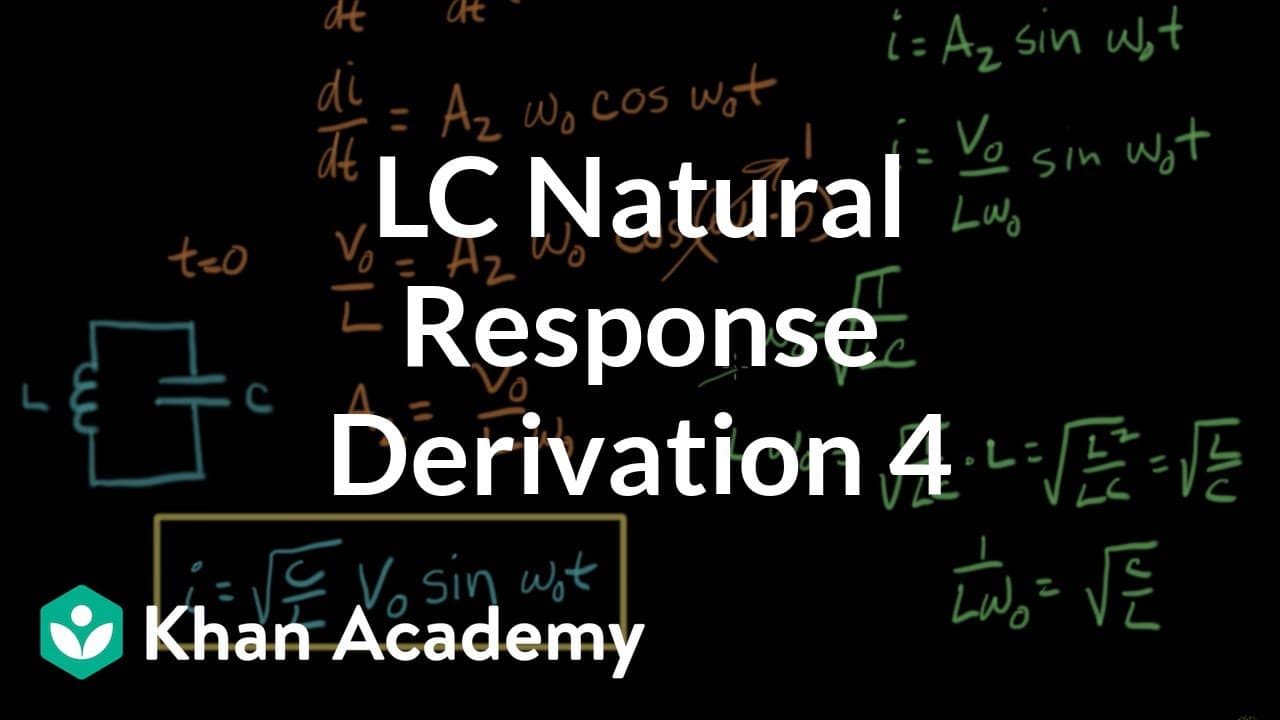
This video explains how to determine the values of A1 and A2 in the proposed solution for current in an LC circuit using initial conditions, and demonstrates how to find the natural response of an LC circuit.
Transcript
- [Voiceover] So now we're gonna use the initial conditions to figure out our values, our two constant values A1 and A2. That is in our proposed solution for current for the LC circuit. So one thing we need to do, because this is a second order equation. We need to have two initial conditions for the variable that we're studying here. So we're stud... Read More
Key Insights
- ⏳ Two initial conditions, di/dt at time equal to zero and the voltage across the inductor at time equal to zero, are required for studying current in an LC circuit.
- 0️⃣ The value of A1 in the solution for current becomes zero when the value of current at time equal to zero is zero.
- ❓ The second initial condition is used to determine A2, which is found to be V0/Lω0.
Install to Summarize YouTube Videos and Get Transcripts
Explore YouTube Video Summarizer or Get YouTube Transcript Extractor
Questions & Answers
Q: What are the initial conditions required to determine the values of A1 and A2 in the solution for current in an LC circuit?
The two initial conditions required are: di/dt at time equal to zero and the voltage across the inductor at time equal to zero.
Q: How is A1 determined in the proposed solution for current in an LC circuit?
By plugging in the value of current at time equal to zero (which is zero), A1 is found to be zero.
Q: How is A2 determined in the proposed solution for current in an LC circuit?
The second initial condition involves finding di/dt of the proposed solution and plugging in the value at time equal to zero. By solving the equation, A2 is determined to be V0/Lω0.
Q: What is the final solution for the natural response of an LC circuit?
The natural response of an LC circuit can be expressed as I = √(C/L) × V0 × sin(ω0t), where ω0 is determined by the component values and V0 represents the initial energy.
Summary & Key Takeaways
-
The initial conditions for studying current in an LC circuit require two values: di/dt at time equal to zero and the voltage across the inductor at time equal to zero.
-
By plugging in the values for di/dt and voltage at time equal to zero, A1 is found to be zero, resulting in a simplified proposed solution for current in the LC circuit.
-
The second initial condition is used to find A2, which is determined to be V0/Lω0, resulting in the final solution for the natural response of the LC circuit.
Read in Other Languages (beta)
Share This Summary 📚
Summarize YouTube Videos and Get Video Transcripts with 1-Click
Try YouTube Summary with ChatGPT & Claude or YouTube Transcript Generator
Explore More Summaries from Khan Academy 📚



Summarize YouTube Videos and Get Video Transcripts with 1-Click
Try YouTube Summary with ChatGPT & Claude or YouTube Transcript Generator