Newton's first law of motion | Forces and Newton's laws of motion | Physics | Khan Academy
TL;DR
Objects have a natural tendency to come to rest or maintain their motion unless acted upon by an unbalanced force.
Transcript
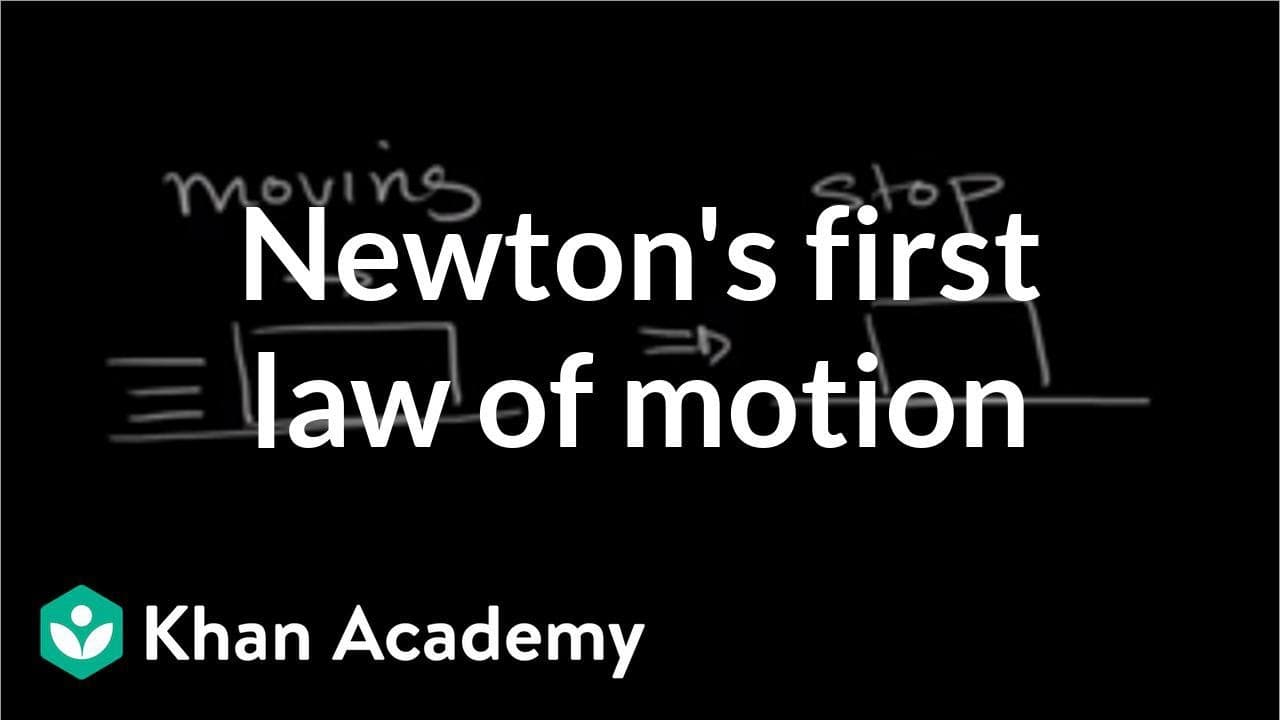
Human beings have always observed that if you have an object that is moving, so this is a moving object, traveling to the right here, that it seems to stop on its own. That if you do nothing to this moving object, on its own, this object is going to come to a stop. It is going to come to rest. And on the other side of things, if you want to keep an... Read More
Key Insights
- 😣 Objects in motion tend to come to rest on their own unless acted upon by an unbalanced force.
- 🧑🏭 Newton, Galileo, and Descartes proposed that objects have a tendency to maintain their motion unless acted upon by an external force.
- 🖐️ The environment and interactions with external forces, like friction, play a crucial role in either stopping or maintaining an object's motion.
- 🥹 Newton's First Law of Motion contradicted the assumption held for thousands of years that objects have a natural tendency to stop.
- 🤔 The insight provided by Newton, Galileo, and Descartes was based on observations and thought experiments.
- 😣 Understanding the concept of net force is essential in comprehending how objects come to rest or maintain their motion.
- 👻 Applying a force can either balance the net negative force, allowing an object to maintain its velocity, or increase the object's acceleration.
Install to Summarize YouTube Videos and Get Transcripts
Explore YouTube Video Summarizer or Get YouTube Transcript Extractor
Questions & Answers
Q: Why did human beings assume that objects have a natural tendency to stop?
Human beings observed that objects in motion tend to come to rest in everyday experiences, leading to the assumption that objects have a natural tendency to stop.
Q: Who are the three gentlemen who proposed the opposite idea?
The three gentlemen are Newton, Galileo, and Descartes, who suggested that objects have a tendency to maintain their motion unless acted upon by an unbalanced force.
Q: What role does friction play in stopping an object's motion?
Friction is an external force that acts against an object's motion. When interacting with a surface, friction generates a net force that opposes the object's motion and eventually brings it to a halt.
Q: How does applying a force affect an object's motion?
Applying a force can either counteract the net negative force, allowing the object to maintain its velocity, or accelerate the object depending on the magnitude and direction of the force applied.
Summary & Key Takeaways
-
Human beings have observed that objects in motion tend to come to rest on their own unless acted upon by an external force.
-
Newton, Galileo, and Descartes proposed that objects have a tendency to maintain their motion unless acted upon by an unbalanced force.
-
The environment and interactions with external forces, such as friction, can either stop or maintain an object's motion.
Read in Other Languages (beta)
Share This Summary 📚
Summarize YouTube Videos and Get Video Transcripts with 1-Click
Try YouTube Summary with ChatGPT & Claude or YouTube Transcript Generator
Explore More Summaries from Khan Academy 📚



Summarize YouTube Videos and Get Video Transcripts with 1-Click
Try YouTube Summary with ChatGPT & Claude or YouTube Transcript Generator