Optimal decision-making and opportunity costs | AP(R) Microeconomics | Khan Academy
TL;DR
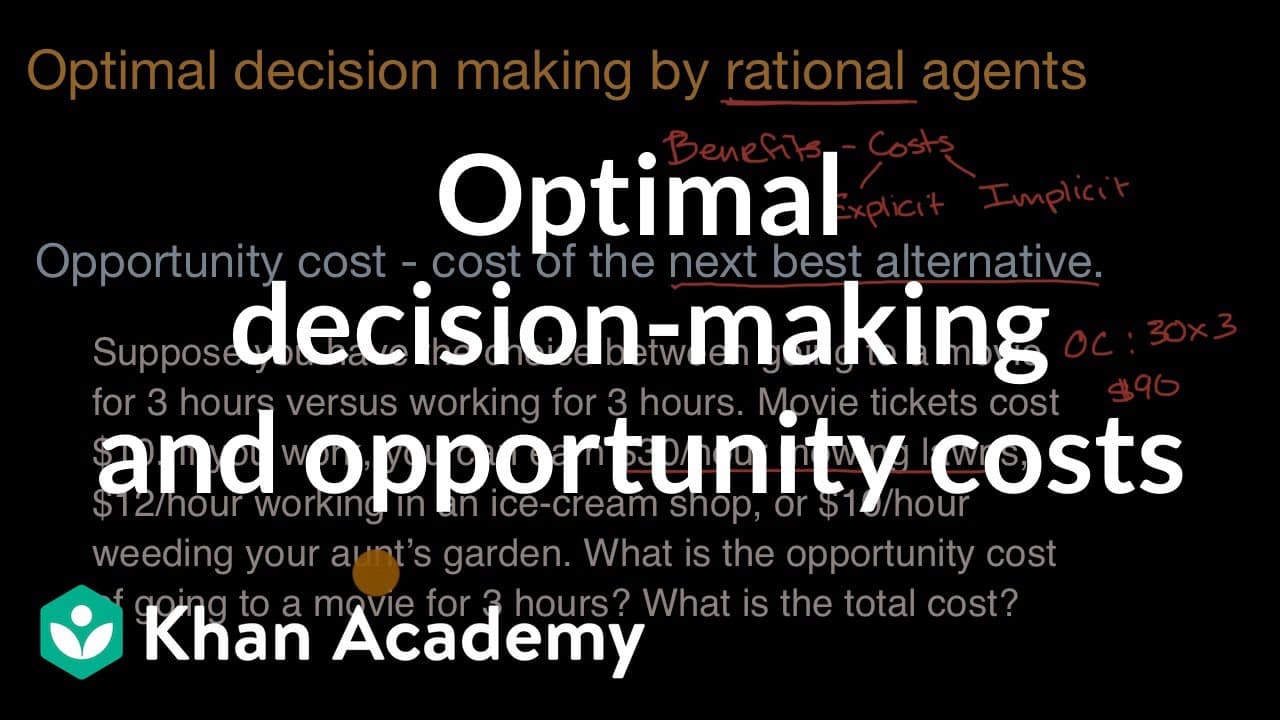
Rational agents make decisions based on the costs and benefits, maximizing the difference between them.
Transcript
- [Instructor] What we're going to do in this video is think about optimal decision making by rational agents. And it's just thinking about how would a logical, someone with a lot of reasoning ability, make optimal decisions, make the best decisions for themselves? Well they would look at the costs and benefits of a decision and they would try to d... Read More
Key Insights
- 🇨🇷 Rational agents make optimal decisions by maximizing the difference between benefits and costs.
- 🇨🇷 Costs in decision making can be explicit or implicit, with implicit costs often represented by opportunity costs.
- 🇨🇷 The opportunity cost is the cost of the next best alternative and plays an important role in decision making.
- 🇨🇷 The total cost includes the implicit costs (e.g., opportunity cost) and the explicit costs (e.g., price).
- 🇨🇷 A rational agent compares the benefits and costs to make an optimal decision.
- 👋 The benefit of a choice can be quantified and compared to the costs to determine the best decision.
- 👋 The next best alternative is a crucial factor in calculating opportunity cost.
Install to Summarize YouTube Videos and Get Transcripts
Explore YouTube Video Summarizer or Get YouTube Transcript Extractor
Questions & Answers
Q: What is the concept of an opportunity cost?
An opportunity cost is the cost of the next best alternative. In decision making, it represents what is given up by choosing one option over another. For example, if someone chooses to go to a movie, the opportunity cost might be the money they could have earned during that time.
Q: How does a rational agent make optimal decisions?
A rational agent considers the costs and benefits of different options and aims to maximize the difference between them. By comparing the benefits and costs, an optimal decision can be made. The decision that maximizes this difference is considered the best choice.
Q: What are the types of costs considered in decision making?
Costs in decision making can be explicit or implicit. Explicit costs are those with a clear price associated with them, while implicit costs, such as opportunity costs, are not easily quantifiable in monetary terms but represent what is given up.
Q: How is the total cost calculated in decision making?
The total cost in decision making is the sum of the explicit costs (e.g., the price of a movie ticket) and the implicit costs (e.g., opportunity cost). It represents the overall cost of a particular choice.
Summary & Key Takeaways
-
Rational agents make optimal decisions by considering the costs and benefits of a choice and maximizing the difference between them.
-
Costs can be explicit (associated with a price) or implicit (opportunity cost, the cost of the next best alternative).
-
In the example provided, the opportunity cost of going to a movie for three hours is $90, and the total cost (including explicit cost) is $100.
Read in Other Languages (beta)
Share This Summary 📚
Summarize YouTube Videos and Get Video Transcripts with 1-Click
Try YouTube Summary with ChatGPT & Claude or YouTube Transcript Generator
Explore More Summaries from Khan Academy 📚



Summarize YouTube Videos and Get Video Transcripts with 1-Click
Try YouTube Summary with ChatGPT & Claude or YouTube Transcript Generator