Numerical Based on Decay Constant Problem 12 - Nuclear Chemistry & Radioactivity
TL;DR
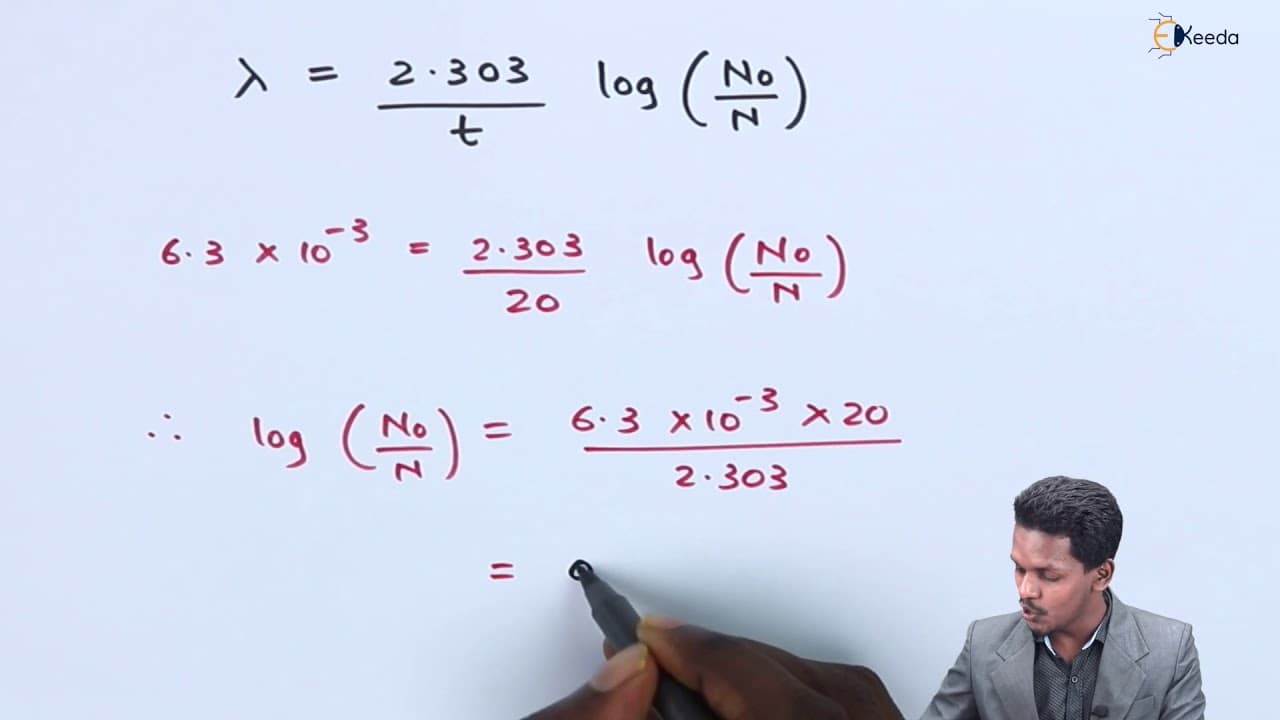
Calculate the fraction of a fluorine 19 sample that decays in 20 minutes using the given data and formulas.
Transcript
click the bell icon to get latest videos from akira her friends in the Prius topic we have discussed about the problem number 11 that was a numerical based on the decay constant and here we are doing the problem number 12 so what is the cushion and what is the required thing that is what we have to calculate this is what we are going to do in this ... Read More
Key Insights
- ☢️ The decay constant (lambda) is a crucial parameter in radioactive decay calculations.
- 🛟 The half-life of a radioactive substance can be used to calculate the decay constant.
- 🤶 Logarithms and antilogarithms are used to find the values of n0/M and the undecayed fraction.
Install to Summarize YouTube Videos and Get Transcripts
Explore YouTube Video Summarizer or Get YouTube Transcript Extractor
Questions & Answers
Q: How do you calculate the decay constant (lambda) using the half-life?
The decay constant (lambda) can be calculated using the formula lambda = 0.693 / T1/2, where T1/2 is the half-life of the radioactive substance.
Q: What is the formula for finding the undecayed fraction of a radioactive sample?
The undecayed fraction can be found by dividing n (the amount of sample decayed) by M naught (the initial amount of sample) and subtracting it from 1.
Q: How is the value of log(n0/M) found in the problem?
The value of log(n0/M) is determined by rearranging the decay constant formula to solve for log(n0/M).
Q: What is the relationship between the decay constant, time, and the fraction of sample decayed?
The decay constant and time are used in an equation to find the value of log(n0/M), which represents the fraction of sample decayed.
Summary & Key Takeaways
-
The problem involves finding the fraction of a fluorine 19 sample that decays in 20 minutes, given the half-life of fluorine-18 is 110 minutes.
-
The decay constant (lambda) is calculated using the formula lambda = 0.693 / T1/2, resulting in a value of 6.3 x 10^-3 min^-1.
-
By substituting the decay constant, time, and formula into an equation, the value of log(n0/M) is determined to be 0.0547.
-
The value of n0/M is then found by taking the antilog of 0.0547, resulting in a value of 1.134.
-
The undecayed fraction is calculated as 0.881, and the decayed fraction is found to be 0.119.
Read in Other Languages (beta)
Share This Summary 📚
Summarize YouTube Videos and Get Video Transcripts with 1-Click
Try YouTube Summary with ChatGPT & Claude or YouTube Transcript Generator
Explore More Summaries from Ekeeda 📚


Summarize YouTube Videos and Get Video Transcripts with 1-Click
Try YouTube Summary with ChatGPT & Claude or YouTube Transcript Generator