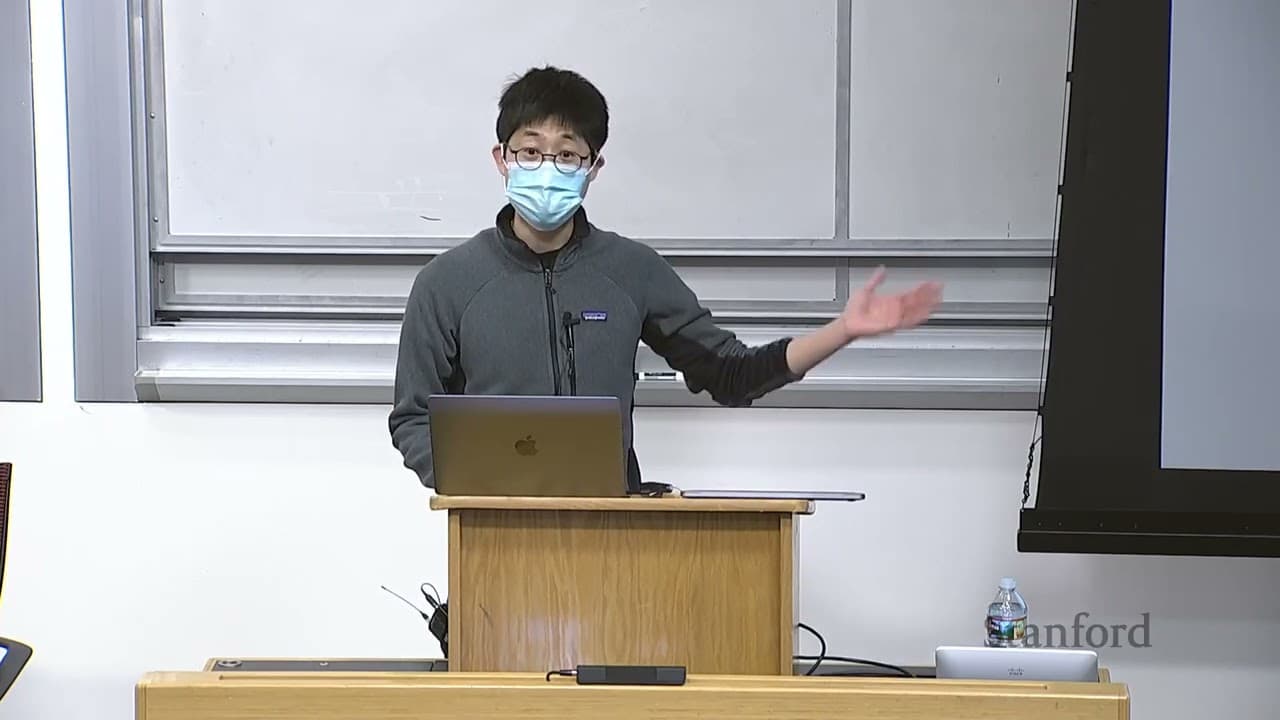
Stanford CS224N NLP with Deep Learning |Spring 2022|Guest Lecture: Building Knowledge Representation
TL;DR
Memory augmented models, such as the one discussed in this content, leverage external knowledge sources to improve the accuracy and capabilities of language models in tasks like question answering and dialogue systems.
Transcript
so i'm delighted to introduce our our second invited speaker for 224n um kelvin goo so kelvin is a senior research scientist at google with interests in retrieval augmented language models and using knowledge in neural networks and is perhaps best known for his work on the realm model which is one of the things he'll doubtless talk about today um y... Read More
Key Insights
- ℹ️ Memory augmented models leverage external knowledge sources to improve AI models' capabilities.
- ⁉️ Retrieval and utilization of knowledge in AI models can enhance tasks like question answering and dialogue systems.
- 💁 External tools like web search engines can be used to retrieve relevant information, but custom memory retrievers offer advantages.
- 🚂 Training a retriever can be done with or without gold passages, using different training signals and techniques.
Install to Summarize YouTube Videos and Get Transcripts
Explore YouTube Video Summarizer or Get YouTube Transcript Extractor
Questions & Answers
Q: How do memory augmented models retrieve and utilize knowledge?
Memory augmented models use external tools, like web search engines or custom memory retrievers, to retrieve information relevant to a given task. They then incorporate this knowledge into their responses or predictions. The retrieval process can involve scoring and ranking memories based on their similarities to the input.
Q: What are the advantages of using memory augmented models?
Memory augmented models can access and incorporate external knowledge, enhancing their performance and accuracy. They allow for fast and modular knowledge editing, attribution, interpretability, and efficient scaling. These models can be trained to retrieve the most relevant information, improving the output and capabilities of AI systems.
Q: Are there any challenges or limitations to using memory augmented models?
One challenge is the selection and representation of memories, as well as the balance between remembering too much or underutilizing the retrieved knowledge. Another limitation is the reliance on external tools, which may have limitations or biases. Additionally, training data and resources are required to train these models effectively.
Q: How can memory augmented models be trained without gold passages?
End-to-end learning of the retriever is a technique that uses the performance of the reader component as a training signal for the retriever. By observing that a good memory retrieval leads to a good answer from the reader, the retriever can be trained to improve its selection of relevant memories.
Summary & Key Takeaways
-
Traditional AI models lack the ability to incorporate domain knowledge, limiting their capabilities.
-
Language models can automatically acquire knowledge from the web, but the information can be noisy and unreliable.
-
Memory augmented models address the limitations of traditional AI models by using external knowledge sources and retrieving relevant information.
-
These models are trained to effectively retrieve and incorporate knowledge to assist with tasks such as question answering, dialogue systems, and more.
Read in Other Languages (beta)
Share This Summary 📚
Summarize YouTube Videos and Get Video Transcripts with 1-Click
Try YouTube Summary with ChatGPT & Claude or YouTube Transcript Generator
Explore More Summaries from Stanford Online 📚


Summarize YouTube Videos and Get Video Transcripts with 1-Click
Try YouTube Summary with ChatGPT & Claude or YouTube Transcript Generator