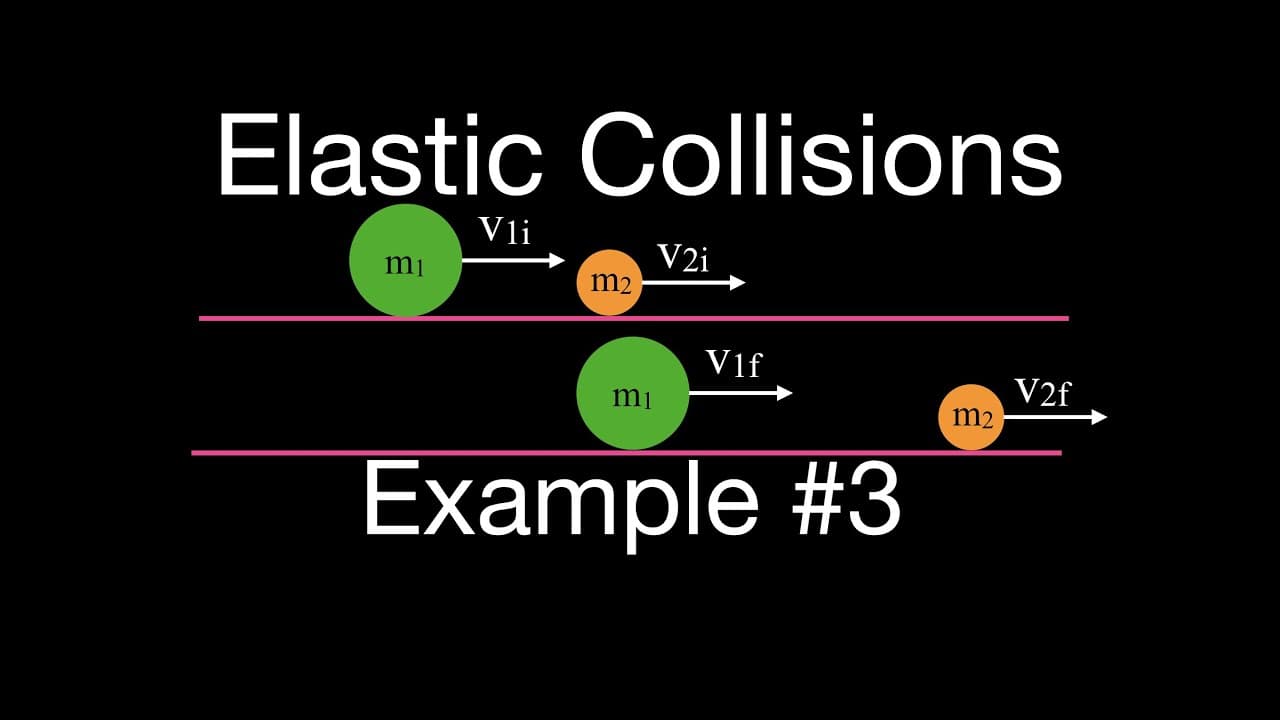
Momentum (13 of 16) Elastic Collisions, Example 3
TL;DR
This video explains how to calculate the final velocities of two masses after an inelastic collision using equations and step-by-step calculations.
Transcript
okay in today's video we're going to go over another example from momentum and inelastic collisions and as you can see this is an example number three and this is the situation we have we have two masses we have a ball with a mass of 3.8 kilograms and moving velocity of 8.0 or eight meters per second and it collides with a second mass it's the ball... Read More
Key Insights
- 💋 Inelastic collisions involve objects sticking together and moving as a single mass.
- 💥 The equation m1v1 + m2v2 = (m1 + m2)v is used to calculate the final velocities in an inelastic collision.
- 💆 Mass number one's final velocity decreases, while mass number two's final velocity increases in this example.
- 🪈 Understanding order of operations is crucial for accurate calculations.
- 💥 Share this video with friends to help them learn about momentum and inelastic collisions.
- ❓ The final velocities reflect the energy transfer between the colliding masses.
- 💋 Inelastic collisions result in a loss of kinetic energy due to deformation or sticking together.
Install to Summarize YouTube Videos and Get Transcripts
Explore YouTube Video Summarizer or Get YouTube Transcript Extractor
Questions & Answers
Q: What is the difference between an inelastic collision and an elastic collision?
In an inelastic collision, the colliding objects stick together and move as one, while in an elastic collision, the objects bounce off each other without any energy loss or deformation.
Q: How do you calculate the final velocities in an inelastic collision?
In an inelastic collision, you can use the equation m1v1 + m2v2 = (m1 + m2)v, where m1 and m2 are the masses of the objects, v1 and v2 are their initial velocities, and v is the final velocity.
Q: Why does the final velocity of mass number one decrease after the collision?
The final velocity of mass number one decreases because it transfers some of its energy to mass number two during the collision, causing a decrease in its own velocity.
Q: How does the final velocity of mass number two change after the collision?
The final velocity of mass number two increases after the collision because it gains some of the energy transferred by mass number one, resulting in an increase in velocity.
Summary & Key Takeaways
-
The video demonstrates an example of an inelastic collision involving two masses: 3.8 kg and 1.5 kg.
-
The initial velocities of the two masses are 8 m/s and 2.5 m/s respectively.
-
Using the equations for calculating final velocities in elastic collisions, the video shows how to calculate the final velocities of both masses after the collision.
Read in Other Languages (beta)
Share This Summary 📚
Summarize YouTube Videos and Get Video Transcripts with 1-Click
Try YouTube Summary with ChatGPT & Claude or YouTube Transcript Generator
Explore More Summaries from Step by Step Science 📚

Summarize YouTube Videos and Get Video Transcripts with 1-Click
Try YouTube Summary with ChatGPT & Claude or YouTube Transcript Generator