How FLANGER, CHORUS & PHASER process your sound - Sound Design Theory
TL;DR
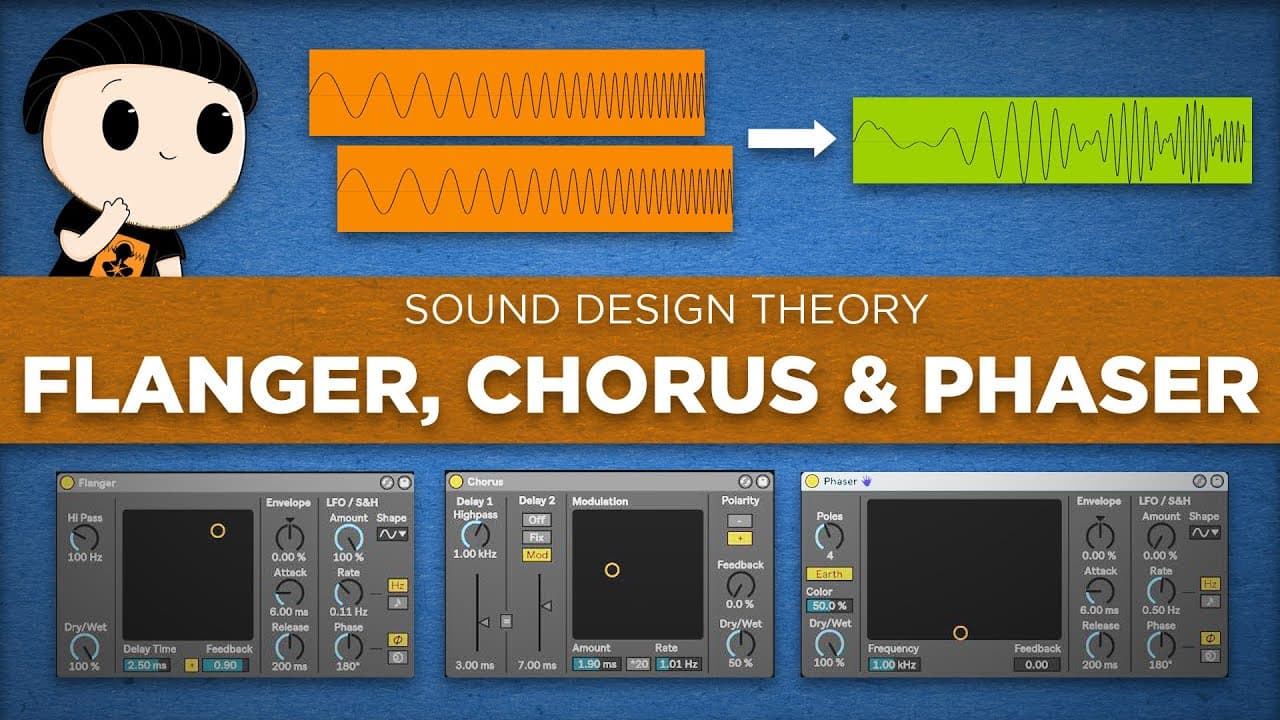
This video explores the flanger, chorus, and phaser effects, which are modulation effects that alter the sound using a short delay time and an LFO.
Transcript
in the last video we talked about the delay effect and a lot of different things we can do with it in today's episode we'll follow the same direction as we will explore three effects that use a very similar process we'll talk about flanger chorus and phaser effects they are called modulation effects because they usually have one or several lfos ind... Read More
Key Insights
- 🎵 Flanger, chorus, and phaser effects are all modulation effects that use a similar process of duplicating and delaying signals.
- 🎸 Flanger effects use a small delay time and create phase cancellation and amplification, resulting in a sweeping sound.
- 🎧 The delay time in a flanger effect is often controlled by an LFO, which creates a moving comb filter effect.
- 🎶 Chorus effects also duplicate and delay signals, but with a higher delay time. The modulation of the delay time alters the pitch, creating a dissonance and rich hammering tone.
- 🎹 Chorus effects give the impression of multiple sources and are commonly used on vocals, pianos, and guitars to add thickness.
- 💫 Stereo chorus effects utilize two different LFO speeds to pitch the left and right channels differently.
- 🌌 Phaser effects duplicate signals and process them through all-pass filters, creating non-linear phase shifts and comb filter effects. They sound less harsh than flanger effects.
- 🔊 The number of all-pass filters used in a phaser determines the strength of the effect, and the LFO controls the sweeping effect.
Install to Summarize YouTube Videos and Get Transcripts
Explore YouTube Video Summarizer or Get YouTube Transcript Extractor
Questions & Answers
Q: How does the flanger effect create phase cancellation and amplification?
In the flanger effect, the signal is duplicated and slightly delayed. This delay creates points where the two waveforms have the same or opposite polarities, resulting in phase cancellation or amplification. This adds texture and movement to the sound.
Q: What makes the chorus effect different from the flanger effect?
The chorus effect also duplicates a signal and delays it, but by a higher amount. It then modulates the delay time, which alters the pitch of the second copy. This creates a dissonant beating effect that adds thickness and interest to the sound.
Q: How does the phaser effect differ from the flanger effect?
The phaser effect duplicates a signal and processes it through all-pass filters. These filters phase shift different frequencies in a non-linear way, creating less drastic frequency cuts compared to the flanger effect. This results in a softer and less harsh sound.
Q: What parameters control the modulation effects in music production?
The modulation effects, such as flanger, chorus, and phaser, have common parameters. They include a delay time, feedback parameter, rate, and depth knobs to control the LFO speed and movement of the effect. Additionally, the phaser effect may have a frequency knob and an option to use more or fewer filters (poles) for different effects.
Summary & Key Takeaways
-
The flanger effect duplicates a signal, delays the second copy slightly, and creates phase cancellation and amplification, resulting in a comb filter-like sound.
-
The chorus effect also duplicates a signal, but delays it by a higher amount and modulates the delay time to create pitch modulation and a rich, hammering tone.
-
The phaser effect duplicates a signal, processes it through all-pass filters to create phase shifts, and produces less drastic frequency cuts compared to the flanger effect.
Read in Other Languages (beta)
Share This Summary 📚
Summarize YouTube Videos and Get Video Transcripts with 1-Click
Try YouTube Summary with ChatGPT & Claude or YouTube Transcript Generator
Explore More Summaries from Woochia - Charly Sauret 📚
Summarize YouTube Videos and Get Video Transcripts with 1-Click
Try YouTube Summary with ChatGPT & Claude or YouTube Transcript Generator