Corollary 2 of Euler's Theorem Formula and Proof
TL;DR
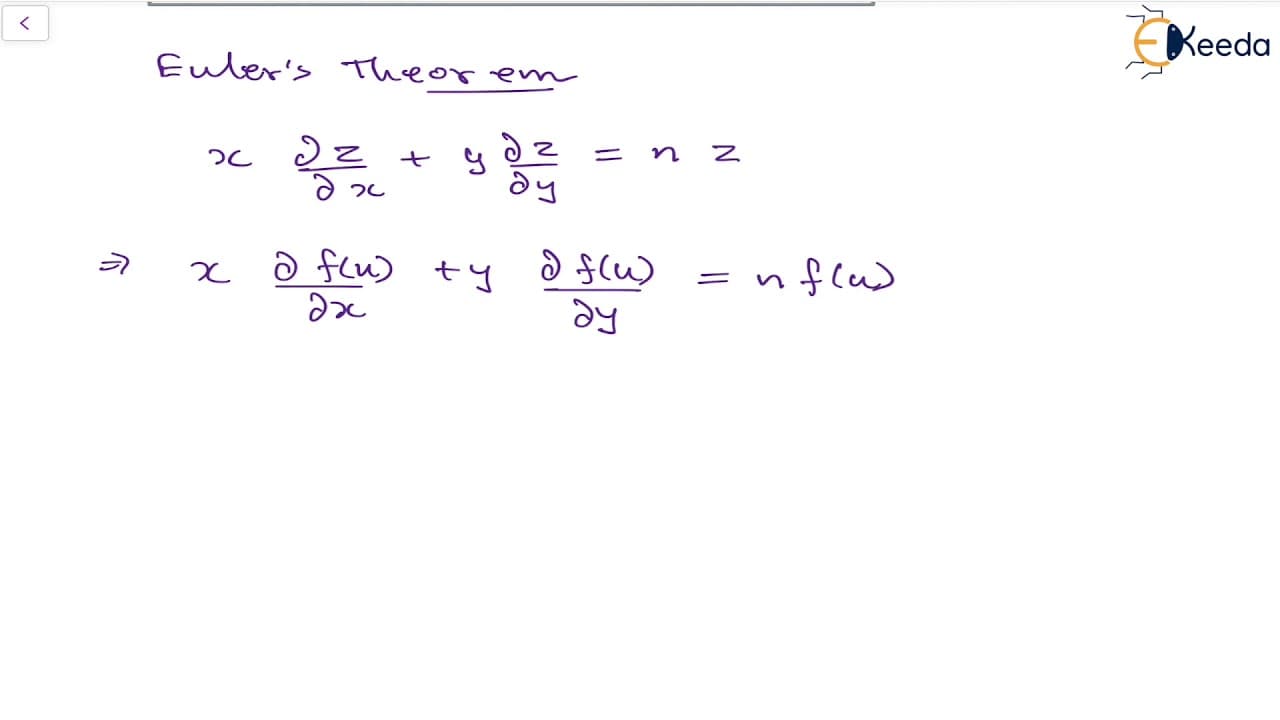
The corollary states that if there is a function u of degree n and another function z which is homogeneous of degree n, then the equation x(d u/d x) + y(d u/d y) = n(f(u)/f'(u)) holds.
Transcript
hello in this session we'll see corollary 2 of euler's theorem we'll see the formula and it's proof so in this corollary 2 let's say we have a function u in x and y with degree n but u is or you may not be a homogeneous function so in that case if there is another function let's say z which is function of u and this is homogeneous of degree n then ... Read More
Key Insights
- 🚱 Corollary 2 of Euler's theorem explains the relationship between non-homogeneous and homogeneous functions.
- 😄 The equation x(d u/d x) + y(d u/d y) = n(f(u)/f'(u)) provides a way to calculate derivatives and understand the behavior of such functions.
- 📏 The proof involves substituting the homogeneous function with f(u) and applying the chain rule to find the derivatives.
- 🏑 This corollary has applications in various fields, including physics, economics, and engineering.
- 👻 The corollary allows for the analysis of relationships and properties of functions in both theoretical and real-world scenarios.
- ❓ Euler's theorem is a fundamental result in mathematics that has implications in different areas.
- 🚱 Understanding the relationship between homogeneous and non-homogeneous functions helps in solving differential equations and optimization problems.
Install to Summarize YouTube Videos and Get Transcripts
Explore YouTube Video Summarizer or Get YouTube Transcript Extractor
Questions & Answers
Q: What does corollary 2 of Euler's theorem state?
Corollary 2 states that if we have a non-homogeneous function u of degree n and a homogeneous function z of degree n, then x(d u/d x) + y(d u/d y) = n(f(u)/f'(u)).
Q: How is the proof of the corollary carried out?
The proof involves considering z as a function of u, applying Euler's theorem to z, substituting it with f(u), and using the chain rule to differentiate and simplify the equation until we obtain x(d u/d x) + y(d u/d y) = n(f(u)/f'(u)).
Q: What is the significance of this corollary?
Corollary 2 provides a mathematical relationship between non-homogeneous and homogeneous functions, allowing for the calculation of derivatives and understanding the behavior of such functions.
Q: Can this corollary be applied in real-world scenarios?
Yes, this corollary can be applied in various fields such as physics, economics, and engineering, where non-homogeneous and homogeneous functions are used to model real-world phenomena. It helps in analyzing the relationships between variables and understanding their properties.
Summary & Key Takeaways
-
Corollary 2 of Euler's theorem explains the relationship between a function u and a function z, where z is a homogeneous function of the degree n that depends on u.
-
The corollary states that the equation x(d u/d x) + y(d u/d y) = n(f(u)/f'(u)) holds.
-
The proof of the corollary involves applying Euler's theorem to the function z, substituting it with f(u), and using the chain rule to find the differentiation.
Read in Other Languages (beta)
Share This Summary 📚
Summarize YouTube Videos and Get Video Transcripts with 1-Click
Try YouTube Summary with ChatGPT & Claude or YouTube Transcript Generator
Explore More Summaries from Ekeeda 📚




Summarize YouTube Videos and Get Video Transcripts with 1-Click
Try YouTube Summary with ChatGPT & Claude or YouTube Transcript Generator