Initial Value And Final Value Theorem of Laplace Transform | Signals and Systems Problem 03
TL;DR
This video explains how to solve a specific problem using the initial value and final value theorem of the Laplace transform.
Transcript
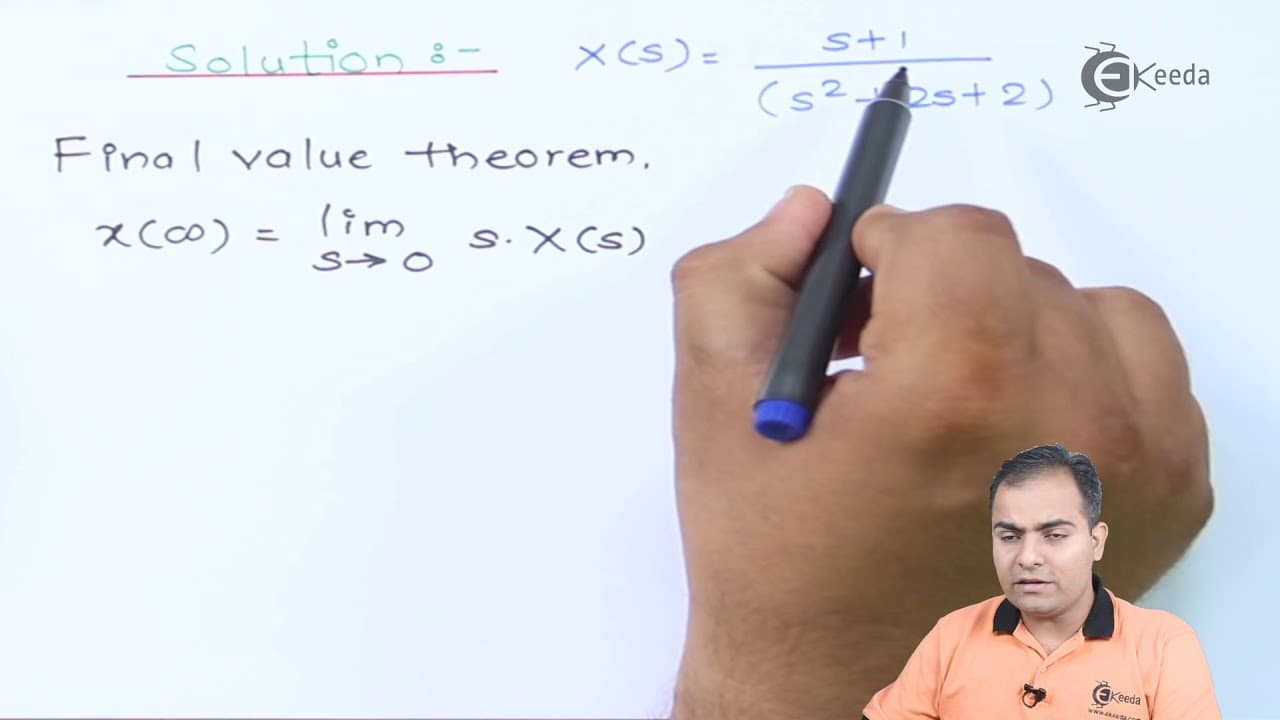
click the bell icon to get latest videos from equator hello friends and today we are going to stall and next to numerical that is problem number three on initial value and final value theorem of Laplace transform now in today's question is a simple ex office is equals to s plus 1 whole divided by s square plus 2 s plus 2 and we have to find out ini... Read More
Key Insights
- 😀 The initial value theorem is used to find the initial value of a function by evaluating the Laplace transform at s = 0.
- 😀 The final value theorem is used to find the final value of a function by canceling extra s in the denominator and applying the limit as s tends to zero.
- 😀 Taking s common in the numerator and denominator is only done in the initial value theorem, not in the final value theorem.
- 😑 The initial value of a function can be found by substituting s = 0 in the Laplace transform and simplifying the expression.
- 😀 The final value of a function can be found by canceling extra s in the denominator of the Laplace transform and applying the limit as s tends to zero.
- 🔨 The Laplace transform is a mathematical tool used to solve differential equations.
- 🆘 The initial value and final value theorems are properties of the Laplace transform that help in finding specific values of a function.
Install to Summarize YouTube Videos and Get Transcripts
Explore YouTube Video Summarizer or Get YouTube Transcript Extractor
Questions & Answers
Q: What is the initial value theorem of the Laplace transform?
The initial value theorem states that the limit of the Laplace transform of a function as s tends to zero is equal to the initial value of the function.
Q: How can we apply the initial value theorem to find the initial value of a function?
To find the initial value, we replace s in the Laplace transform function with zero and evaluate the resulting expression.
Q: What is the final value theorem of the Laplace transform?
The final value theorem states that the limit of the Laplace transform of a function as s tends to infinity is equal to the final value of the function.
Q: What are the steps to find the final value of a function using the final value theorem?
To find the final value, we do not take s common from the numerator and denominator. Instead, we cancel any extra s in the denominator and directly apply the limit as s tends to zero to obtain the final value.
Summary & Key Takeaways
-
The video introduces a specific problem involving a function and its Laplace transform.
-
The initial value theorem is used to find the initial value of the function.
-
The final value theorem is used to find the final value of the function.
Read in Other Languages (beta)
Share This Summary 📚
Summarize YouTube Videos and Get Video Transcripts with 1-Click
Try YouTube Summary with ChatGPT & Claude or YouTube Transcript Generator
Explore More Summaries from Ekeeda 📚

Summarize YouTube Videos and Get Video Transcripts with 1-Click
Try YouTube Summary with ChatGPT & Claude or YouTube Transcript Generator