Modification of the Database in SQL - Structured Query Language (SQL) - Database Management System
TL;DR
This video discusses how to modify a database using SQL, covering deletion, insertion, and updation of data.
Transcript
click the Bell icon to get latest videos from akira hello friends today we are going to discuss about modifying a database using the structured query language or SQL we will talk about the deletion of data from a database inserting the data in various conditions and finally updating the data on a database when we are talking about modifying the dat... Read More
Key Insights
- ❓ Modifying a database in SQL involves the manipulation of data using DML (Data Manipulation Language).
- 🛟 Deletion in SQL removes data from a relation while preserving the database structure.
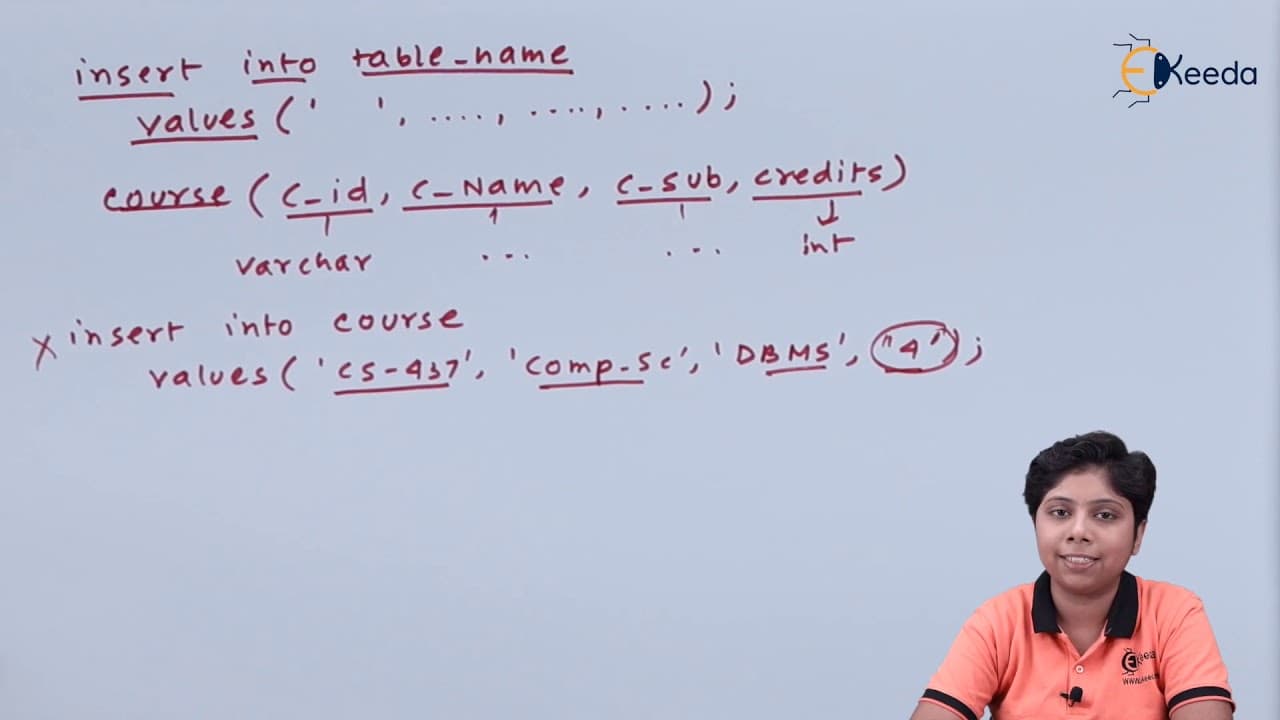
- 👶 Insertion is about adding new data to the database, ensuring that the values match the attribute data types and any specified constraints.
- 👻 Updation allows for changing existing data in the database and can be done based on single or multiple conditions.
- ❓ Predicates and conditions can be used in deletion, insertion, and updation statements to specify criteria for the operation.
- 👻 SQL provides flexibility in handling null values, allowing for the omission of values during insertion or using them as conditions for updation.
- ©️ Copying values from one relation to another requires matching attribute data types and the same number of attributes.
Install to Summarize YouTube Videos and Get Transcripts
Explore YouTube Video Summarizer or Get YouTube Transcript Extractor
Questions & Answers
Q: How does deletion work in SQL?
Deletion in SQL removes data from a database while preserving the database structure. The basic syntax for deletion is "DELETE FROM table_name". To delete specific records, you can add conditions using predicates like "WHERE" to specify criteria for deletion.
Q: Can deletion be done based on multiple conditions?
Yes, deletion in SQL can be based on multiple conditions. You can use logical operators like "AND" and "OR" to combine conditions in the "WHERE" clause. This allows for more specific and targeted deletion of records that meet multiple criteria.
Q: How does insertion work in SQL?
Insertion in SQL involves adding new data to a database. The syntax for insertion is "INSERT INTO table_name VALUES (value1, value2, ...)". It is important to ensure that the values provided match the attribute data types and satisfy any constraints defined in the database schema.
Q: Is it possible to skip inserting values for certain attributes?
Yes, it is possible to skip inserting values for certain attributes as long as they allow for null values. In such cases, you can omit the value for that attribute during insertion. However, if an attribute has a default value defined in the schema, it will be used instead.
Q: Can values be copied from one relation to another in SQL?
Yes, values can be copied from one relation to another in SQL. This can be done by selecting the desired values from one relation and using them in an insertion statement for another relation. The attribute data types and the number of attributes must match between the two relations for the copy to be successful.
Summary & Key Takeaways
-
The video explains the basics of modifying a database using SQL, specifically focusing on deletion, insertion, and updation of data.
-
Deletion in SQL involves removing data from a database while maintaining the database structure.
-
Insertion involves adding new data to the database, ensuring that the values match the attribute data types and any specified constraints.
-
Updation allows for changing existing data in the database, with various conditions and predicates determining which records to update.
Read in Other Languages (beta)
Share This Summary 📚
Summarize YouTube Videos and Get Video Transcripts with 1-Click
Try YouTube Summary with ChatGPT & Claude or YouTube Transcript Generator
Explore More Summaries from Ekeeda 📚






Summarize YouTube Videos and Get Video Transcripts with 1-Click
Try YouTube Summary with ChatGPT & Claude or YouTube Transcript Generator