What Color Were Ancient Roman Statues Originally?
TL;DR
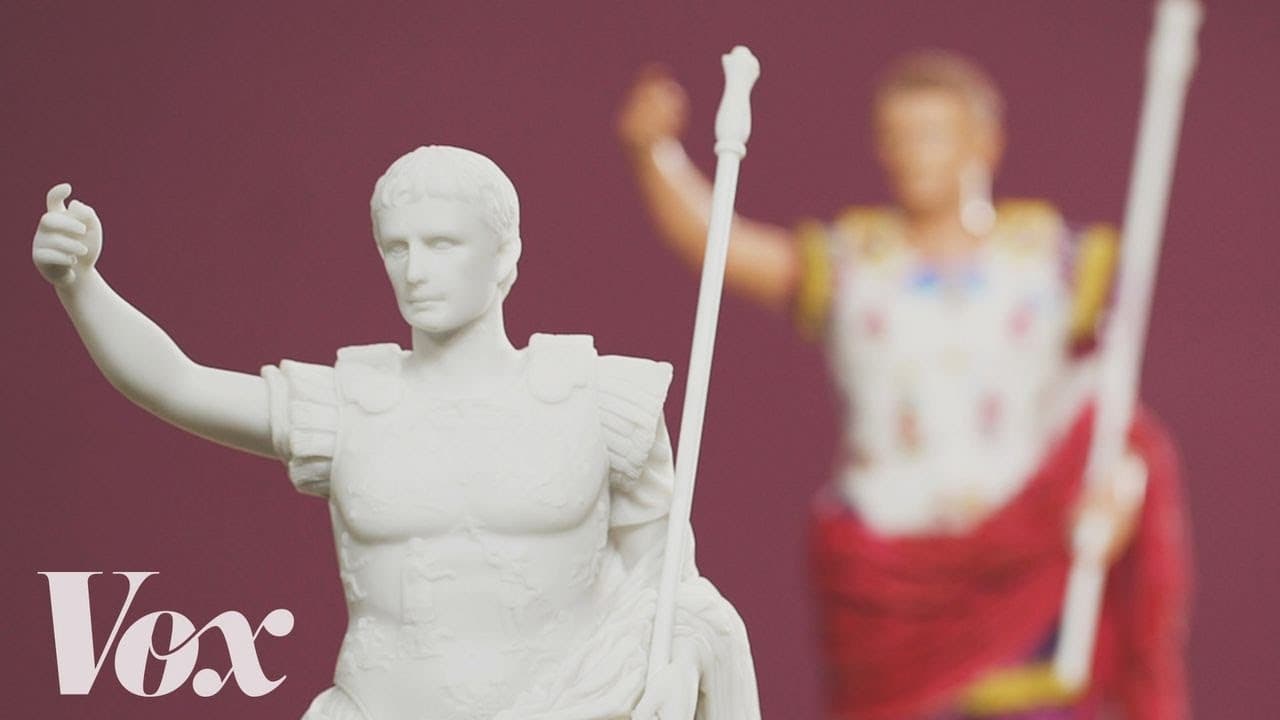
Ancient Roman and Greek statues were originally painted in vibrant colors, not plain white marble as commonly believed. This misconception originated during the Renaissance when artists imitated faded versions of these sculptures. Modern historians utilize techniques like ultraviolet light and pigment analysis to accurately reconstruct the original colors, revealing that these works were intended to be colorful expressions of art.
Transcript
This is Caesar Augustus. He was the first official emperor of the Roman Empire. And if you’ve ever had to study Roman history, You might be familiar with this little sculpture’s very famous original. It’s called the “Augustus of Prima Porta.” It was carved in the 1st century AD, during his reign as emperor. Then it was lost to time, before it was d... Read More
Key Insights
- Ancient Roman and Greek statues were originally painted in vibrant colors, contrary to the common perception of white marble.
- The misconception of white marble statues began during the Renaissance when artists like Michelangelo imitated faded ancient sculptures.
- Johann Joachim Winckelmann, an influential art historian, perpetuated the idea that whiteness equated to beauty, ignoring evidence of colored statues.
- The rediscovery of Pompeii provided clear evidence of colored statues, yet this was largely ignored or dismissed by historians.
- Modern art historians now prioritize accuracy over aesthetics, using scientific methods to reconstruct the original colors of ancient sculptures.
- Ultraviolet light and pigment analysis allow scientists to detect and recreate the original colors on ancient statues.
- Reconstructed statues in full color provide a more authentic understanding of how ancient Greeks and Romans viewed their art.
- The shift in art history reflects a broader cultural reassessment of historical narratives and the biases that shaped them.
Install to Summarize YouTube Videos and Get Transcripts
Explore YouTube Video Summarizer or Get YouTube Transcript Extractor
Questions & Answers
Q: Why do we commonly believe Roman statues were white?
The belief that Roman statues were white stems from Renaissance artists like Michelangelo, who imitated the faded sculptures they uncovered. Art historians, influenced by figures like Johann Joachim Winckelmann, further perpetuated this misconception by valuing the pristine white appearance over historical accuracy.
Q: What role did Johann Joachim Winckelmann play in the perception of Roman statues?
Johann Joachim Winckelmann was a pivotal figure in art history who promoted the idea that whiteness was synonymous with beauty. His influential writings ignored evidence of colored statues, reinforcing the misconception that ancient sculptures were intended to be white marble.
Q: How has modern science contributed to understanding ancient statues?
Modern science has helped reveal the original colors of ancient statues through techniques like ultraviolet light and pigment analysis. These methods allow researchers to detect traces of original pigments, enabling them to create accurate reconstructions that challenge the long-standing belief in white marble sculptures.
Q: What evidence from Pompeii contradicts the white marble misconception?
Pompeii's well-preserved frescoes and murals depict colorful statues, providing clear evidence that ancient sculptures were painted. Despite this, early art historians largely ignored or dismissed this evidence, contributing to the enduring misconception of white marble statues.
Q: How do reconstructed statues impact our understanding of ancient art?
Reconstructed statues, shown in their original vibrant colors, offer a more authentic view of ancient art. They provide insight into how Greeks and Romans perceived their sculptures, emphasizing the importance of color in conveying lifelike and divine qualities, thus enriching our understanding of historical aesthetics.
Q: What methods are used to reconstruct the colors of ancient statues?
Researchers use ultraviolet light to reveal hidden pigment traces and conduct chemical analysis to identify original pigments. These methods, combined with historical descriptions, allow for the creation of accurate reconstructions that display the statues' original vibrant colors, challenging the white marble narrative.
Q: Why did Renaissance artists prefer white marble?
Renaissance artists preferred white marble because they were imitating the faded ancient sculptures they uncovered, which had lost their original paint over time. The aesthetic preference for white marble was reinforced by influential figures like Winckelmann, who equated whiteness with beauty.
Q: What is the significance of color in ancient sculptures?
Color in ancient sculptures was crucial for achieving lifelike and divine representations. It added drama, emotion, and realism, transforming marble into depictions of gods and historical figures. Understanding this aspect of ancient art challenges modern perceptions and offers a more accurate view of classical antiquity.
Summary & Key Takeaways
-
Ancient Roman and Greek sculptures were not originally white marble but were painted in vibrant colors. This misconception arose during the Renaissance when artists, unaware of the original colors, imitated the faded sculptures they found.
-
Johann Joachim Winckelmann's influential writings further entrenched the idea of white marble beauty, despite evidence from Pompeii showing colorful statues. Modern historians now use science to reconstruct these original colors accurately.
-
Techniques like ultraviolet light and pigment analysis enable researchers to recreate the original vibrant appearance of ancient statues, challenging long-held misconceptions and offering a more accurate glimpse into historical art.
Read in Other Languages (beta)
Share This Summary 📚
Summarize YouTube Videos and Get Video Transcripts with 1-Click
Try YouTube Summary with ChatGPT & Claude or YouTube Transcript Generator
Explore More Summaries from Vox 📚

Summarize YouTube Videos and Get Video Transcripts with 1-Click
Try YouTube Summary with ChatGPT & Claude or YouTube Transcript Generator