The pre-equilibrium approximation | Kinetics | AP Chemistry | Khan Academy
TL;DR
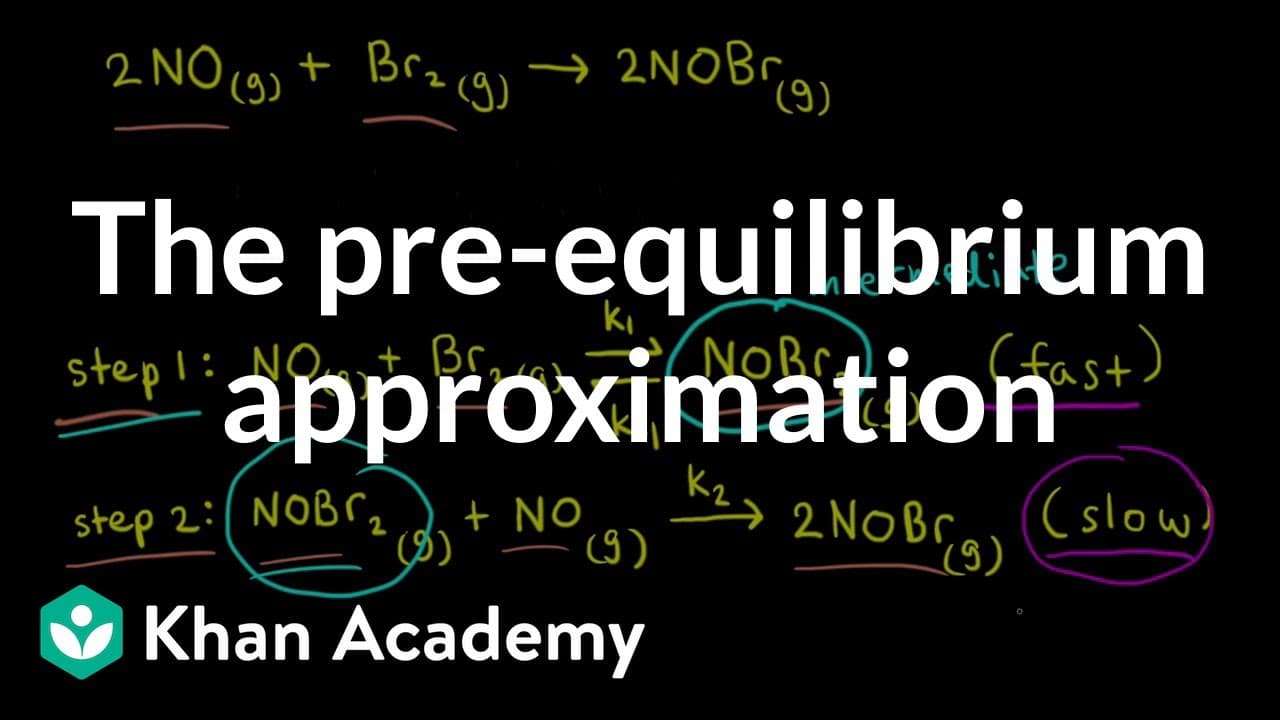
The Pre-equilibrium Approximation is used to determine the rate law for a reaction with a fast initial step.
Transcript
- [Instructor] The Pre-equilibrium Approximation is used to find the rate law for a mechanism with a fast initial step. As an example, let's look at the reaction between nitric oxide and bromine. In the first step of the mechanism, nitric oxide combines with bromine to form NOBr2. And in the second step of the mechanism, NOBr2 reacts with NO to for... Read More
Key Insights
- ☠️ The Pre-equilibrium Approximation is useful for finding the rate law for a reaction with a fast initial step.
- ☠️ The rate determining step in a mechanism is the slowest step.
- ☠️ The rate law for the overall reaction can be obtained by writing the rate law for the slow step and substituting the concentration of an intermediate using the Pre-equilibrium Approximation.
- ☠️ Coefficients in the overall reaction cannot be directly used as exponents in the rate law, except for elementary reactions.
Install to Summarize YouTube Videos and Get Transcripts
Explore YouTube Video Summarizer or Get YouTube Transcript Extractor
Questions & Answers
Q: What is the Pre-equilibrium Approximation used for?
The Pre-equilibrium Approximation is used to find the rate law for a reaction with a fast initial step.
Q: How is the rate determining step determined in a mechanism?
The rate determining step in a mechanism is the slowest step.
Q: How can the rate law for the overall reaction be written using the Pre-equilibrium Approximation?
The rate law for the overall reaction can be obtained by writing the rate law for the slow step and substituting the concentration of an intermediate using the Pre-equilibrium Approximation.
Q: Can the coefficients in the overall reaction be directly used as exponents in the rate law?
No, the coefficients in the overall reaction cannot be directly used as exponents in the rate law. This can only be done for elementary reactions.
Summary & Key Takeaways
-
The Pre-equilibrium Approximation is used to find the rate law for a reaction with a fast initial step.
-
The rate determining step in a mechanism is the slowest step.
-
The rate law for the overall reaction can be obtained by writing the rate law for the slow step and substituting the concentration of an intermediate using the Pre-equilibrium Approximation.
Read in Other Languages (beta)
Share This Summary 📚
Summarize YouTube Videos and Get Video Transcripts with 1-Click
Try YouTube Summary with ChatGPT & Claude or YouTube Transcript Generator
Explore More Summaries from Khan Academy 📚



Summarize YouTube Videos and Get Video Transcripts with 1-Click
Try YouTube Summary with ChatGPT & Claude or YouTube Transcript Generator