30,000,000 km/h Star, Flex from the JWST Team, Mystery of Quasars Solved | Space Bites
TL;DR
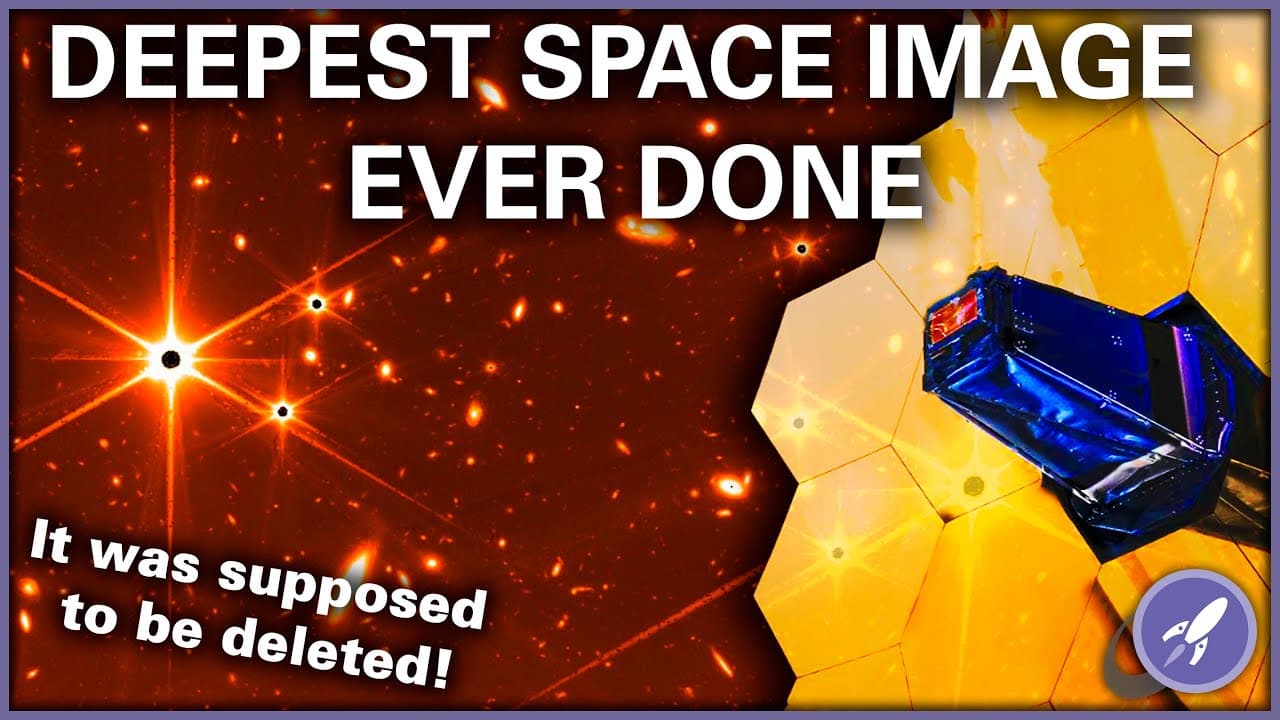
NASA's Capstone mission encounters temporary communication issues, James Webb Space Telescope captures the deepest image of the Universe, the origin of supermassive black holes is potentially linked to early galaxy formations, sail planes could be used for exploration on Mars, the stability of the Solar System is secured for 100 billion years, a star orbits the Milky Way's supermassive black hole at 3% the speed of light, the Psyche mission faces a delay, and SpaceX's SuperHeavy and Starship prepare for testing and upcoming launches.
Transcript
Fraser Cain: Hi, everyone, I'm Fraser Cain. I'm the publisher of Universe Today, I've been a space in astronomy news journalist for over 20 years. This is our space bytes episode where we collect together a lot of the breaking news this week in space and astronomy, and video it at you. I also write a much longer email newsletter that goes in great ... Read More
Key Insights
- 😀 NASA's Capstone mission faced temporary communication issues after launch but regained contact and continues its journey to orbit the Moon.
- 👾 The James Webb Space Telescope has already captured stunning deep-space images during its testing phase, with more to come once it officially begins operations.
- ✴️ The origin of supermassive black holes in the early Universe may involve the collapse of supermassive stars formed within cold gas streams rather than the traditional supernova and black hole merger theory.
- 🪐 Sail planes or gliders could potentially be used for extended exploration on Mars, utilizing the planet's high-altitude winds.
- 🍉 The Solar System's stability is projected to last for 100 billion years, providing long-term safety for any future inhabitants.
- 🖤 SgrA* orbits the supermassive black hole at the Milky Way's center at an extraordinary speed, showcasing the intense gravitational force present.
- 😀 The Psyche mission faces a delay due to software testing requirements but remains committed to studying asteroid Psyche in the future.
Install to Summarize YouTube Videos and Get Transcripts
Explore YouTube Video Summarizer or Get YouTube Transcript Extractor
Questions & Answers
Q: What caused the temporary communication loss with NASA's Capstone mission, and has it been resolved?
The Capstone mission encountered communication issues due to improperly formatted commands sent to the radio system. After debugging, NASA regained contact with the spacecraft and confirmed its on-track trajectory to reach the Moon in November.
Q: What significant achievement did the James Webb Space Telescope accomplish during a test run?
During a test, the James Webb Space Telescope captured the deepest image of the Universe to date, revealing never-before-seen galaxies outside the reach of existing telescopes.
Q: How were supermassive black holes in the early Universe theorized to have formed?
Traditional ideas of supernova explosions and black hole mergers couldn't explain the early presence of supermassive black holes. However, simulations have suggested that cold gas streams in the early Universe could form supermassive stars, which may then collapse into massive black holes.
Q: How could sail planes be used for exploration on Mars?
Engineers are considering sail planes or gliders for Mars exploration due to the planet's low atmospheric density. The sail planes would rely on high-altitude winds to maintain lift, potentially allowing for extended exploration and coverage of Martian terrain.
Q: Is the stability of the Solar System assured for the long term?
According to calculations, the Solar System is expected to remain stable for 100 billion years. The merger between the Milky Way and Andromeda is unlikely to result in destructive collisions between stars due to the vast distances separating them.
Q: What impressive speed does a star reach near the Milky Way's supermassive black hole?
A star known as SgrA* orbits the supermassive black hole at the center of the Milky Way at speeds almost reaching 3% the speed of light.
Q: What caused the delay in the Psyche mission, and when is it expected to launch?
The Psyche mission has been delayed due to software testing concerns. The mission, heading to asteroid Psyche, will now aim for a launch window in either 2023 or 2024.
Q: How many Raptor v2 engines will be featured on SpaceX's SuperHeavy and Starship?
The SuperHeavy booster will have 33 Raptor v2 engines optimized for sea level, while the Starship will have six Raptor v2 engines, with three optimized for sea level and three for vacuum.
Summary & Key Takeaways
-
NASA's Capstone mission experienced communication problems soon after launch but has since reestablished contact and is on track to reach the Moon in November.
-
The James Webb Space Telescope produced an unprecedented deep image of the Universe during a test, revealing numerous never-before-seen galaxies.
-
The origin of supermassive black holes in the early Universe may be attributed to the formation of supermassive stars that collapse into massive black holes.
-
Engineers are exploring the possibility of using sail planes or gliders on Mars for extended exploration, taking advantage of strong Martian winds at high altitudes.
-
The stability of the Solar System is projected to last for 100 billion years, with the Milky Way and Andromeda merger unlikely to result in destructive collisions between stars.
-
A star in close proximity to the Milky Way's supermassive black hole, SgrA*, orbits at an incredible speed of almost 3% the speed of light.
-
The Psyche mission, headed to asteroid Psyche, faces a delay due to software testing issues.
-
SpaceX's SuperHeavy booster and Starship are being prepared for testing and upcoming launches, with 39 Raptor v2 engines in total.
Read in Other Languages (beta)
Share This Summary 📚
Summarize YouTube Videos and Get Video Transcripts with 1-Click
Try YouTube Summary with ChatGPT & Claude or YouTube Transcript Generator
Explore More Summaries from Fraser Cain 📚





Summarize YouTube Videos and Get Video Transcripts with 1-Click
Try YouTube Summary with ChatGPT & Claude or YouTube Transcript Generator