MTEL Math Practice Test: 41-45
TL;DR
This content covers various probability and statistics problems, including finding mean and median, calculating probabilities, and estimating expected values.
Transcript
Problem 41. Use the histogram below to answer the question that follows. Here's our histogram. Two six-sided number cubes. They sound suspiciously like regular dice. Two six-sided number cubes are rolled simultaneously 10 times. So it's like you're rolling two dice 10 times. The sums are recorded in the histogram shown above. So when you look at wh... Read More
Key Insights
- 😫 Histograms can be used to determine mean and median values in a data set.
- 👥 Percentage differences can be calculated to compare different groups or events.
- #️⃣ Probabilities can be calculated by dividing the number of favorable outcomes by the total number of possible outcomes.
- 🍹 Expected values can be estimated by multiplying probabilities by the associated values and summing up the results.
- 📈 Analyzing graphs and tables can provide valuable insights into data patterns and trends.
- 🧡 Understanding probability concepts is essential for solving a wide range of problems.
- 😫 Mean and median are measures of central tendency that can provide insights into the average and middle values of a data set.
Install to Summarize YouTube Videos and Get Transcripts
Explore YouTube Video Summarizer or Get YouTube Transcript Extractor
Questions & Answers
Q: How can we determine the mean and median from a histogram?
To find the median, identify the middle number(s) in the data set. If there are two middle numbers, take their average. To find the mean, add up all the data points and divide by the total number of data points.
Q: How can we compare percentages in a given data set?
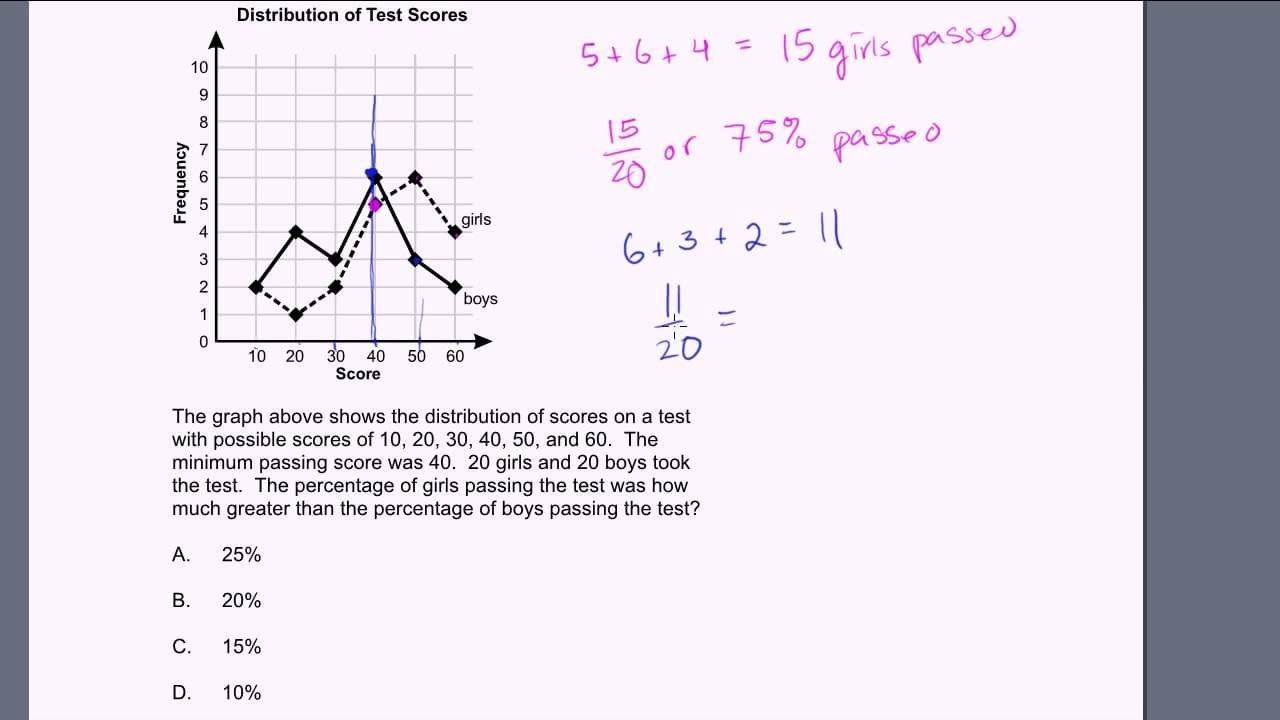
To compare percentages, subtract one percentage from another. The resulting difference represents how much greater one percentage is compared to the other.
Q: How can we determine the probability of an event given a specific condition?
To calculate the probability of an event given a specific condition, divide the number of favorable outcomes by the total number of possible outcomes.
Q: How can we estimate the expected value based on probabilities?
Multiply each probability by the value associated with that event and sum up the results to calculate the expected value.
Summary & Key Takeaways
-
The first problem involves analyzing a histogram and using it to determine the mean and median of a data set.
-
The second problem revolves around interpreting a graph to compare the percentage of girls and boys passing a test.
-
The third problem requires using a table to calculate the probability of a specific age group preferring a particular milkshake flavor.
-
The fourth problem deals with finding the probability of selecting specific blocks from a set of different shapes.
-
The fifth problem involves using a spinner to estimate the number of fruit baskets to give away at a party.
Read in Other Languages (beta)
Share This Summary 📚
Summarize YouTube Videos and Get Video Transcripts with 1-Click
Try YouTube Summary with ChatGPT & Claude or YouTube Transcript Generator
Explore More Summaries from Khan Academy 📚





Summarize YouTube Videos and Get Video Transcripts with 1-Click
Try YouTube Summary with ChatGPT & Claude or YouTube Transcript Generator