Example of derivative as limit of average rate of change
TL;DR
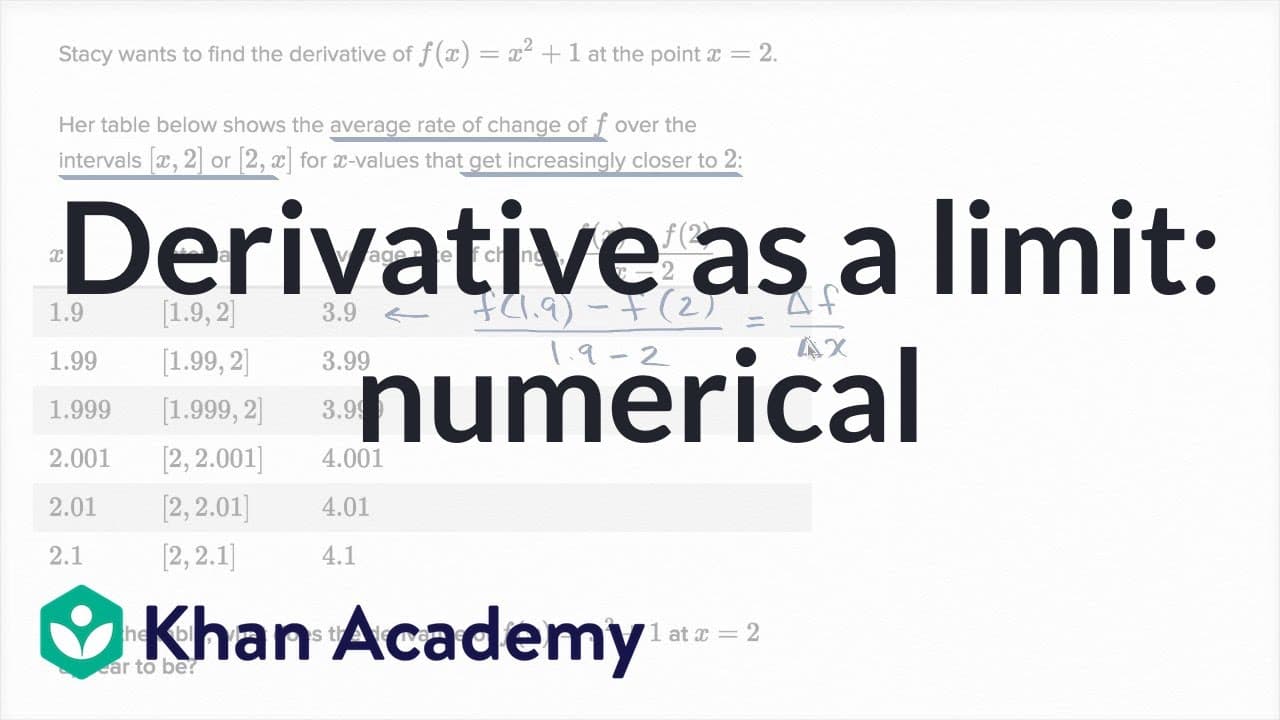
The video explains how to find the derivative of a function at a specific point by calculating the average rate of change between that point and another point that approaches it, suggesting that the derivative at x equals two appears to be four.
Transcript
- [Voiceover] Stacy wants to find the derivative of f of x equals x squared plus one at the point x equals two. Her table below shows the average rate of change of f over the intervals from x to two or from two to x, and these are closed intervals, for x-values that get increasingly closer to two. so they get-- so we're talking about the average ra... Read More
Key Insights
- 😒 The video demonstrates how to use the average rate of change to estimate the derivative of a function at a specific point.
- 💱 The data in the table shows that as the x-values approach two, the average rate of change approaches four, indicating that the derivative at x equals two may be four.
- ☺️ The limit as x approaches two gives the exact value of the derivative at x equals two.
- 🫥 The average rate of change is a concept related to finding the slope of a secant line, whereas the derivative represents the slope of a tangent line.
- ☠️ Understanding the relationship between average rate of change and the derivative helps in approximating and finding exact values of derivatives.
- 👈 The video highlights one of the definitions of a derivative, which involves finding the limit of the average rate of change as the x-values approach the desired point.
- 💱 The table provides a visual representation of how the average rate of change changes as the x-values get closer to two.
Install to Summarize YouTube Videos and Get Transcripts
Explore YouTube Video Summarizer or Get YouTube Transcript Extractor
Questions & Answers
Q: How does Stacy calculate the average rate of change in the table?
Stacy calculates the average rate of change by subtracting the value of the function at the x-value from the value of the function at x equals two, and then dividing it by the difference between the x-values.
Q: What does the data in the table suggest about the derivative at x equals two?
The data in the table suggests that as the x-values approach two from both sides, the average rate of change gets closer to four, indicating that the derivative at x equals two appears to be four.
Q: Is the average rate of change the same as the derivative?
No, the average rate of change is not the same as the derivative. The average rate of change only provides an approximation of the derivative at a specific point.
Q: What does the limit as x approaches two represent in this context?
The limit as x approaches two represents the actual derivative of the function at x equals two. It gives the precise value of the slope of the tangent line to the function at that point.
Summary & Key Takeaways
-
The video introduces the concept of finding the derivative of a function at a specific point by calculating the average rate of change between that point and another point.
-
It provides a table showing the average rate of change of the function as the x-values get increasingly closer to two.
-
By analyzing the data in the table, the video concludes that the derivative of the given function at x equals two appears to be equal to four.
Read in Other Languages (beta)
Share This Summary 📚
Summarize YouTube Videos and Get Video Transcripts with 1-Click
Try YouTube Summary with ChatGPT & Claude or YouTube Transcript Generator
Explore More Summaries from Khan Academy 📚



Summarize YouTube Videos and Get Video Transcripts with 1-Click
Try YouTube Summary with ChatGPT & Claude or YouTube Transcript Generator