How Do Intermolecular Forces Affect Boiling Points?
TL;DR
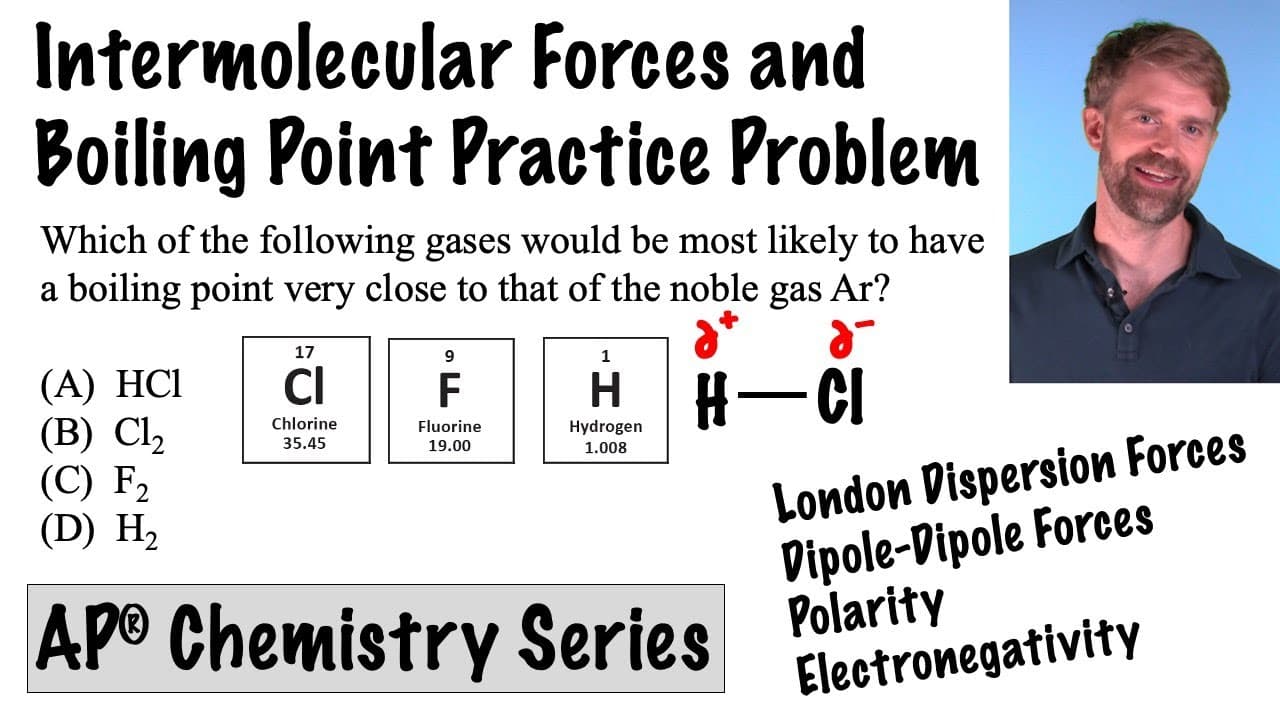
Intermolecular forces determine boiling points, with stronger forces leading to higher temperatures. Argon, a noble gas with low intermolecular forces, is compared to diatomic elements. Fluorine (F2) is identified as having a similar number of electrons and mass to argon, making it likely to share similar boiling point characteristics.
Transcript
here we're going to do a problem that focuses on intermolecular forces and boiling point it's part of a bunch of AP chem resources you can check out right here so which of the following gases would be most likely to have a boiling point very close to that of the noble gas Argon now whenever the AP exam gives you formulas and asks you about boiling ... Read More
Key Insights
- 😥 Boiling point is determined by intermolecular forces, with stronger forces resulting in higher boiling points.
- 😘 Argon, a noble gas, has low intermolecular forces due to its nonpolar, single-atom structure.
- 😥 The number of electrons and mass of particles can influence their intermolecular forces and boiling points.
- 🤙 Nonpolar particles experience the weakest intermolecular forces called London dispersion forces, caused by the random motion of electrons.
- 💪 HCl is an outlier in the given answer choices due to its polar nature and stronger dipole-dipole attractions.
- 😚 F2 is the correct answer choice as it has the closest number of electrons to Argon and a similar mass, indicating similar intermolecular forces and boiling point.
- 😥 The AP exam often tests knowledge of boiling points to assess understanding of intermolecular forces in different substances.
Install to Summarize YouTube Videos and Get Transcripts
Explore YouTube Video Summarizer or Get YouTube Transcript Extractor
Questions & Answers
Q: Why does the AP exam often ask about boiling points and other phase-related data of substances?
The AP exam asks about boiling points to test understanding of intermolecular forces, as stronger forces result in higher boiling points.
Q: Why is HCl the outlier in the given answer choices?
HCl is the outlier because it is a polar molecule, experiencing stronger dipole-dipole attractions and higher boiling point compared to nonpolar molecules.
Q: How do nonpolar particles experience intermolecular forces?
Nonpolar particles experience London dispersion forces, which are caused by the temporary dipoles created by the random motion of electrons.
Q: Why is F2 the correct answer choice?
F2 has 18 electrons, similar to Argon, indicating similar London dispersion forces. Additionally, F2 has a similar mass to Argon, further supporting its selection.
Summary & Key Takeaways
-
The boiling point of a substance is determined by the strength of intermolecular forces between its particles.
-
Argon, a noble gas, has low intermolecular forces and exists as single atoms.
-
The answer choice with the closest number of electrons to Argon and similar masses is likely to have similar intermolecular forces.
Read in Other Languages (beta)
Share This Summary 📚
Summarize YouTube Videos and Get Video Transcripts with 1-Click
Try YouTube Summary with ChatGPT & Claude or YouTube Transcript Generator
Explore More Summaries from Tyler DeWitt 📚




Summarize YouTube Videos and Get Video Transcripts with 1-Click
Try YouTube Summary with ChatGPT & Claude or YouTube Transcript Generator