How Does Free Energy Relate to Equilibrium?
TL;DR
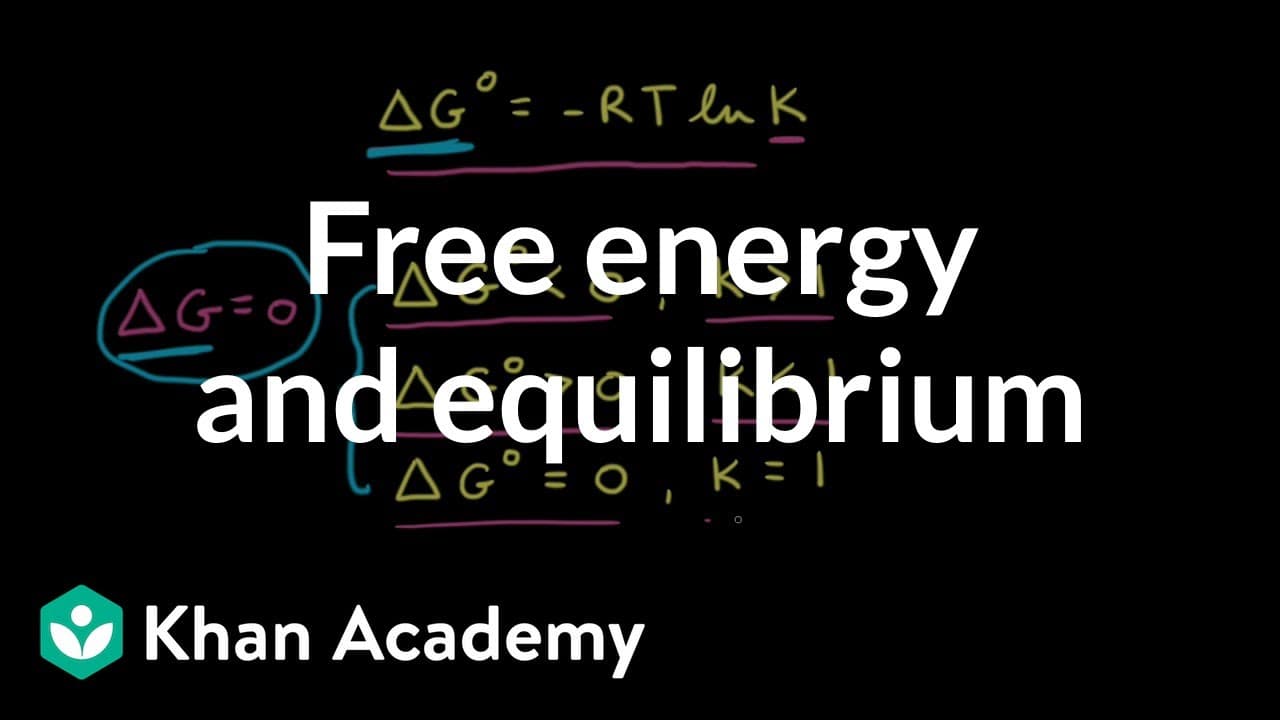
The relationship between free energy and equilibrium is defined by the equation ΔG° = -RT ln(K). This demonstrates that if ΔG° is negative, products dominate at equilibrium, whereas a positive ΔG° indicates that reactants are favored. Understanding this relationship allows us to calculate the equilibrium constant (K) based on the standard change in free energy.
Transcript
- [Instructor] Let's say we have a generic reaction where reactants turn into products. And our goal is to think about the relationship between free energy and this reaction when it comes to equilibrium. First, we need to consider the equation that allows us to calculate non-standard changes in free energy delta G. We can think about delta G as the... Read More
Key Insights
- ♊ The equation delta G = delta G naught + RT ln(Q) is used to calculate non-standard changes in free energy.
- 😝 At equilibrium, the instantaneous difference in free energy is zero and the reaction quotient (Q) is equal to the equilibrium constant (K).
- 🥶 Delta G naught represents the standard change in free energy between reactants and products at a specified temperature.
- ❎ If delta G naught is negative, the equilibrium constant (K) is greater than one, indicating that products are favored at equilibrium.
- 😉 If delta G naught is positive, the equilibrium constant (K) is less than one, indicating that reactants are favored at equilibrium.
- 🎃 The equation delta G naught = -RT ln(K) allows for the calculation of the equilibrium constant (K) if delta G naught is known.
- #️⃣ Equilibrium constants do not have units, and the number of significant figures in the power of e is determined by the number of decimal places.
Install to Summarize YouTube Videos and Get Transcripts
Explore YouTube Video Summarizer or Get YouTube Transcript Extractor
Questions & Answers
Q: What is the equation used to calculate non-standard changes in free energy?
The equation used is delta G = delta G naught + RT ln(Q), where delta G is the instantaneous difference in free energy between reactants and products, delta G naught is the standard change in free energy, R is the ideal gas constant, T is the temperature in Kelvin, and Q is the reaction quotient.
Q: How is equilibrium defined in relation to free energy?
At equilibrium, the instantaneous difference in free energy between reactants and products is zero, meaning there is no more driving force for the reaction. The reaction quotient (Q) at equilibrium is equal to the equilibrium constant (K).
Q: What does the equation delta G naught = -RT ln(K) represent?
This equation represents the relationship between the standard change in free energy (delta G naught) and the equilibrium constant (K) for a reaction at a specific temperature. The negative sign indicates that delta G naught is proportional to the natural logarithm of K.
Q: How can the equilibrium constant be calculated using delta G naught?
By rearranging the equation, delta G naught = -RT ln(K), we can solve for K. Dividing both sides by -RT gives ln(K) = -delta G naught / RT. By taking the exponential of both sides, we get K = e^(-delta G naught / RT).
Summary & Key Takeaways
-
The equation delta G = delta G naught + RT ln(Q) is used to calculate the non-standard changes in free energy, where delta G is the instantaneous difference in free energy between reactants and products, delta G naught is the standard change in free energy, R is the ideal gas constant, T is the temperature in Kelvin, and Q is the reaction quotient.
-
At equilibrium, the instantaneous difference in free energy between reactants and products is zero and the reaction quotient (Q) is equal to the equilibrium constant (K).
-
By rearranging the equation, delta G naught = -RT ln(K), we can calculate the equilibrium constant for a reaction at a specific temperature if we know the standard change in free energy.
Read in Other Languages (beta)
Share This Summary 📚
Summarize YouTube Videos and Get Video Transcripts with 1-Click
Try YouTube Summary with ChatGPT & Claude or YouTube Transcript Generator
Explore More Summaries from Khan Academy 📚



Summarize YouTube Videos and Get Video Transcripts with 1-Click
Try YouTube Summary with ChatGPT & Claude or YouTube Transcript Generator