Proof that c^n converges to Zero - Advanced Calculus/Introductory Real Analysis
TL;DR
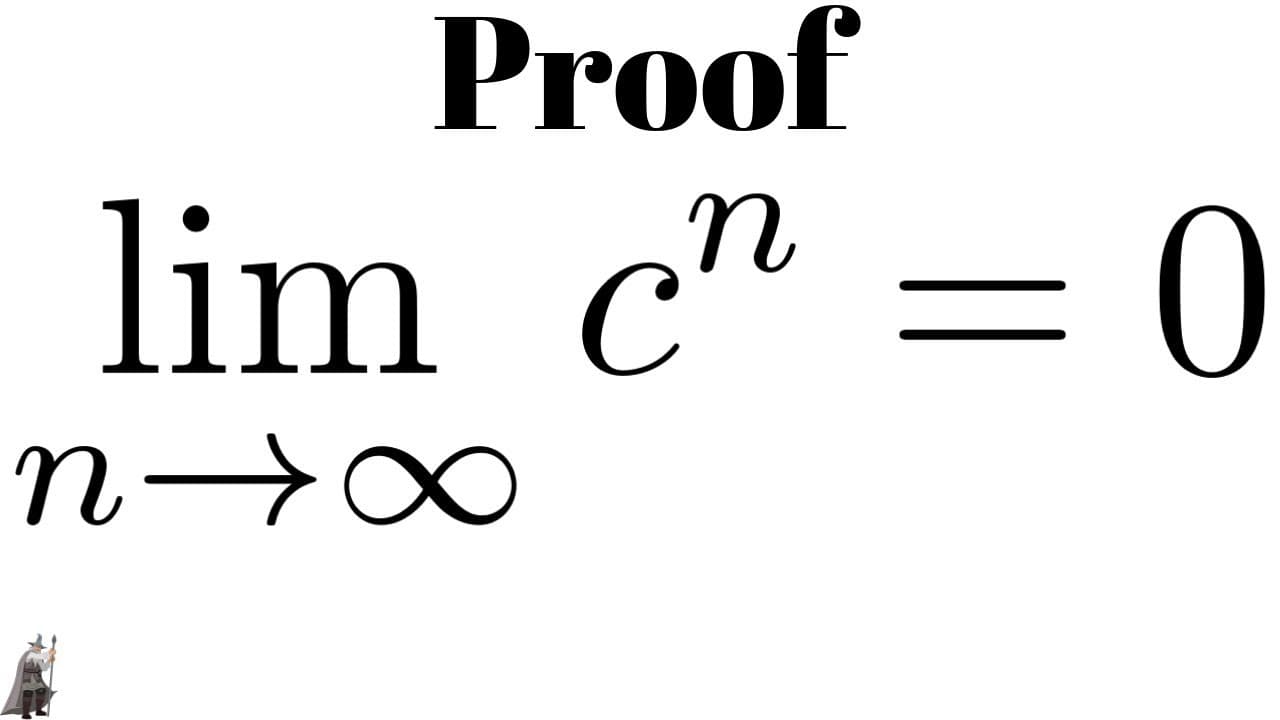
This video provides a step-by-step proof demonstrating that as the limit of n goes to infinity, where C is a number strictly between 0 and 1, C to the power of N approaches 0.
Transcript
prove that the limit as n goes to infinity of C to the N is equal to 0 if C is a number strictly between 0 & 1 proof before we start writing the proof let me recall the definition of what this means so we say that the limit as n goes to infinity of a sequence which we can call say a sub n is equal to L if for all epsilon greater than 0 we can find ... Read More
Key Insights
- 😚 The limit of a sequence represents the value that the terms of the sequence get closer to as the index increases.
- 💦 Proofs for limits often involve working backward and finding suitable natural numbers.
- #️⃣ The Archimedean principle guarantees the existence of a natural number greater than any given number.
- 🇧🇶 In this specific case, the limit as n goes to infinity of C to the N is proved to be 0 if C is a number strictly between 0 and 1.
- ❎ The proof can be extended to negative values of C between -1 and 0 by considering the absolute value of C.
- 😒 The use of logarithms helps solve the inequality and determine the relationship between the variables.
- ❓ The explanation of the proof is clear and detailed, providing a step-by-step breakdown of the process.
Install to Summarize YouTube Videos and Get Transcripts
Explore YouTube Video Summarizer or Get YouTube Transcript Extractor
Questions & Answers
Q: What is the definition of a limit in mathematics?
In mathematics, the limit of a sequence is a value that the terms of the sequence approach as the index gets arbitrarily large.
Q: How do we solve limits using proofs?
To solve limits using proofs, it is common to work backward, starting with an epsilon greater than 0, and finding a natural number such that the distance between the sequence and the limit is smaller than epsilon for all n greater than that natural number.
Q: What is the significance of the Archimedean principle in this proof?
The Archimedean principle ensures that we can always find a natural number that is greater than any given number, thus guaranteeing the existence of a suitable natural number for the proof.
Q: Can the proof be extended to negative values of C?
Yes, the proof can also be extended to negative values of C as long as C is between -1 and 0. In that case, the absolute value of C will be taken into consideration.
Summary & Key Takeaways
-
The video explains the definition of limits and sequences in mathematics.
-
It demonstrates how to work backward to solve proofs for limits.
-
The Archimedean principle is used to choose a suitable natural number to prove the given limit.
Read in Other Languages (beta)
Share This Summary 📚
Summarize YouTube Videos and Get Video Transcripts with 1-Click
Try YouTube Summary with ChatGPT & Claude or YouTube Transcript Generator
Explore More Summaries from The Math Sorcerer 📚


Summarize YouTube Videos and Get Video Transcripts with 1-Click
Try YouTube Summary with ChatGPT & Claude or YouTube Transcript Generator