Which BMW M5 Generation Wins in a Drag Race?
TL;DR
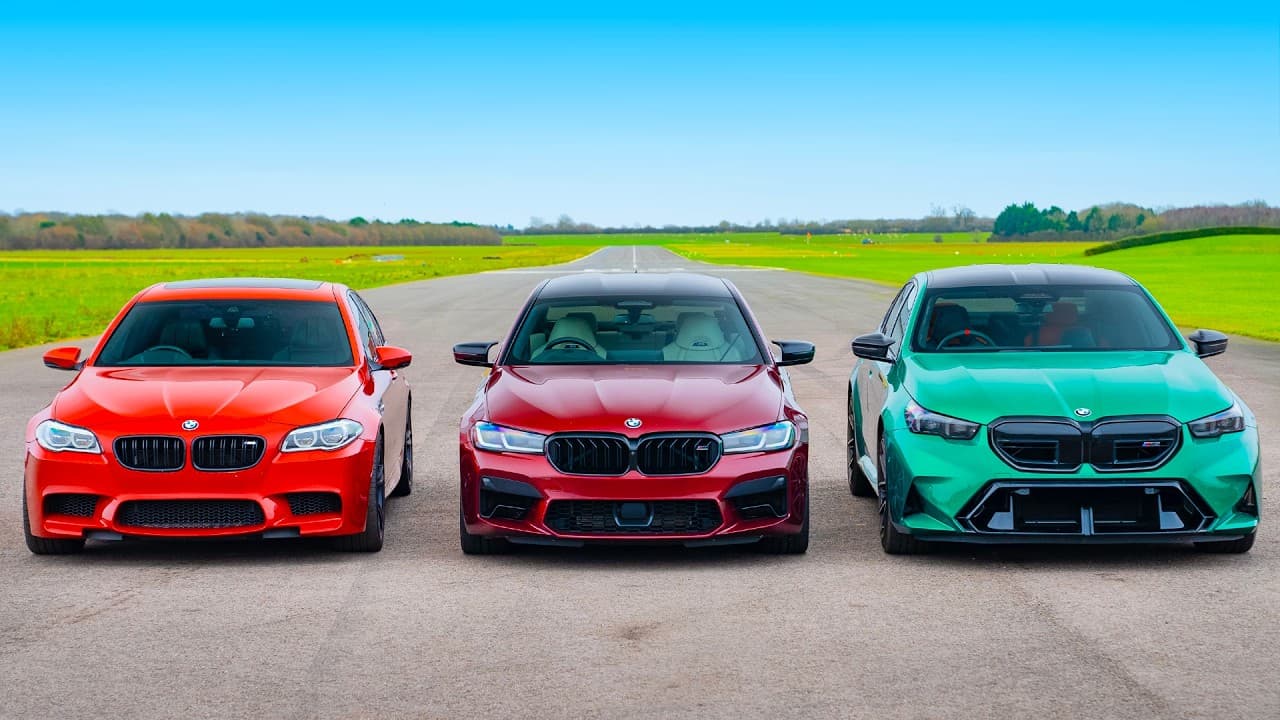
In a drag race featuring the G90 hybrid, F90 competition, and F10 models, the F90 completed the quarter mile in 11.1 seconds, outperforming the G90's 11.3 seconds and the F10's 13.3 seconds. The F90's superior power-to-weight ratio and all-wheel drive gave it an edge, while the G90 struggled with weight despite having the highest horsepower.
Transcript
what we win in a drag race between the new g90 BMW M5 hybrids its predecessor the f90 BMW M5 no hybrid and that car's predecessor the F10 BMW M5 that one's rear wheel drive they're four-wheel drive and that one's quite heavy cuz of all the Battery tech it's going to be interesting to see how it plays out over the standing quarter mile anyway I'm Ma... Read More
Key Insights
- The G90 BMW M5 hybrid, despite its substantial power output, faces challenges due to its heavy weight, affecting its power-to-weight ratio.
- The F90 BMW M5 competition model, with a better power-to-weight ratio than the F10, benefits from four-wheel drive without a significant weight penalty.
- The F10 BMW M5, being rear-wheel drive, struggles with traction issues, especially in colder conditions, impacting its performance off the line.
- The drag race reveals that the power-to-weight ratio and traction significantly impact the performance of these vehicles, with the F90 initially performing better.
- The G90's electric motor provides an advantage in rolling races, offering a quick torque fill that helps it maintain a lead.
- Interior quality and material feel were subjective, with differing opinions on which model felt more luxurious or expensive.
- The drag race highlighted the importance of tuning, as the F90 initially ran with a piggyback ECU, affecting its performance.
- The brake test showed unexpected results, with the F10 outperforming the heavier G90, despite the latter's advanced braking technology.
Install to Summarize YouTube Videos and Get Transcripts
Explore YouTube Video Summarizer or Get YouTube Transcript Extractor
Questions & Answers
Q: How does the weight of the G90 BMW M5 affect its performance?
The G90 BMW M5's substantial weight of 2,435 kg negatively impacts its power-to-weight ratio, despite its impressive 727 horsepower. This means that even with more power, the car struggles to accelerate as quickly as its lighter predecessors, particularly in a drag race scenario.
Q: Why did the F10 BMW M5 struggle in the drag race?
The F10 BMW M5 struggled primarily due to its rear-wheel drive configuration, which led to traction issues, especially on a cold track. Its 575 horsepower was not enough to overcome these traction challenges, making it less competitive against the all-wheel-drive F90 and G90 models.
Q: What advantage does the G90's electric motor provide?
The G90's electric motor offers a significant advantage in terms of torque fill, providing immediate power and improving acceleration, especially in rolling races. This electric assistance helps the G90 maintain a lead in scenarios where quick acceleration is crucial.
Q: How did tuning affect the F90 BMW M5's performance?
Initially, the F90 BMW M5 ran with a piggyback ECU, which enhanced its performance beyond stock capabilities. This tuning allowed it to perform better in the drag race, but once removed, the car's performance returned to its standard specifications, highlighting the impact of tuning on vehicle dynamics.
Q: What were the subjective opinions on the interior quality of the cars?
Opinions on interior quality varied, with some preferring the newer G90's design and materials, while others favored the F90's feel. These subjective views highlight the personal preferences and priorities of drivers when it comes to luxury and comfort in car interiors.
Q: Why was the brake test result surprising?
The brake test result was surprising because the older, lighter F10 outperformed the heavier G90, despite the G90's advanced braking technology and carbon ceramic brakes. This outcome suggests that factors like weight distribution and tire condition can significantly influence braking performance.
Q: What were the key challenges faced by the F10 BMW M5?
The F10 BMW M5 faced challenges primarily due to its rear-wheel drive, which led to traction issues and wheel spin, especially on a cold track. These factors hindered its ability to launch effectively, making it less competitive in the drag race against its all-wheel-drive counterparts.
Q: How did the rolling races differ from the drag races in terms of results?
In the rolling races, the G90's electric motor provided a significant advantage with its quick torque fill, allowing it to maintain a lead. Unlike the drag races where launch control and traction were crucial, the rolling races highlighted the G90's ability to sustain speed and power over a distance.
Summary & Key Takeaways
-
The BMW M5 drag race featured three generations: the G90 hybrid, F90 competition, and F10, each with a 4.4L twin-turbo V8 engine. Despite the G90's higher power, its weight impacted its performance, making the race results intriguing.
-
The F90, initially running with a piggyback ECU, demonstrated impressive performance, while the F10 struggled with traction due to its rear-wheel drive setup. The race showcased the impact of power-to-weight ratios and traction on performance.
-
Interior comparisons revealed subjective preferences, with some preferring the newer model's design. The brake test results were surprising, with the lighter F10 outperforming the G90, highlighting the complexities of vehicle dynamics.
Read in Other Languages (beta)
Share This Summary 📚
Summarize YouTube Videos and Get Video Transcripts with 1-Click
Try YouTube Summary with ChatGPT & Claude or YouTube Transcript Generator
Explore More Summaries from carwow 📚





Summarize YouTube Videos and Get Video Transcripts with 1-Click
Try YouTube Summary with ChatGPT & Claude or YouTube Transcript Generator