Adding Rational Expressions Example 3
TL;DR
Learn how to subtract rational expressions by factoring and finding the least common multiple.
Transcript
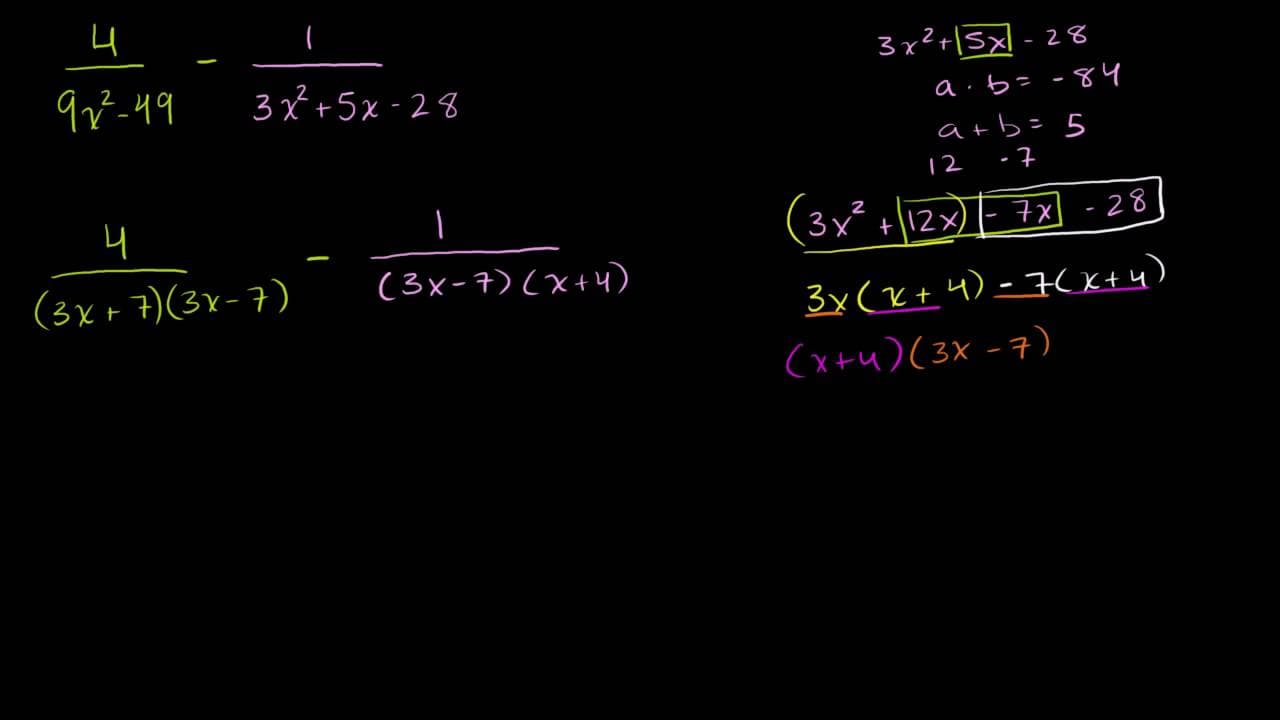
Let's do one more fairly involved example of adding, or in this case actually subtracting rational expressions. Let's say I have 4 over 9x squared minus 49. And from that I want to subtract-- maybe I'll do this in different color-- I want to subtract 1 over 3x squared plus 5x, minus 28. So just like we saw in the last video, we want to find the lea... Read More
Key Insights
- 😑 Rational expressions can be subtracted by finding the least common multiple through factoring.
- 😑 Difference of squares can be used to factor expressions of the form a^2 - b^2.
- 😑 Grouping can be used to factor expressions with non-1 coefficients without using the Pythagorean theorem.
- 😑 The common denominator is formed by multiplying all the factors of the individual expressions.
Install to Summarize YouTube Videos and Get Transcripts
Explore YouTube Video Summarizer or Get YouTube Transcript Extractor
Questions & Answers
Q: How do you subtract rational expressions?
To subtract rational expressions, you need to find the least common multiple by factoring each expression and then combine them with a common denominator.
Q: What is the key step in factoring the first expression?
The key step in factoring the first expression is recognizing it as a difference of squares, which allows us to rewrite it as (3x + 7)(3x - 7).
Q: How is the second expression factored using grouping?
The second expression is factored using grouping by finding two numbers that multiply to give the product of the leading coefficient and the constant term and add up to the coefficient of the linear term.
Q: What is the final result after subtracting the rational expressions?
The final result is (x + 9)/(3x + 7)(3x - 7)(x + 4), where the common denominator contains all the factors of both expressions.
Summary & Key Takeaways
-
To subtract rational expressions, you need to find the least common multiple by factoring each expression.
-
Factor the first expression as a difference of squares: 4/(9x^2 - 49) = 4/((3x + 7)(3x - 7)).
-
Factor the second expression using grouping: 1/(3x^2 + 5x - 28) = 1/((3x + 7)(x - 4)).
-
Find the common denominator by multiplying the factors: (3x + 7)(3x - 7)(x + 4).
-
Multiply the numerators and denominators accordingly and simplify to get the final result: x + 9/(3x + 7)(3x - 7)(x + 4).
Read in Other Languages (beta)
Share This Summary 📚
Summarize YouTube Videos and Get Video Transcripts with 1-Click
Try YouTube Summary with ChatGPT & Claude or YouTube Transcript Generator
Explore More Summaries from Khan Academy 📚



Summarize YouTube Videos and Get Video Transcripts with 1-Click
Try YouTube Summary with ChatGPT & Claude or YouTube Transcript Generator