Water potential worked example
TL;DR
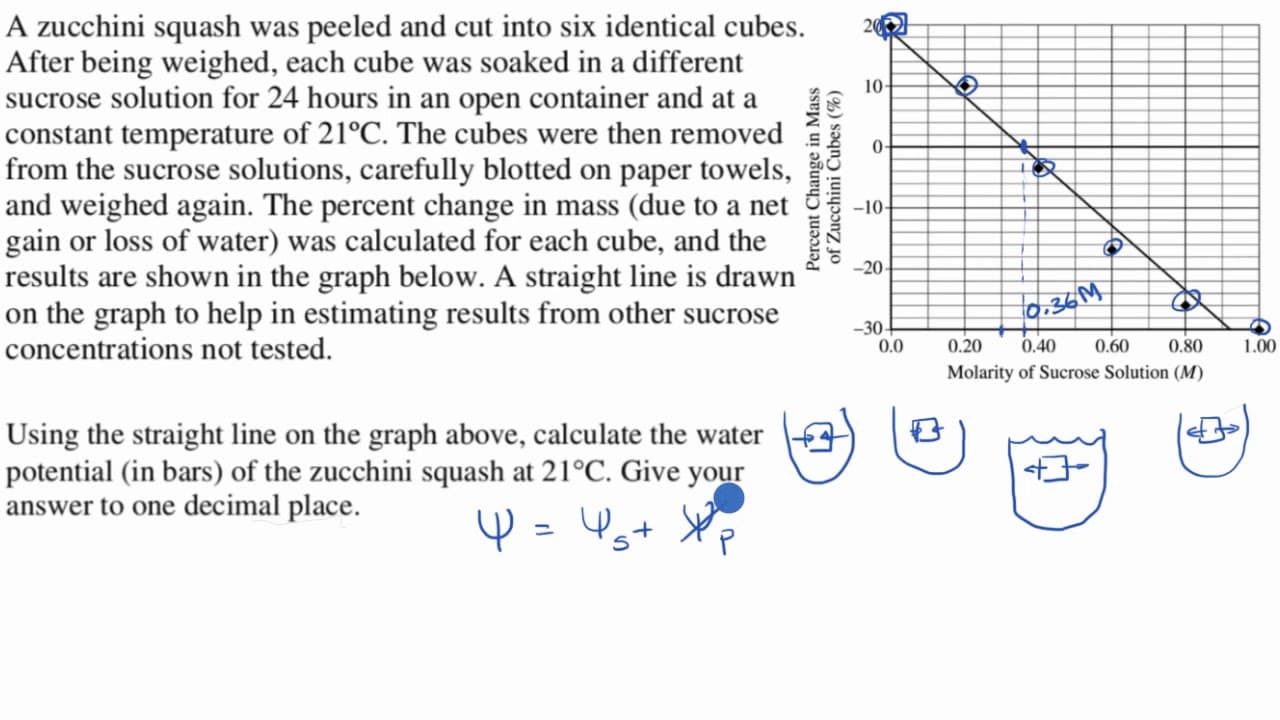
By observing the change in mass of zucchini squash cubes soaked in different sucrose solutions, we can calculate the water potential of the squash.
Transcript
- [Instructor] A zucchini squash was peeled and cut into six identical cubes. After being weighed, each cubed was soaked in a different sucrose solution for 24 hours in an open container and at a constant temperature of 21 degrees Celsius. The cubes were then removed from the sucrose solutions, carefully blotted on paper towels and weighed again. T... Read More
Key Insights
- 💦 The change in mass of zucchini squash cubes soaked in various sucrose solutions indicates the net gain or loss of water.
- 💦 Comparing the change in mass to a sucrose solution with no net inflow or outflow of water helps determine the water potential of the zucchini squash.
- 💦 The water potential formula takes into account solute potential, which is influenced by the concentration of sucrose in the solution.
- 🤢 The water potential of the zucchini squash was calculated to be -8.8 bars at 21 degrees Celsius.
- 💦 Water potential is an important concept in understanding water movement in plants and their ability to maintain turgidity.
- 💦 Different concentrations of solutes can affect the water potential and osmotic potential of a solution.
- 🏆 The graph provided in the content helps estimate results for sucrose concentrations not tested.
Install to Summarize YouTube Videos and Get Transcripts
Explore YouTube Video Summarizer or Get YouTube Transcript Extractor
Questions & Answers
Q: How does the change in mass of zucchini squash cubes indicate the net gain or loss of water?
The change in mass of the cubes after being soaked in sucrose solutions reflects the net gain or loss of water. An increase in mass indicates an inflow of water, while a decrease suggests an outflow.
Q: How does the water potential of the zucchini squash relate to the sucrose solution?
The water potential of the zucchini squash is equal to the water potential of the sucrose solution when there is no net inflow or outflow of water. This occurs when the cubes are placed in a sucrose solution with a concentration of 0.36 moles per liter.
Q: What is the formula for calculating solute potential?
The solute potential of a solution can be calculated using the formula: solute potential = -i * molarity * R * temperature. In this case, since sucrose does not disassociate, the value of i is 1.
Q: How was the water potential of the zucchini squash at 21 degrees Celsius calculated?
By substituting the values into the solute potential formula (-1 * 0.36 * 0.0831 * 294), the water potential of the zucchini squash was determined to be -8.8 bars.
Summary & Key Takeaways
-
Zucchini squash cubes were soaked in various sucrose solutions, resulting in a net gain or loss of water, as shown in a graph.
-
The water potential of the zucchini squash can be determined by comparing it to a sucrose solution with no net inflow or outflow of water.
-
The water potential formula, which takes into account solute potential and pressure potential, is used to calculate the water potential of the sucrose solution.
Read in Other Languages (beta)
Share This Summary 📚
Summarize YouTube Videos and Get Video Transcripts with 1-Click
Try YouTube Summary with ChatGPT & Claude or YouTube Transcript Generator
Explore More Summaries from Khan Academy 📚



Summarize YouTube Videos and Get Video Transcripts with 1-Click
Try YouTube Summary with ChatGPT & Claude or YouTube Transcript Generator