🔴 Why is the James Webb Space Telescope so amazing? | [OFFICE HOURS] Podcast 078
TL;DR
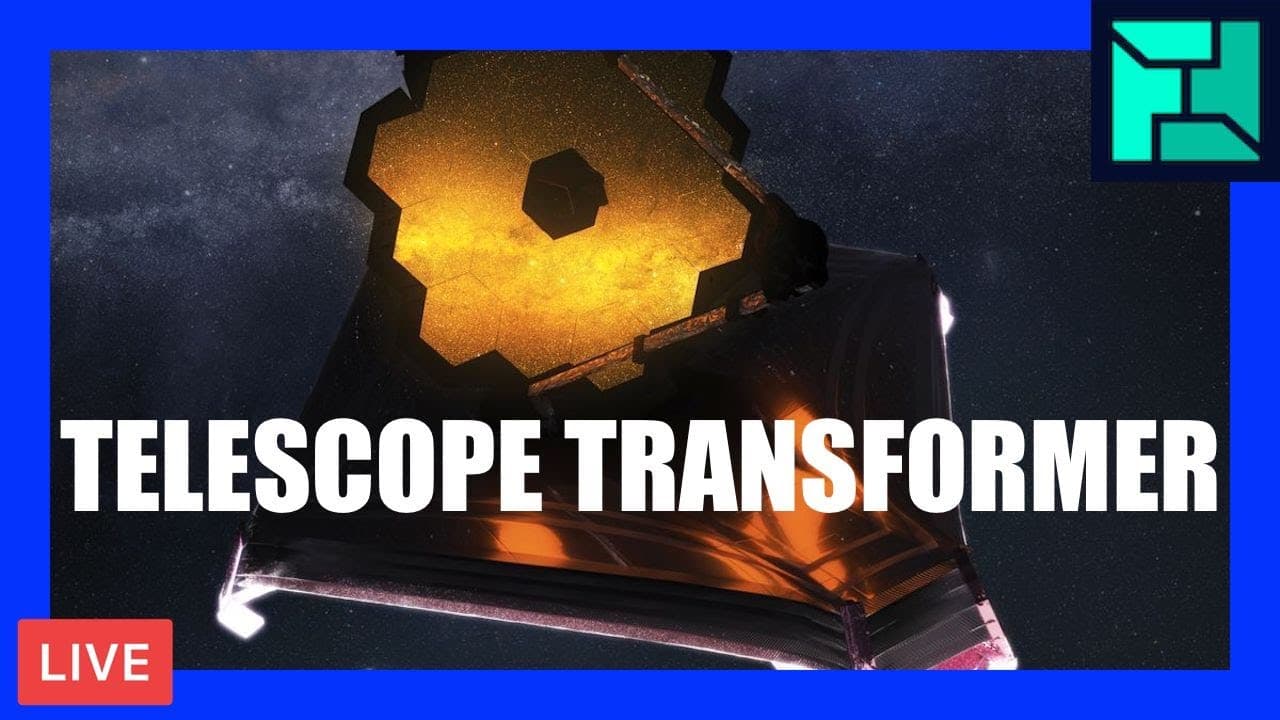
The James Webb Space Telescope (JWST) is a groundbreaking scientific instrument in space that will revolutionize our understanding of the universe.
Transcript
do so you foreign okay hello there friend what are we actually seeing starts to get complicated it was easy it will start to separate are definitely not behind that restricted access to it they're not forgettable i should shells well alright we've been tracking this thing for weeks we still don't know what it is the basilisk has its eyes on you wha... Read More
Key Insights
- 😫 The JWST is set to become the most productive scientific instrument in human history, surpassing the Hubble Telescope's impact.
- 🙂 Its ability to observe infrared light will enable unprecedented studies of distant galaxies, star formation, exoplanets, and the early universe.
- 🧑🔬 The telescope's size, complexity, and cost emphasize the significance of its mission and the challenges overcome by scientists and engineers.
- ✊ Proper storage and disposal of nuclear waste from nuclear power plants are essential to mitigate potential risks and environmental concerns.
Install to Summarize YouTube Videos and Get Transcripts
Explore YouTube Video Summarizer or Get YouTube Transcript Extractor
Questions & Answers
Q: How does the size of the JWST's mirror compare to the Hubble Telescope's?
The JWST's mirror is significantly larger, measuring 1.75 meters compared to the Hubble's 2.4 meters. This will provide a hundredfold increase in resolving ability, allowing for more detailed observations of celestial objects.
Q: What makes the JWST's sunshield crucial for its operations?
The sunshield is designed to block out sunlight, Earth's reflected light, and the moon's light to create a cold environment. This is essential for observing faint infrared signals from distant galaxies and avoiding interference from heat sources.
Q: How will the JWST help scientists study the early universe?
By observing infrared light, the JWST can see through cosmic dust and detect the earliest galaxies that formed shortly after the Big Bang. This will provide insights into the formation of stars, galaxies, and the evolution of the universe.
Q: What are the challenges in deploying the JWST and making it fully operational?
The main challenge is unfurling the complex sunshield and ensuring it maintains its structural integrity. Once deployed, the telescope's instruments must be calibrated and aligned correctly to capture the highest-quality data.
Summary & Key Takeaways
-
The JWST is the successor to the Hubble Telescope and has been in development for over 30 years.
-
It is the largest and most complex space telescope ever built, with a mirror that is 100 times more powerful than the Hubble's, enabling it to capture detailed images of the early universe.
-
The telescope's main objective is to observe infrared light, allowing scientists to study distant galaxies, the formation of stars and planets, and the origins of life.
Read in Other Languages (beta)
Share This Summary 📚
Summarize YouTube Videos and Get Video Transcripts with 1-Click
Try YouTube Summary with ChatGPT & Claude or YouTube Transcript Generator
Explore More Summaries from [OFFICE HOURS] 📚


![🔴 Viral "Hanger Reflex" Explained! | [OFFICE HOURS] Podcast 090 thumbnail](/_next/image?url=https%3A%2F%2Fi.ytimg.com%2Fvi%2F-GQPNu0erKc%2Fhqdefault.jpg&w=750&q=75)

Summarize YouTube Videos and Get Video Transcripts with 1-Click
Try YouTube Summary with ChatGPT & Claude or YouTube Transcript Generator