Multiprocessor Scheduling
TL;DR
This video discusses the concepts of multiprocessor scheduling, focusing on symmetric and asymmetric multiprocessing approaches.
Transcript
click the Bell icon to get latest videos from akira hello friends today we are going to discuss about multiprocessor scheduling and approaches that are implemented due to the multiprocessor scheduling it may be a symmetric or symmetric but there must be some constraints which should keep in mind while implementing the scheduling scheduling is very ... Read More
Key Insights
- ❓ Multiprocessor scheduling becomes more complex with multiple CPUs available.
- 🔂 Symmetric multiprocessing simplifies scheduling by using a single processor for decisions and system activities.
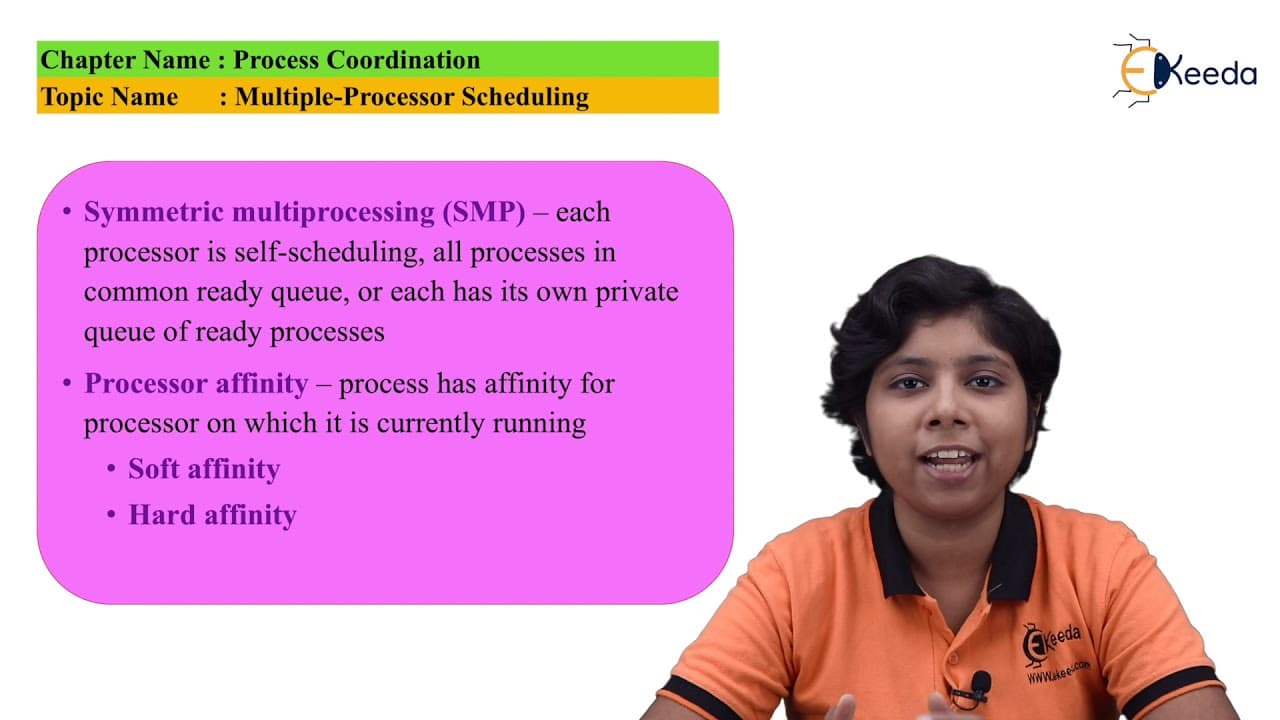
- 👻 Asymmetric multiprocessing allows all processors to self-schedule, requiring careful handling of shared data structures.
- 🏪 It is important to store shared data in private regions and ensure access restrictions to avoid conflicts in scheduling.
Install to Summarize YouTube Videos and Get Transcripts
Explore YouTube Video Summarizer or Get YouTube Transcript Extractor
Questions & Answers
Q: What is the difference between symmetric and asymmetric multiprocessing scheduling?
Symmetric multiprocessing uses a single processor for scheduling decisions, while asymmetric multiprocessing allows all processors to self-schedule. In symmetric multiprocessing, one processor acts as a master server, while in asymmetric multiprocessing, each processor can select processes from a common or private ready queue.
Q: What are the challenges of multiprocessor scheduling with shared data structures?
When multiple processes are trying to access and modify shared data structures, the scheduler must be programmed carefully to prevent conflicts. It is important to store shared data in a private region and ensure simultaneous access restrictions to avoid scheduling the same process on different processors.
Q: Which operating systems use the SMP architecture of scheduling?
Many popular operating systems, such as Windows, Linux, and Solaris, are implemented using symmetric multiprocessing (SMP) architecture for scheduling in multiprocessor systems.
Q: What are the advantages of symmetric multiprocessing scheduling?
Symmetric multiprocessing can simplify scheduling by using a single processor for scheduling decisions and system activities. This reduces the need to share data structures among processors, resulting in improved efficiency.
Summary & Key Takeaways
-
Multiprocessor scheduling becomes complex when there are multiple CPUs available, and it is important to consider constraints during implementation.
-
Symmetric multiprocessing involves a single processor making scheduling decisions, while asymmetric multiprocessing allows all processors to self-schedule.
-
Both approaches require careful handling of shared data structures and access restrictions.
Read in Other Languages (beta)
Share This Summary 📚
Summarize YouTube Videos and Get Video Transcripts with 1-Click
Try YouTube Summary with ChatGPT & Claude or YouTube Transcript Generator
Explore More Summaries from Ekeeda 📚






Summarize YouTube Videos and Get Video Transcripts with 1-Click
Try YouTube Summary with ChatGPT & Claude or YouTube Transcript Generator