Short Notes 1 Chomsky Hierarchy
TL;DR
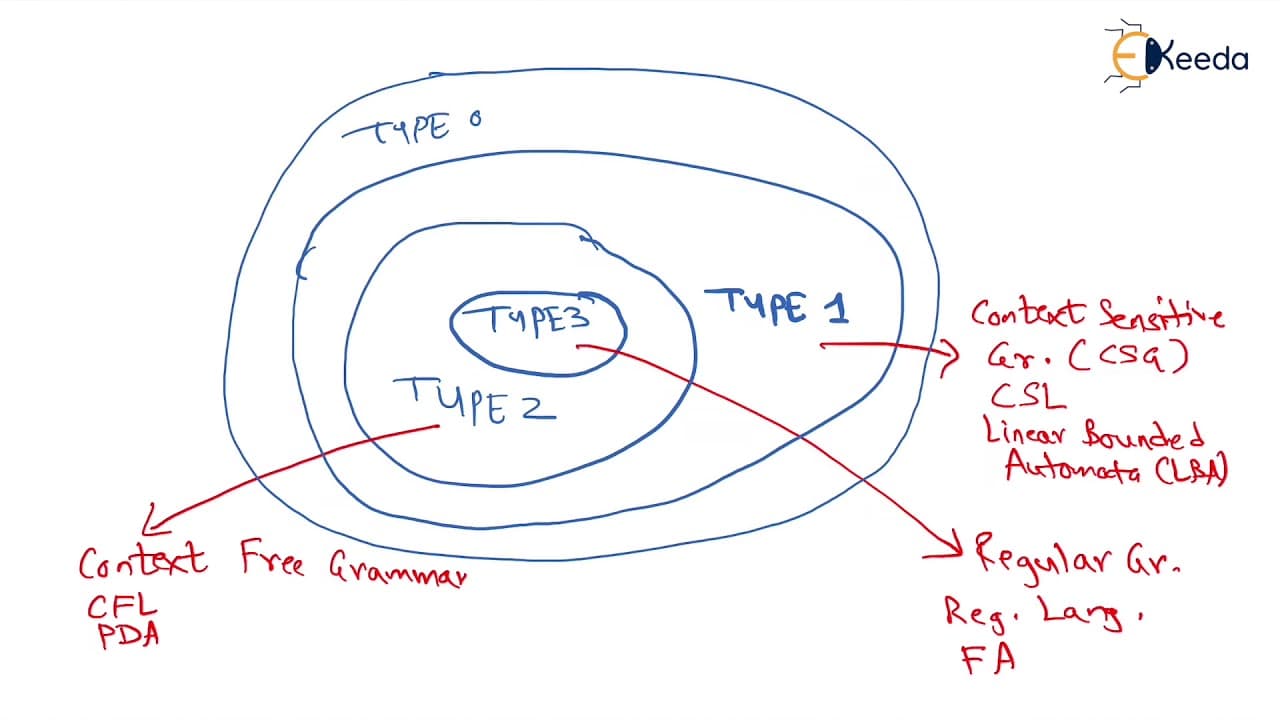
Chomsky Hierarchy classifies grammars into four types: regular grammar, context-free grammar, context-sensitive grammar, and unrestricted grammar.
Transcript
hello friends welcome to the next session here we are going to discuss Chomsky hierarchy let's get started so friends the next important short note that we have over here is Chomsky hierarchy now this comes as a theory answer in five marks for the main exam so the question over here says explain Chomsky hierarchy or explain the types of grammar or ... Read More
Key Insights
- 🥶 Chomsky Hierarchy classifies grammars into four types: regular, context-free, context-sensitive, and unrestricted.
- 🎰 Each type of grammar corresponds to a specific language and requires a different machine for generation.
- ❓ Regular languages are the simplest, while recursively enumerable languages are the most complex.
- 🎰 The unrestricted grammar, generated by Turing machines, is the most powerful type of grammar.
- ❓ Chomsky Hierarchy provides a framework for understanding the complexity of grammars and the languages they generate.
- 🛀 The hierarchy shows the relationships and limitations between different types of grammars.
- 🅰️ The classification of grammar types helps in analyzing and solving language-related problems.
Install to Summarize YouTube Videos and Get Transcripts
Explore YouTube Video Summarizer or Get YouTube Transcript Extractor
Questions & Answers
Q: What is Chomsky Hierarchy?
Chomsky Hierarchy is a theory that categorizes grammars into four types based on their complexity.
Q: What is a regular grammar?
A regular grammar is the simplest type in Chomsky Hierarchy. It generates regular languages and is represented by finite automata.
Q: What is a context-free grammar?
A context-free grammar is the second type in Chomsky Hierarchy. It generates context-free languages and is represented by pushdown automata.
Q: What is an unrestricted grammar?
An unrestricted grammar is the most complex type in Chomsky Hierarchy. It generates recursively enumerable languages and is represented by Turing machines.
Summary & Key Takeaways
-
Chomsky Hierarchy is a theory that classifies grammars into four types: regular, context-free, context-sensitive, and unrestricted.
-
Each type of grammar generates a specific language, and different machines are used for each type.
-
The most powerful type of grammar is the unrestricted grammar, which is generated using a Turing machine.
Read in Other Languages (beta)
Share This Summary 📚
Summarize YouTube Videos and Get Video Transcripts with 1-Click
Try YouTube Summary with ChatGPT & Claude or YouTube Transcript Generator
Explore More Summaries from Ekeeda 📚




Summarize YouTube Videos and Get Video Transcripts with 1-Click
Try YouTube Summary with ChatGPT & Claude or YouTube Transcript Generator