Quasars | Stars, black holes and galaxies | Cosmology & Astronomy | Khan Academy
TL;DR
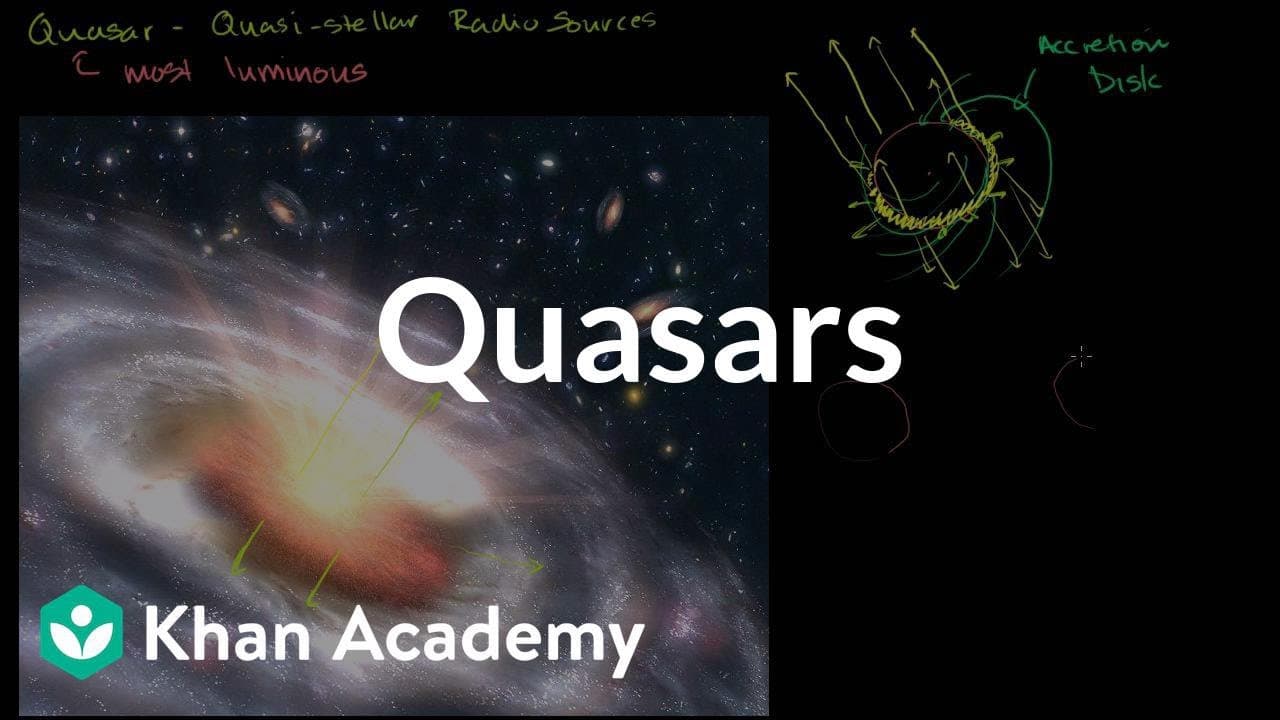
Quasars are highly energetic objects that are not stars, but rather the active nuclei of galaxies, emitting radiation from their accretion disks around supermassive black holes.
Transcript
What I want to do in this video is talk a little bit about quasars. And that's a short form for quasi-stellar radio sources. And this name is just a byproduct of the first observations of quasars. Because all they looked like were these kind of point-like sources of electromagnetic radiation, mainly in the radio part of the spectrum. So that's why ... Read More
Key Insights
- 🖤 Quasars are the active centers of galaxies, powered by supermassive black holes.
- 🖤 The radiation from quasars is emitted by the material in their accretion disks, not the black holes themselves.
- 🙂 Quasars are incredibly bright and can be observed from distances of billions of light-years.
- 💱 The presence of quasars in the early universe suggests a constantly changing universe and relates to the Big Bang theory.
- 🥺 Over time, much of the material near black holes falls into them, leading to a decrease in active quasars.
- 🌌 The Milky Way Galaxy may have had an active nucleus in the past, but currently does not exhibit quasar-like behavior.
- 💆 Quasars devour large amounts of mass per year, generating immense energy.
Install to Summarize YouTube Videos and Get Transcripts
Explore YouTube Video Summarizer or Get YouTube Transcript Extractor
Questions & Answers
Q: How are quasars different from stars?
Quasars are not stars but the active cores of galaxies. They emit radiation from their accretion disks, which are formed by material falling towards and orbiting around a supermassive black hole.
Q: Why is the radiation emitted by quasars not from the black hole itself?
The radiation is actually emitted by the matter in the accretion disk, which hasn't reached the event horizon. Once inside the event horizon, any emitted radiation cannot escape the black hole.
Q: Why does the radiation from quasars come out perpendicular to the accretion disk?
Radiation emitted along the accretion disk's direction would be absorbed, making other things hotter. Only radiation emitted perpendicular to the disk can transmit freely into space.
Q: How bright can quasars be?
Quasars are the most luminous objects in the universe, with some being a trillion times more luminous than the Sun. They can even be brighter than entire galaxies.
Summary & Key Takeaways
-
Quasars, short for quasi-stellar radio sources, were named for their appearance as point-like sources of radiation in the radio part of the spectrum.
-
Quasars are actually the active nuclei of galaxies, with supermassive black holes at their centers surrounded by accretion disks.
-
The intense heat and velocities near the black hole cause material in the accretion disk to emit high-frequency electromagnetic radiation, mainly in the X-ray part of the spectrum.
Read in Other Languages (beta)
Share This Summary 📚
Summarize YouTube Videos and Get Video Transcripts with 1-Click
Try YouTube Summary with ChatGPT & Claude or YouTube Transcript Generator
Explore More Summaries from Khan Academy 📚



Summarize YouTube Videos and Get Video Transcripts with 1-Click
Try YouTube Summary with ChatGPT & Claude or YouTube Transcript Generator