Products
Features
YouTube Video Summarizer
Summarize YouTube videos
Web & PDF Highlighter
Highlight web pages & PDFs
Chat with PDF
Ask any PDF questions with AI
Ask AI Clone
Chat with your highlights & memories
Audio Transcriber
Transcribe audio files to text
Glasp Reader
Read and highlight articles
Kindle Highlight Export
Export your Kindle highlights
Idea Hatch
Hatch ideas from your highlights
Integrations
Obsidian Plugin
Notion Integration
Pocket Integration
Instapaper Integration
Medium Integration
Readwise Integration
Snipd Integration
Hypothesis Integration
Apps & Extensions
Chrome Extension
Safari Extension
Edge Add-ons
Firefox Add-ons
iOS App
Android App
Discover
Discover
Ideas
Discover new ideas and insights
Articles
Curated articles and insights
Books
Book recommendations by great minds
Posts
Essays and notes from readers
Quotes
Inspiring quotes collection
Videos
Curated videos and summaries
Explore Glasp
Glasp Newsletter
Weekly insights and updates
Glasp Talk
Interview series with great minds
Glasp Blog
Latest news and articles
Glasp Use Cases
Learn how others use Glasp
Build & Support
Glasp API
Access Glasp's API for developers
MCP Connector
Connect Glasp to Claude & ChatGPT
Community
Glasp Reddit Community
Students
Student discount and benefits
FAQs
Frequently Asked Questions
AboutPricing
DashboardLog inSign up

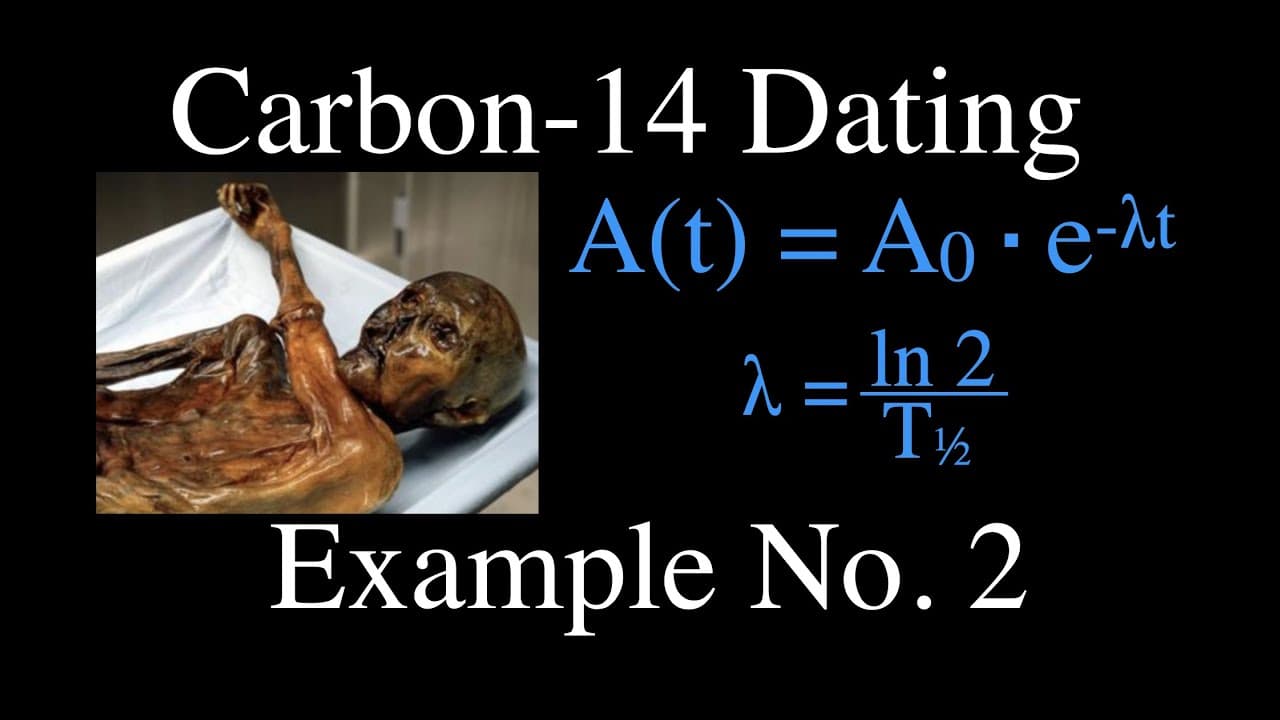
Radioactivity (16 of 16) Carbon-14 Dating, When Did Ötzi Die?
2.8K views
•
May 14, 2019
by
Step by Step Science
YouTube video player
Radioactivity (16 of 16) Carbon-14 Dating, When Did Ötzi Die?

TL;DR

A video explains how to use the activity of carbon-14 to determine the age of a mummy discovered in the Alps.

Transcript

okay in today's video we're gonna be doing example number two for carbon-14 dating in this video we're gonna be using activity please don't forget before we go on here down here in the bottom right hand corner please subscribe to my channel support my channel get all my excellent physics chemistry and math videos and while you're at it leave me a c... Read More

Key Insights

  • 🤕 Carbon-14 dating is a method used to determine the age of organic remains.
  • 🧑‍💻 The decay constant of carbon-14 is calculated using the natural log of 2 divided by the half-life of carbon-14.
  • 🤕 The activity of carbon-14 in a sample can be used to calculate the age of the sample using the carbon-14 decay equation.

Install to Summarize YouTube Videos and Get Transcripts

Explore YouTube Video Summarizer or Get YouTube Transcript Extractor

Questions & Answers

Q: How does carbon-14 dating work?

Carbon-14 dating relies on the radioactive decay of carbon-14 to determine the age of organic remains. The decay process is used to measure the activity of carbon-14 in a sample.

Q: What information is needed for carbon-14 dating?

To determine the age of a sample using carbon-14 dating, you need to know the original activity of carbon-14 in a living organism, the decay constant of carbon-14, and the current activity of carbon-14 in the sample.

Q: How is the decay constant of carbon-14 calculated?

The decay constant of carbon-14 is calculated using the natural log of 2 divided by the half-life of carbon-14. In this case, the decay constant is 3.84x10^-12 s^-1.

Q: How is the age of the mummy calculated?

The age of the mummy is calculated by solving the carbon-14 decay equation. By substituting the known values of activity into the equation and rearranging, the video calculates the age to be 5,242 years.

Summary & Key Takeaways

  • The video demonstrates an example of carbon-14 dating using the activity of the isotope.

  • A mummy discovered in the Alps had a carbon-14 decay activity of 53% of a living organism.

  • By solving the carbon-14 decay equation, the video determines that the mummy died 5,242 years ago.


Read in Other Languages (beta)

English

Share This Summary 📚

Summarize YouTube Videos and Get Video Transcripts with 1-Click

Download browser extensions on:

Try YouTube Summary with ChatGPT & Claude or YouTube Transcript Generator

Explore More Summaries from Step by Step Science 📚
Farsighteness vs. Nearsightedness, An Explanation thumbnail
Farsighteness vs. Nearsightedness, An Explanation
Step by Step Science
Point Charges (4 of 10) Change in Electric Potential Energy thumbnail
Point Charges (4 of 10) Change in Electric Potential Energy
Step by Step Science
Energy, Work & Power (11 of 31) Work Energy Principle, Net Work Done on an Object thumbnail
Energy, Work & Power (11 of 31) Work Energy Principle, Net Work Done on an Object
Step by Step Science
Coulomb's Law (5 of 7) Force from Three Charges in a Straight Line thumbnail
Coulomb's Law (5 of 7) Force from Three Charges in a Straight Line
Step by Step Science
From the Molecular Formula to the Empirical Formula thumbnail
From the Molecular Formula to the Empirical Formula
Step by Step Science
Newton's 2nd Law (9 of 21) Calculate Acceleration with Friction; Inclined Plane, One Mass thumbnail
Newton's 2nd Law (9 of 21) Calculate Acceleration with Friction; Inclined Plane, One Mass
Step by Step Science

Summarize YouTube Videos and Get Video Transcripts with 1-Click

Download browser extensions on:

Try YouTube Summary with ChatGPT & Claude or YouTube Transcript Generator

Apps & Extensions

  • Chrome Extension
  • Safari Extension
  • Edge Add-ons
  • Firefox Add-ons
  • iOS App
  • Android App

Key Features

  • YouTube Video Summarizer
  • Web & PDF Summarizer
  • Web & PDF Highlighter
  • Chat with PDF
  • Ask AI Clone
  • Audio Transcriber
  • Glasp Reader
  • Kindle Highlight Export
  • Idea Hatch

Integrations

  • Obsidian Plugin
  • Notion Integration
  • Pocket Integration
  • Instapaper Integration
  • Medium Integration
  • Readwise Integration
  • Snipd Integration
  • Hypothesis Integration

More Features

  • APIs
  • MCP Connector
  • Blog & Post
  • Embed Links
  • Image Highlight
  • Personality Test
  • Quote Shots

Company

  • About us
  • Blog
  • Community
  • FAQs
  • Job Board
  • Newsletter
  • Pricing
Terms

•

Privacy

•

Guidelines

© 2026 Glasp Inc. All rights reserved.