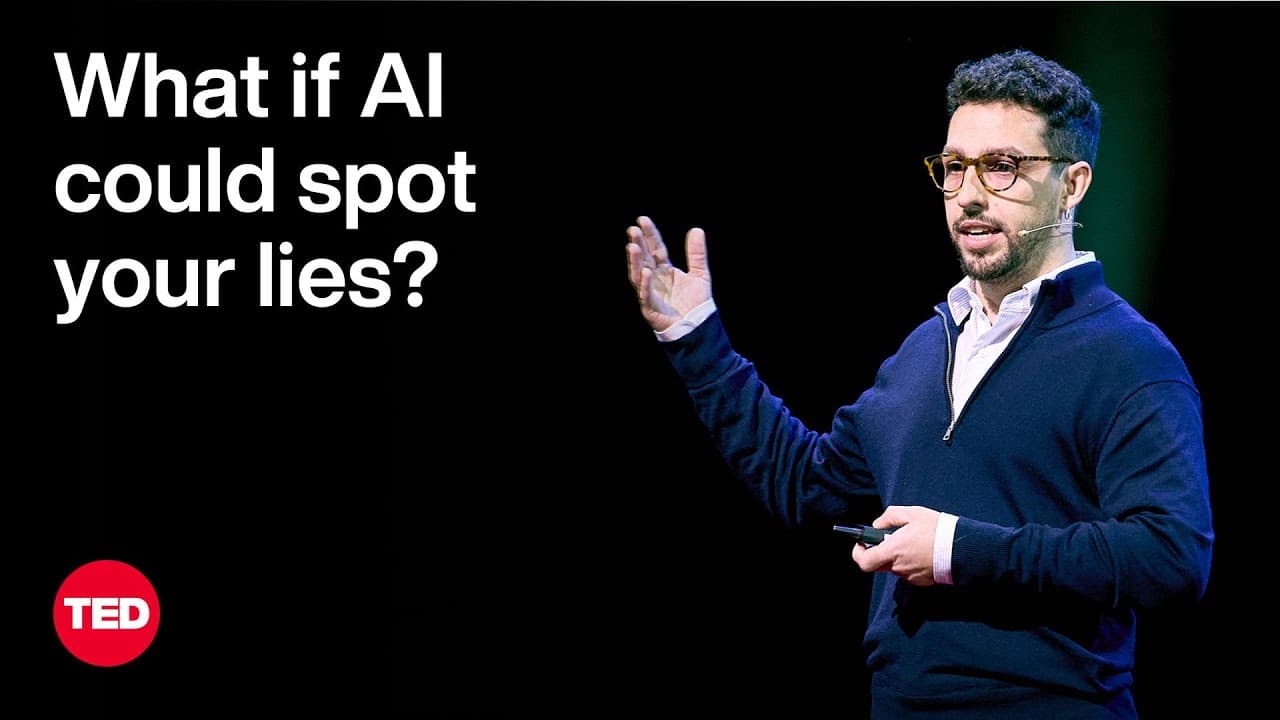
What if AI Could Spot Your Lies? | Riccardo Loconte | TED
TL;DR
AI can potentially detect lies more accurately than humans.
Transcript
This is something you won't like. But here everyone is a liar. Don't take it too personally. What I mean is that lying is very common and it is now well-established that we lie on a daily basis. Indeed, scientists have estimated that we tell around two lies per day, although, of course, it's not that easy to establish those numbers with certainty. ... Read More
Key Insights
- 😌 Lying is a common behavior, with individuals lying an estimated two times daily.
- 😌 Humans struggle at accurately detecting lies, with average success rates around chance levels.
- 🌥️ The study on FLAN-T5 showcases the ability of large language models to classify truthful versus deceptive statements effectively.
- 😌 Fine-tuning AI using diverse datasets is essential for improving its accuracy and generalization in lie detection.
- 🔉 Future applications of AI could revolutionize various sectors, including security, hiring, and social media management.
- ❓ Ethical considerations are paramount, as overreliance on AI might diminish trust in human interactions.
- 🤔 Critical thinking should be enhanced alongside AI technology to maintain robust judgment and understanding of truth.
Install to Summarize YouTube Videos and Get Transcripts
Explore YouTube Video Summarizer or Get YouTube Transcript Extractor
Questions & Answers
Q: How prevalent is lying in everyday life?
On average, humans lie about two times per day, suggesting that deception is a common behavior. This prevalence raises interesting questions about trust and interpersonal relationships, as most people are typically unaware of the lies being told around them.
Q: Why are humans generally poor at detecting lies?
People’s accuracy in detecting lies typically aligns with chance levels, hovering around 54%. This stems from the complexity of human behavior, where cues for deception vary greatly between individuals and contexts, making it difficult to establish universal indicators of lying.
Q: What role does AI play in detecting lies, according to the study?
The study utilizes a large language model, FLAN-T5, trained on various datasets that contain both truthful and deceptive statements. This AI model, through processes like fine-tuning, aims to classify statements accurately and outperform human judgment in identifying deception.
Q: What were the results of the experiments conducted on FLAN-T5?
Initial experiments showed FLAN-T5 achieving 70-80% accuracy, but accuracy dropped to around 50% when generalizing across contexts. Ultimately, the AI model scored nearly 80% in tests using a comprehensive dataset, demonstrating potential for real-life lie detection applications.
Q: What future applications could AI have in lie detection?
Potential applications include enhancing national security by detecting deceitful intentions, improving hiring processes by distinguishing genuine passion from superficial answers, and combating misinformation on social media by flagging deceptive content and assessing credibility.
Q: What ethical concerns arise from the use of AI in lie detection?
One major concern is the risk of blindly trusting AI outputs, which could lead to the erosion of personal trust and critical thinking. There's also the danger of people getting accused of lying based solely on AI decisions without considering human nuances.
Q: How can the issue of blind reliance on AI be addressed?
To mitigate blind reliance, it's vital to ensure AI systems provide transparent and understandable reasons for their judgments. Encouraging critical thinking and promoting a balanced approach where AI complements rather than replaces human discretion is essential for ethical usage.
Q: What is the key takeaway regarding AI's potential for detecting lies?
The integration of AI in lie detection is promising, but it is crucial to remain vigilant to maintain trust in human relationships. It should aid in our decision-making processes rather than lead to a society reliant on technology for truth validation.
Summary & Key Takeaways
-
Research indicates that humans have a poor track record in accurately detecting lies, achieving just over 50% accuracy. This limitation highlights the need for innovative solutions like artificial intelligence in lie detection.
-
A study explored using large language models, specifically FLAN-T5, for lie detection. Fine-tuning these models with various datasets showed promising results, indicating they could outperform humans in classifying deceptive statements.
-
The integration of AI in lie detection holds future potential across multiple fields, yet it also raises ethical concerns about overreliance on technology, the impact on personal trust, and the necessity for interpretability in AI decisions.
Read in Other Languages (beta)
Share This Summary 📚
Summarize YouTube Videos and Get Video Transcripts with 1-Click
Try YouTube Summary with ChatGPT & Claude or YouTube Transcript Generator
Explore More Summaries from TED 📚




Summarize YouTube Videos and Get Video Transcripts with 1-Click
Try YouTube Summary with ChatGPT & Claude or YouTube Transcript Generator