Numerical Based On Activity Problem No 1 - Nuclear Chemistry & Radioactivity
TL;DR
Calculate the activity of polonium by finding the decay constant and the number of atoms present in a given sample.
Transcript
click the bell icon to get latest videos from akira help friends in the previous topic we have discussed about the decay constant its expression as well as the half-life as we have also discussed about the modes of decay and here we see we are going to talk about the numerical based on the activity proton number one so what is the numerical let wil... Read More
Key Insights
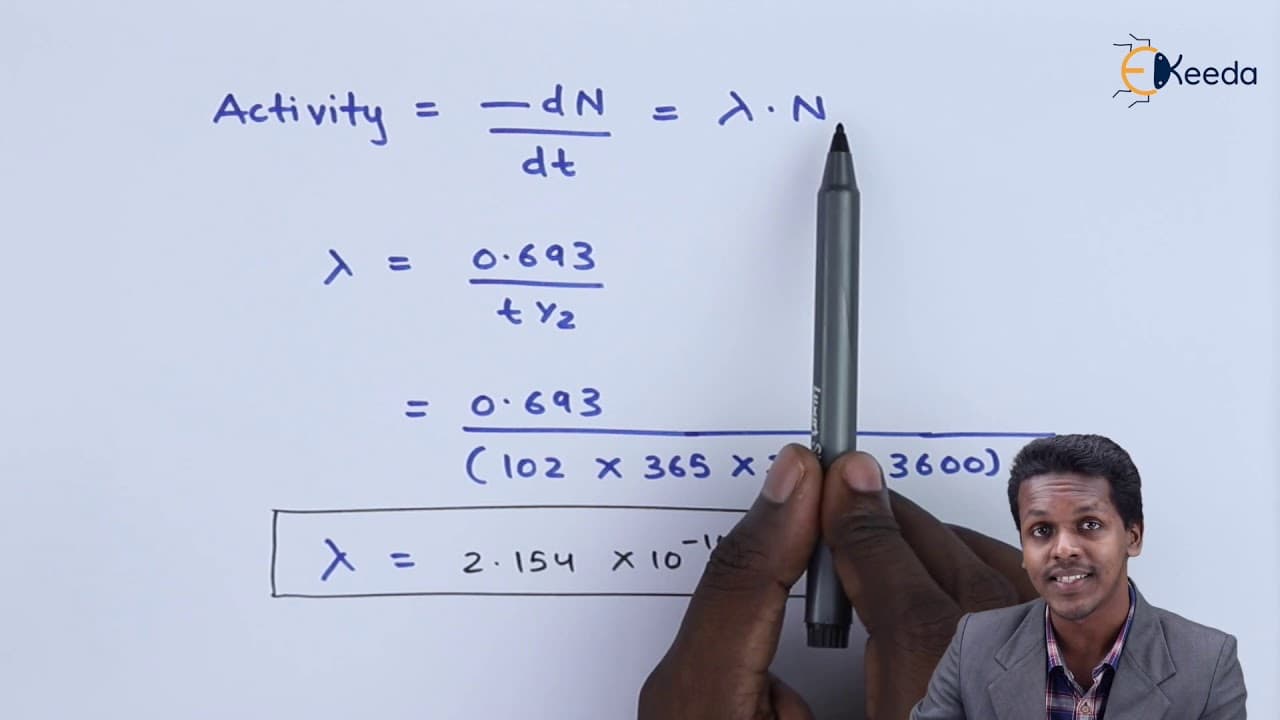
- 🛟 Decay constant (lambda) is calculated using the formula lambda = 0.693 / T_half, where T_half is the half-life of the radio element.
- ⌛ The decay constant should be converted to seconds to match the units of the observation time.
- 🫀 The number of atoms in the sample is determined by multiplying the weight of the sample by Avogadro's number and dividing it by the atomic mass.
- 🫀 The activity of the radio element is calculated by multiplying the decay constant and the number of atoms in the sample.
- 😑 The activity is expressed in particles per second or atoms per second.
- 🫀 The given data includes the half-life of polonium (102 years), the atomic mass number (209), the observation time (1 second), and the sample weight (2 milligrams).
- ☺️ The activity of polonium is found to be 1.24 x 10^6 particles per second.
Install to Summarize YouTube Videos and Get Transcripts
Explore YouTube Video Summarizer or Get YouTube Transcript Extractor
Questions & Answers
Q: What is the formula for calculating the activity of a radio element?
The activity is calculated using the formula Activity = lambda * N, where lambda is the decay constant and N is the number of atoms.
Q: How do you convert the half-life from years to seconds?
To convert the half-life to seconds, you multiply it by 365 (days in a year), 24 (hours in a day), and 3600 (seconds in an hour).
Q: How is the number of atoms in the sample calculated?
The number of atoms is calculated by multiplying the weight of the sample by Avogadro's number and dividing it by the atomic mass of the element.
Q: What units are used for the activity?
The activity is measured in particles per second or atoms per second.
Summary & Key Takeaways
-
The video discusses how to calculate the activity of polonium by using the decay constant and the number of atoms in a sample.
-
The given data includes the half-life of polonium (102 years), the atomic mass number (209), the duration of observation (1 second), and the weight of the sample (2 milligrams).
-
By converting the half-life to seconds, calculating the decay constant, and finding the number of atoms in the sample, the activity of polonium is determined to be 1.24 x 10^6 particles per second.
Read in Other Languages (beta)
Share This Summary 📚
Summarize YouTube Videos and Get Video Transcripts with 1-Click
Try YouTube Summary with ChatGPT & Claude or YouTube Transcript Generator
Explore More Summaries from Ekeeda 📚




Summarize YouTube Videos and Get Video Transcripts with 1-Click
Try YouTube Summary with ChatGPT & Claude or YouTube Transcript Generator