Mass problems | Measurement and geometry | 3rd grade | Khan Academy
TL;DR
Learn how to solve arithmetic word problems involving mass by using simple calculations and conversions.
Transcript
- [Voiceover] Let's see if we can get a sense of different masses, and we're gonna do that by doing the arithmetic word problems with mass on Kahn Academy. So it says which is the closest to the mass of a cow? So it's either seven kilograms or 700 kilograms. So let's think about what seven kilograms would be. So one kilogram if you're used to deali... Read More
Key Insights
- 🏋️ The weight of objects can be compared and estimated by understanding the weight of similar objects.
- 💆 Converting units of mass, such as kilograms to grams, is necessary to accurately solve mass-related word problems.
- 💆 To find the total mass of multiple objects when the mass of one object is known, multiplication is used.
Install to Summarize YouTube Videos and Get Transcripts
Explore YouTube Video Summarizer or Get YouTube Transcript Extractor
Questions & Answers
Q: How do you determine the closest mass to that of a cow?
To determine the closest mass to that of a cow, you need to compare the options of seven kilograms and 700 kilograms. By understanding the weight of different objects, 700 kilograms seems more accurate as cows are much larger and heavier than seven kilograms, which is equivalent to the weight of a large cat.
Q: How do you calculate the total mass of multiple magic wands?
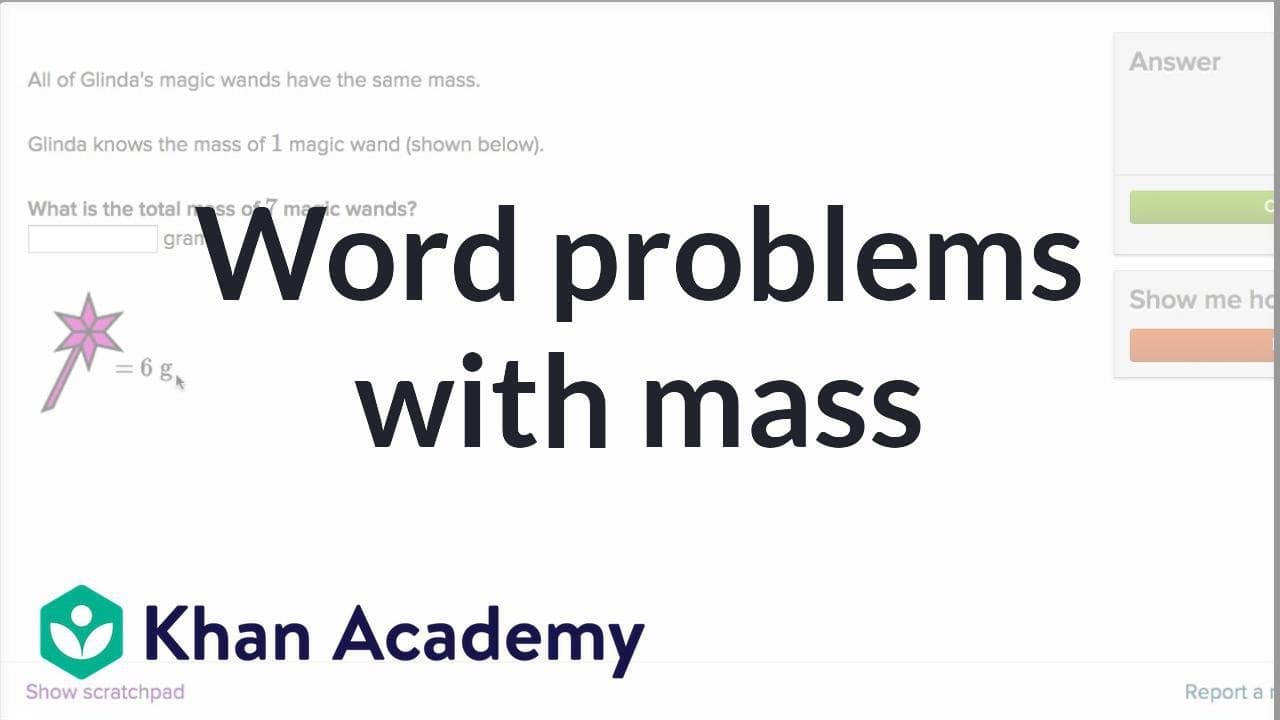
To calculate the total mass of multiple magic wands, multiply the mass of one wand by the number of wands. For example, if the mass of one wand is six grams and you have seven wands, the total mass would be 42 grams.
Q: How can you find the mass of one crayon when the total mass of seven crayons is known?
Divide the total mass of the crayons (56 grams) by the number of crayons (seven) to find the mass of one crayon. In this case, each crayon would weigh eight grams.
Q: What is the process for determining the total mass of multiple pencils?
If the mass of one pencil is known (eight grams) and there are five pencils, multiply the mass of one pencil by the number of pencils. In this scenario, the total mass would be 40 grams.
Summary & Key Takeaways
-
The video discusses how to determine the closest mass to that of a cow, with options of seven kilograms or 700 kilograms, by understanding the weight of different objects.
-
It explains how to calculate the total mass of multiple magic wands when the mass of one wand is given, using basic multiplication.
-
The video demonstrates how to find the mass of one crayon when the total mass of seven crayons is known, through division and multiplication.
-
Lastly, it teaches how to determine the mass of one acorn when the total mass of four acorns is provided, using division and multiplication.
Read in Other Languages (beta)
Share This Summary 📚
Summarize YouTube Videos and Get Video Transcripts with 1-Click
Try YouTube Summary with ChatGPT & Claude or YouTube Transcript Generator
Explore More Summaries from Khan Academy 📚



Summarize YouTube Videos and Get Video Transcripts with 1-Click
Try YouTube Summary with ChatGPT & Claude or YouTube Transcript Generator