What Does Compressing Functions Mean in Math?
TL;DR
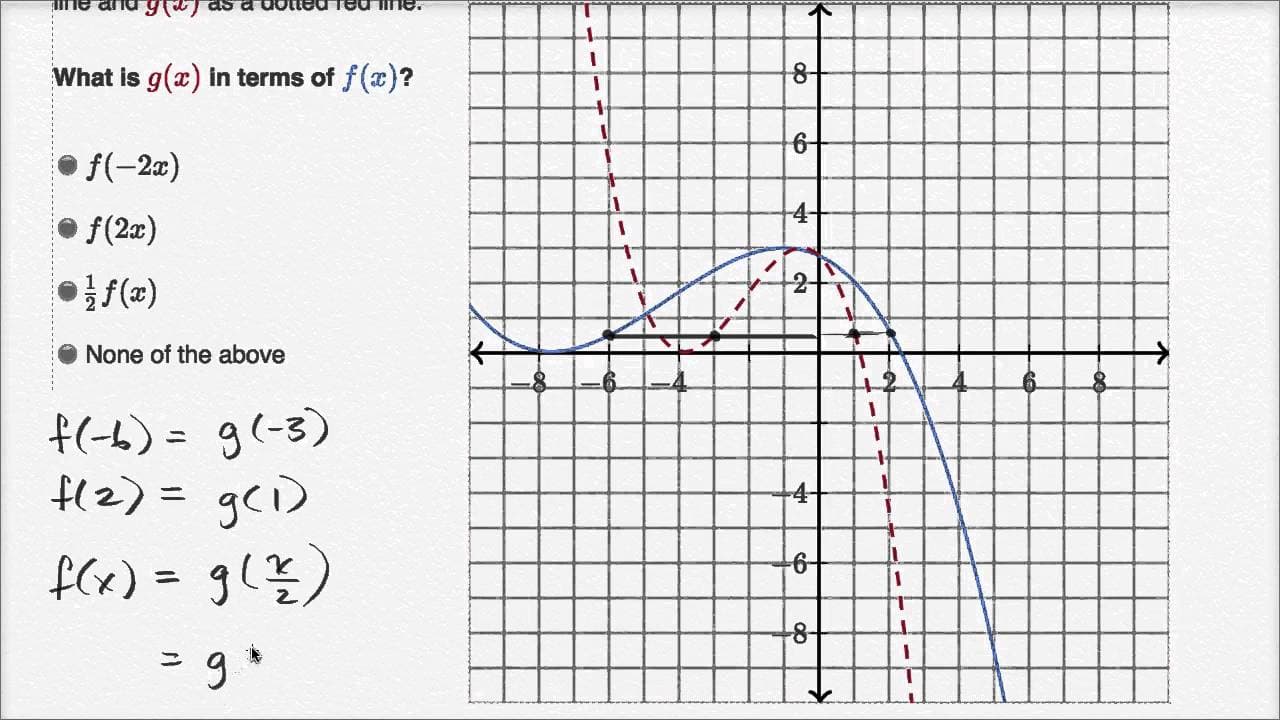
Compressing functions refers to transforming a function f(x) into g(x), where g(x) is a narrower version of f(x). Generally, g(x) can be expressed as f(2x) or f(x/2), indicating that the input for g scales the input for f by a factor of 2. This relationship helps to understand how changes in input affect the shape of the function.
Transcript
- [Voiceover] G of x is a transformation of f of x. The graph here shows this is y is equal to f of x, the solid blue line, This is y is equal to g of x as a dash red line. And it asked us, "What is g of x in terms of f of x?" And like always, pause the video and see if you can give a go at it and then we're going to do it together. All right, so w... Read More
Key Insights
- 🫥 The graph shows that g(x) is a compressed version of f(x), visually represented by the thinner dashed red line compared to the solid blue line.
- 😥 Corresponding points between f(x) and g(x) can be identified to understand their relationship.
- 🟰 Algebraically, it can be concluded that g(x) is equal to f(2x) or f(x/2).
Install to Summarize YouTube Videos and Get Transcripts
Explore YouTube Video Summarizer or Get YouTube Transcript Extractor
Questions & Answers
Q: How can g(x) be described in relation to f(x)?
g(x) can be seen as a compressed version of f(x), obtained by multiplying the input into f(x) by a factor of 2 or dividing the input into g(x) by 2.
Q: What are the corresponding points between f(x) and g(x)?
Corresponding points can be identified by finding where f(x) and g(x) have the same value. For example, f(-6) corresponds to g(-3) and f(2) corresponds to g(1).
Q: How can the relationship between f(x) and g(x) be expressed algebraically?
Algebraically, f(x) can be expressed as g(x/2), meaning that the input into g(x) should be half of the input into f(x). Alternatively, g(x) can be expressed as f(2x), indicating that the input into f(x) should be twice the input into g(x).
Q: What happens to the graph when the input into a function is multiplied by a number larger than 1?
When the input into a function is multiplied by a number larger than 1, it compresses the graph. This means that the function will increase or decrease at a faster rate, resulting in a thinner appearance for the graph.
Summary & Key Takeaways
-
The graph shows f(x) as a solid blue line and g(x) as a dashed red line, representing a transformation of f(x).
-
Corresponding points between f(x) and g(x) can be identified, such as f(-6) and g(-3).
-
In general, for a given x, f(x) is equal to g(x/2) or g(2x).
Read in Other Languages (beta)
Share This Summary 📚
Summarize YouTube Videos and Get Video Transcripts with 1-Click
Try YouTube Summary with ChatGPT & Claude or YouTube Transcript Generator
Explore More Summaries from Khan Academy 📚



Summarize YouTube Videos and Get Video Transcripts with 1-Click
Try YouTube Summary with ChatGPT & Claude or YouTube Transcript Generator