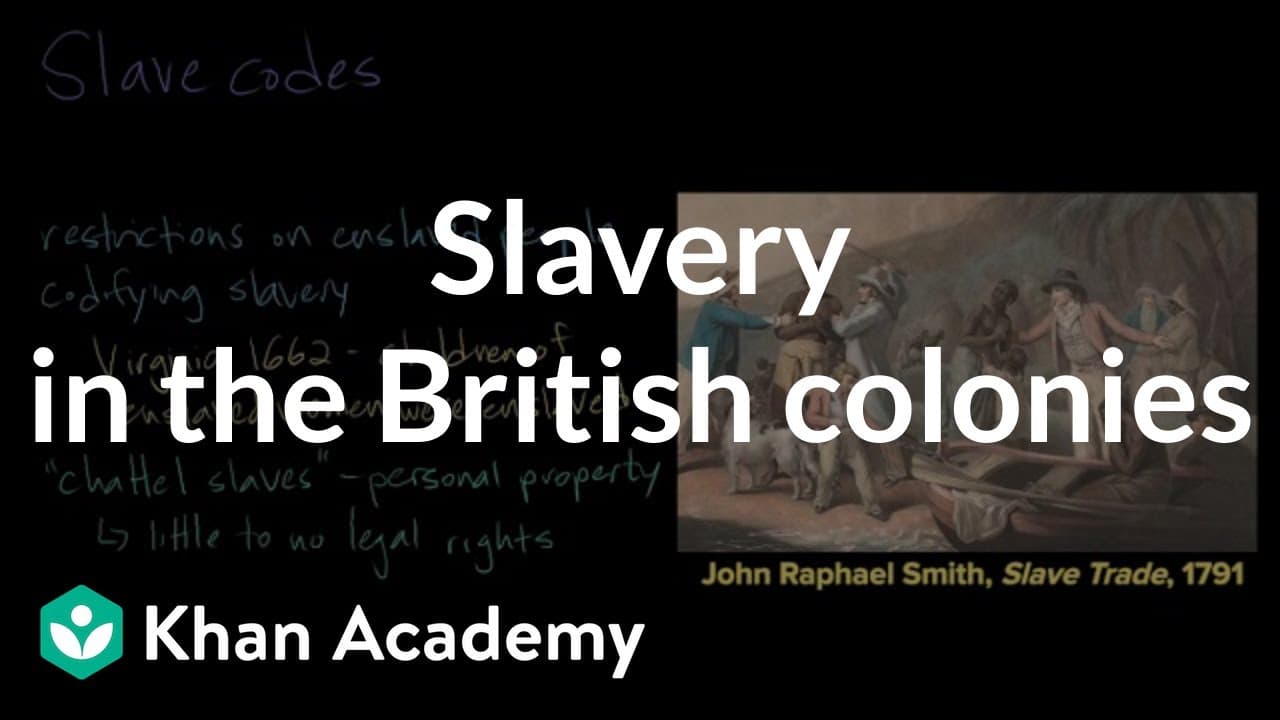
Slavery in the British colonies | Period 2: 1607-1754 | AP US History | Khan Academy
TL;DR
Slavery was a prevalent institution in all British colonies, with the highest concentration in the southern colonies, playing a crucial role in the colonial economy.
Transcript
- [Narrator] This is a chart showing estimated population around the year 1750 in the British colonies in the New World. I've arranged this more or less from north to south and you can see that as you go farther south, the percentage of the population that was enslaved and African grew greater and greater, but one thing to note here is that not any... Read More
Key Insights
- 🎁 Slavery was present in all British colonies, challenging the misconception that it was exclusive to the south.
- 🤍 Enslaved Africans outnumbered white people in some of the southern colonies.
- 🗯️ Colonial governments passed laws that defined enslaved people as chattel property and denied them legal rights.
- 🧔♀️ The experience of being enslaved involved physical and emotional hardship, including the constant threat of rape for women.
- 👯 Enslaved people utilized religion, dance, music, family, and resistance tactics to cope with the harsh realities of slavery.
- 🥺 Slave uprisings, like the Stono Rebellion, led to stricter slave codes.
- 🖐️ Slavery was not limited to the southern colonies; it played a central role in the colonial economy of all British colonies.
Install to Summarize YouTube Videos and Get Transcripts
Explore YouTube Video Summarizer or Get YouTube Transcript Extractor
Questions & Answers
Q: Did slavery only exist in the southern colonies?
No, slavery was present in all British colonies, including the northernmost colonies like New Hampshire.
Q: What were some of the restrictions and laws imposed on enslaved people?
Enslaved people faced restrictions on interracial relationships, and their children followed the condition of their enslaved mothers. They had little to no legal rights and were considered personal property.
Q: How did enslaved people resist slavery?
Enslaved people utilized covert means like breaking tools to make it harder to work and overt means like slave uprisings, such as the Stono Rebellion, which resulted in stricter slave codes.
Q: What was the role of slavery in the economy of the colonies?
Slavery was the bedrock of the colonial economy, not just in the southern colonies but also in all industries that supported slavery in the North, including financing, feeding, shipping, and purchasing products made by enslaved people.
Summary & Key Takeaways
-
Slavery existed in all British colonies, not just in the south, with even the farthest north colony, New Hampshire, having enslaved individuals.
-
The southern colonies, like Maryland, Virginia, and the Caribbean, had the largest concentration of enslaved Africans.
-
Colonial governments passed increasingly strict laws and restrictions on enslaved individuals, defining them as chattel property and denying them legal rights.
Read in Other Languages (beta)
Share This Summary 📚
Summarize YouTube Videos and Get Video Transcripts with 1-Click
Try YouTube Summary with ChatGPT & Claude or YouTube Transcript Generator
Explore More Summaries from Khan Academy 📚



Summarize YouTube Videos and Get Video Transcripts with 1-Click
Try YouTube Summary with ChatGPT & Claude or YouTube Transcript Generator