g-conjecture - Numberphile
TL;DR
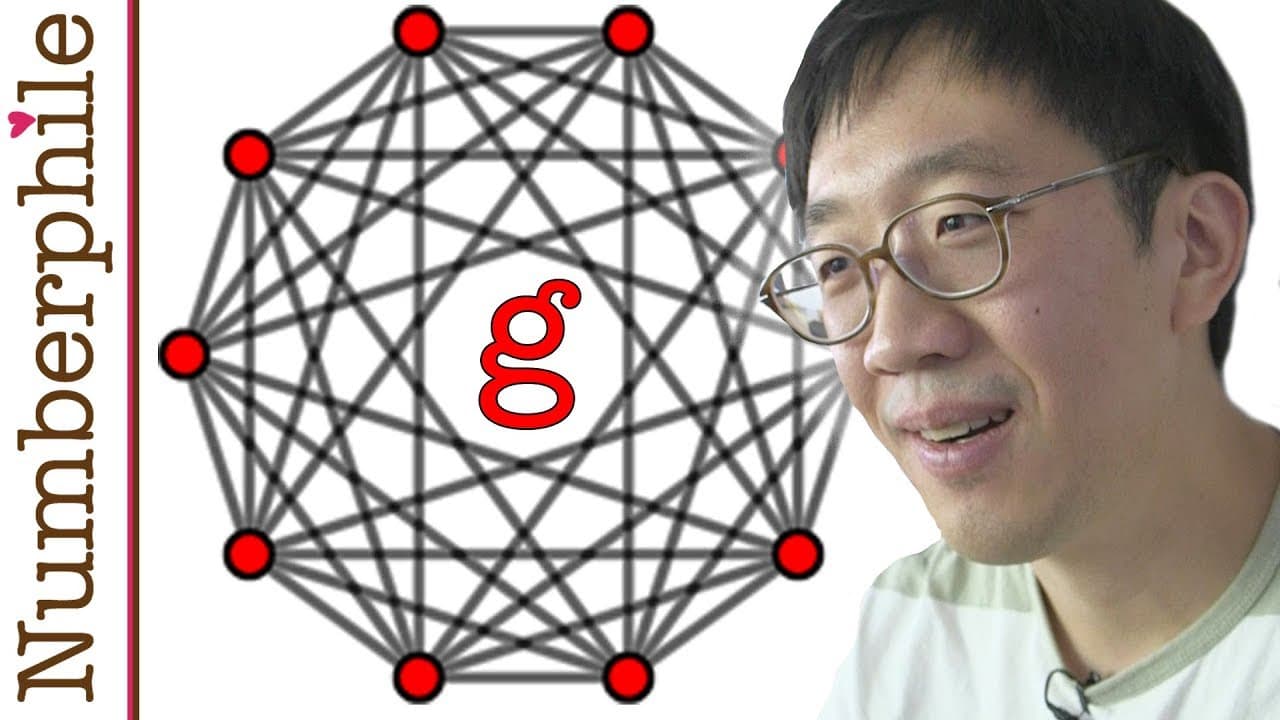
Euler's formula, which states that the alternating sum of the number of faces in a triangulated sphere is always 2 or 0, is just a small part of a larger symmetry known as the H-vector. The H-vector is a palindromic sequence that provides insights into the structure of triangulated spheres. The G-conjecture, an unsolved problem, proposes that the differences of successive H-values, known as the G-vector, are always non-negative.
Transcript
One of my favorite unsolved problems in mathematics. Maybe it's best to start with Euler's formula. Euler's formula tells something about triangulated spheres. So maybe I have to tell you what a triangulated sphere is. Well, intuitively it is a sphere but it is made combinatorial, so that every face is a triangle. So you want to attach bunch of tri... Read More
Key Insights
- 🛩️ Euler's formula is just a small part of a broader symmetry in triangulated spheres known as the H-vector.
- 🇧🇦 The H-vector, a palindromic sequence, provides a more comprehensive understanding of the combinatorial structure of triangulated spheres.
- 🎁 The G-conjecture proposes that the differences between successive H-values, represented by the G-vector, are always non-negative, presenting another aspect of the H-vector's patterns.
Install to Summarize YouTube Videos and Get Transcripts
Explore YouTube Video Summarizer or Get YouTube Transcript Extractor
Questions & Answers
Q: What is Euler's formula and what does it reveal about triangulated spheres?
Euler's formula states that the alternating sum of the number of faces, including vertices, edges, and triangles, in a two-dimensional triangulated sphere always results in either 2 or 0. This formula provides insights into the combinatorial structure of triangulated spheres.
Q: What is the H-vector and how does it relate to the structure of triangulated spheres?
The H-vector is a palindromic sequence derived from the number of faces in various dimensions in a triangulated sphere. It captures the symmetry beyond Euler's formula and serves as a more comprehensive representation of the sphere's structure.
Q: What is the significance of the G-vector?
The G-vector represents the differences between successive values in the H-vector. The G-conjecture proposes that these differences are always non-negative, indicating a weak increase in the H-vector and contributing to the overall understanding of the structure of triangulated spheres.
Q: Is the G-conjecture an unsolved problem in mathematics?
Yes, the G-conjecture remains an unsolved problem. It suggests that the G-vector of any triangulated sphere should have non-negative values, but this conjecture has not been proven or disproven yet.
Summary & Key Takeaways
-
Euler's formula reveals that the alternating sum of the number of faces in a triangulated sphere is always 2 or 0, regardless of the dimensional space.
-
The H-vector, a palindromic sequence derived from the number of faces in various dimensions, is a broader symmetry beyond Euler's formula that characterizes the structure of triangulated spheres.
-
The G-conjecture proposes that the differences between successive H-values, represented by the G-vector, are always non-negative, implying a weak increase in the H-vector.
Read in Other Languages (beta)
Share This Summary 📚
Summarize YouTube Videos and Get Video Transcripts with 1-Click
Try YouTube Summary with ChatGPT & Claude or YouTube Transcript Generator
Explore More Summaries from Numberphile 📚



Summarize YouTube Videos and Get Video Transcripts with 1-Click
Try YouTube Summary with ChatGPT & Claude or YouTube Transcript Generator