How to Code and Visualize Worley Noise
TL;DR
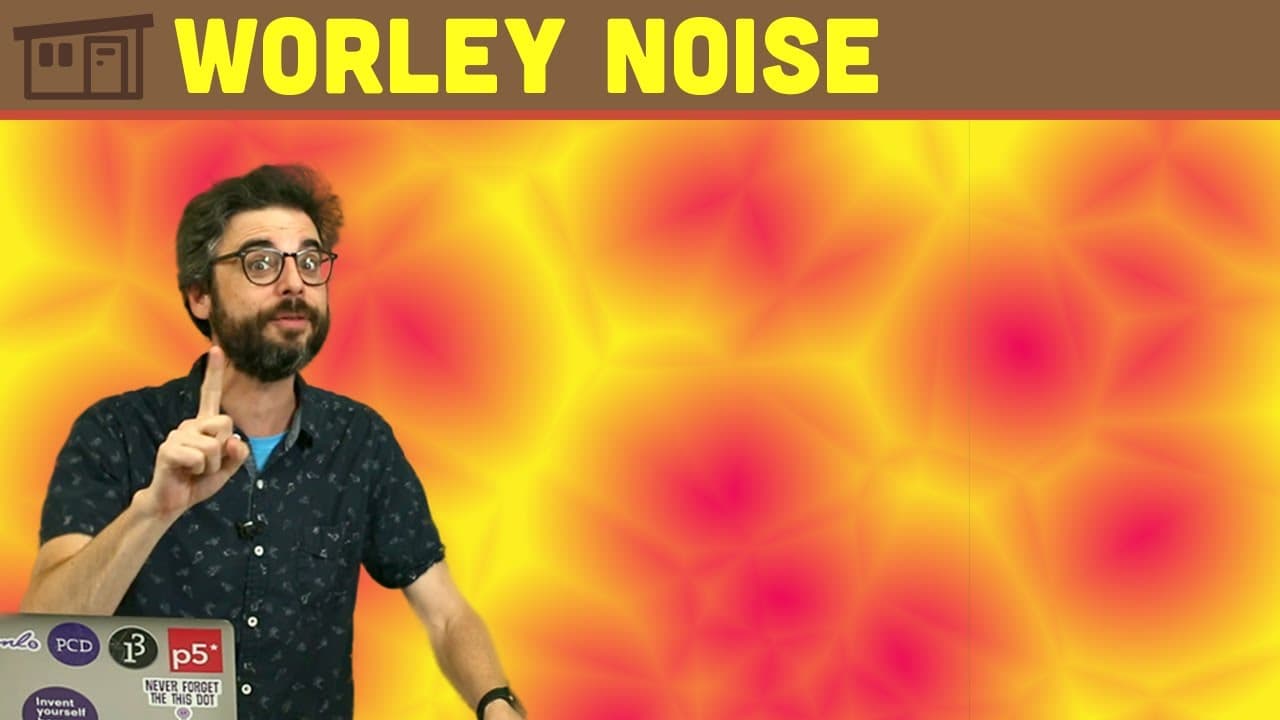
To code and visualize Worley noise, randomly distribute feature points in a two-dimensional space and calculate the distance for each pixel to the closest point. The algorithm allows for variations by changing the number of seed points and the mapping of distances, resulting in different textures and patterns that can even extend into three dimensions.
Transcript
[MUSIC PLAYING] Good morning. Welcome to Coding in the Cabana. I'm here with my co-host, Gloria Pickle. And today the topic is Worley noise. Now I'm particularly excited about this topic. I'm here, quarantined at home, like many of you are who might be watching this all around the world. And I did a live stream where I implemented Worley noise. So ... Read More
Key Insights
- 😚 Worley noise is a form of cellular noise that creates cell-like patterns based on the distance to the closest feature points.
- 😥 The algorithm involves randomly distributing feature points in space and calculating the distance from each pixel to the closest point.
- 😥 Manipulating the number of seed points, the distance function, and the mapping of noise values can create a wide range of textures and patterns.
- 👻 Worley noise can be extended to three dimensions, allowing for the creation of volumetric noise effects.
Install to Summarize YouTube Videos and Get Transcripts
Explore YouTube Video Summarizer or Get YouTube Transcript Extractor
Questions & Answers
Q: What is Worley noise and how does it differ from other noise algorithms?
Worley noise is a cellular noise algorithm that generates texture patterns based on the distance between each pixel and the closest feature point. It differs from other noise algorithms, like Perlin noise, by creating distinct cell-like structures instead of smooth gradients.
Q: How is the Worley noise algorithm visualized in the video?
The algorithm is visualized by setting the color of each pixel in a Processing window based on its noise value. The video demonstrates how to map the noise values to colors and adjust the range and brightness of the mapping.
Q: How can the number of seed points and the value of n be manipulated to create different textures in Worley noise?
By increasing or decreasing the number of seed points, the size and density of the Voronoi-like cells can be adjusted. The value of n determines which closest point's distance is used for noise calculation, with higher values producing more complex and intricate patterns.
Q: Are there any optimizations that can be applied to improve the performance of the Worley noise algorithm?
The video suggests using spatial subdivision, such as a quadtree or a simpler spatial partitioning method, to reduce the number of points that need to be compared for each pixel. This can significantly improve the performance when dealing with large resolutions or high numbers of seed points.
Summary & Key Takeaways
-
The video introduces the concept of Worley noise and its relationship with the Voronoi tessellation.
-
The algorithm for generating Worley noise involves randomly distributing points in space and calculating the distance of each pixel to the closest point.
-
The video shows how different variations of Worley noise can be created by manipulating the number of seed points, the distance functions, and the mapping of noise values to colors.
Read in Other Languages (beta)
Share This Summary 📚
Summarize YouTube Videos and Get Video Transcripts with 1-Click
Try YouTube Summary with ChatGPT & Claude or YouTube Transcript Generator
Explore More Summaries from The Coding Train 📚
Summarize YouTube Videos and Get Video Transcripts with 1-Click
Try YouTube Summary with ChatGPT & Claude or YouTube Transcript Generator