Complex exponentials spin
TL;DR
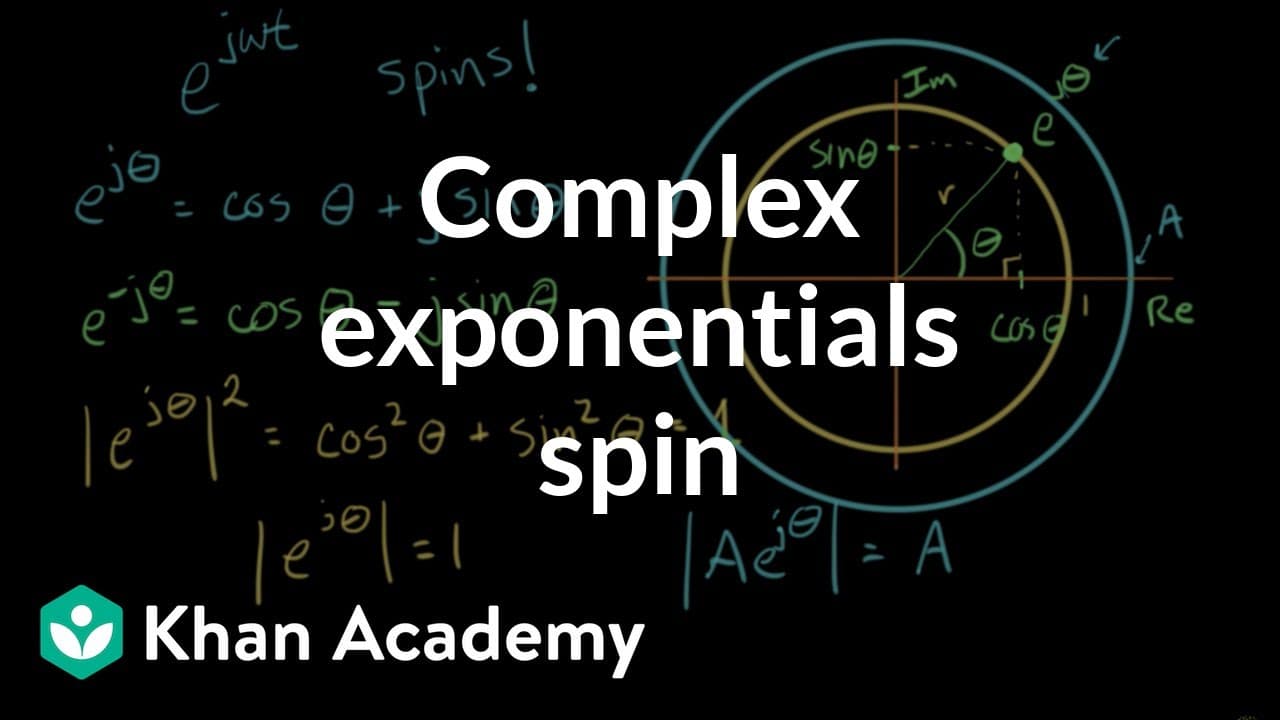
Complex exponentials can be used to represent cosine waves, with E to the J omega T and E to the minus J omega T representing spinning numbers.
Transcript
- [Voiceover] In the last video we did a quick review of the exponential and what it means. And then we looked in and figured out what the magnitude exponential is, the magnitude is 92 is equal to one. Now we're gonna look closely at this complex exponential as it represents a cosine, a part of a cosine. Now we're gonna keep combining some of our i... Read More
Key Insights
- 🏣 Cosine of theta can be expressed as one half times E to the plus J theta plus E to the minus J theta.
- ⌛ Time and frequency are related in representing cosine waves, with time in seconds and frequency in one over seconds.
- 🏣 E to the J omega T and E to the minus J omega T represent spinning numbers on the unit circle, with E to the J omega T rotating counterclockwise and E to the minus J omega T rotating clockwise.
Install to Summarize YouTube Videos and Get Transcripts
Explore YouTube Video Summarizer or Get YouTube Transcript Extractor
Questions & Answers
Q: How can cosine of theta be expressed as two separate exponentials?
To represent cosine of theta, we can use Euler's formula to express it as one half times E to the plus J theta plus E to the minus J theta. This notation allows us to break down the cosine function into two separate exponential terms.
Q: How are time and frequency related in representing cosine waves?
Time is measured in units of seconds, while frequency is measured in units of one over seconds. When time and frequency are multiplied together, we get a dimensionless number, and the cosine function is then taken with this dimensionless number as the argument.
Q: What does the spinning number represent in mathematical notation?
The spinning number is represented by E to the J omega T or E to the minus J omega T. These complex exponentials indicate a number that rotates on the unit circle as time progresses, with E to the J omega T rotating counterclockwise and E to the minus J omega T rotating clockwise.
Q: What is the significance of E to the J omega T and E to the minus J omega T in representing cosine waves?
E to the J omega T and E to the minus J omega T are powerful representations of spinning numbers that can be used to describe every aspect of a cosine wave. They allow for a deeper understanding of the behavior and properties of cosine waves.
Summary & Key Takeaways
-
The content discusses the relationship between complex exponentials and cosine waves, showing how cosine of theta can be expressed as two separate exponentials.
-
It introduces arguments of time and frequency to represent cosine waves, with time in seconds and frequency in one over seconds.
-
The video explains how E to the J omega T and E to the minus J omega T represent spinning numbers on the unit circle, rotating in different directions.
Read in Other Languages (beta)
Share This Summary 📚
Summarize YouTube Videos and Get Video Transcripts with 1-Click
Try YouTube Summary with ChatGPT & Claude or YouTube Transcript Generator
Explore More Summaries from Khan Academy 📚



Summarize YouTube Videos and Get Video Transcripts with 1-Click
Try YouTube Summary with ChatGPT & Claude or YouTube Transcript Generator