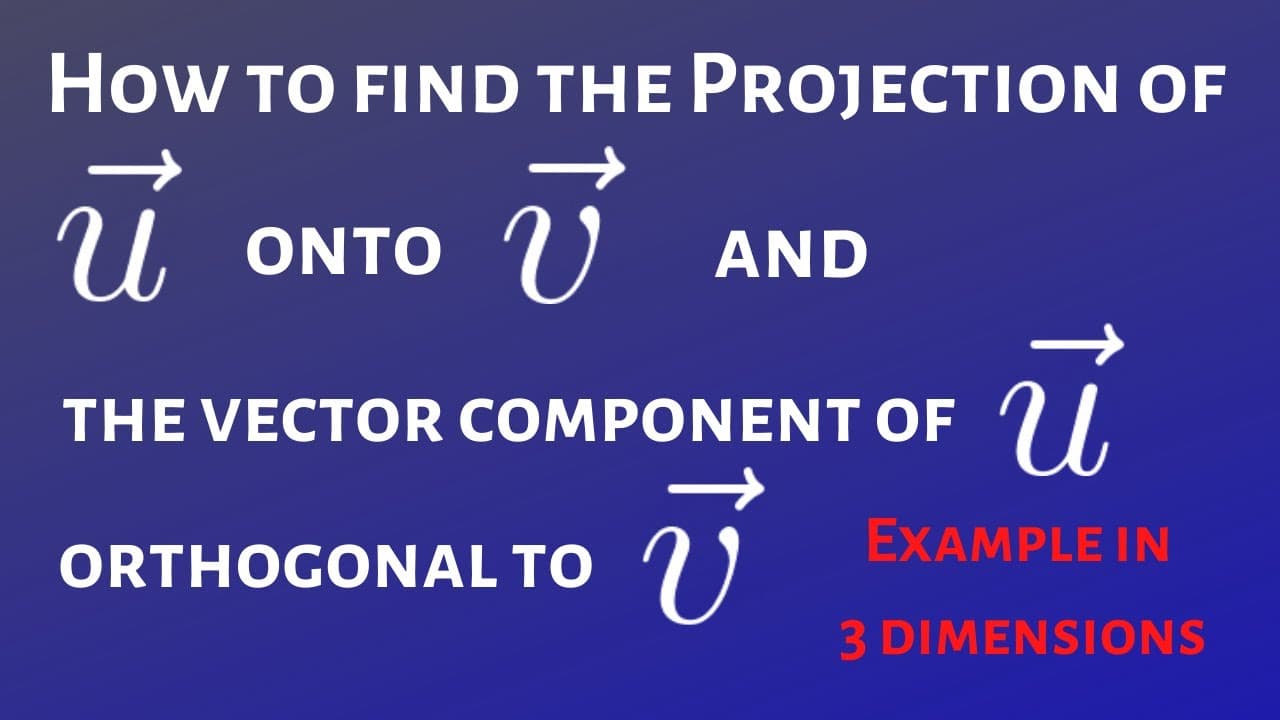
How to Find the Projection of u Onto v and the Vector Component of u Orthogonal to v (3 dimensions)
TL;DR
This video explains how to find the projection of one vector onto another and the vector component orthogonal to it.
Transcript
hi everyone in this video we have two vectors and we have to answer two questions we have to find the projection of u onto v and the vector component of u orthogonal to v before we do the problem i want to briefly just explain what these things are so i'm just going to draw a little 2d picture to explain things even though this is 3d the picture is... Read More
Key Insights
- 💦 Vector projection involves finding the projection of one vector onto another by dropping it down to the second vector.
- ✋ The vector component orthogonal to a given vector is obtained by creating a vector perpendicular to it that stops at the tip of the first vector.
- 😍 The formula for finding the projection of vector u onto v is (u dot v / |v|^2) * v.
- 🈸 Vector projection and vector component analysis have various applications in physics.
- 🍹 The projection and orthogonal component can be used to express vector u as their sum.
- 🏑 Vector projection is widely used in physics and other scientific fields.
- 🫥 The dot product and magnitude of vectors play significant roles in vector projection.
Install to Summarize YouTube Videos and Get Transcripts
Explore YouTube Video Summarizer or Get YouTube Transcript Extractor
Questions & Answers
Q: What is vector projection?
Vector projection refers to the process of finding the projection of one vector onto another. It involves dropping the first vector perpendicular to the second vector and obtaining a new vector that lies on the same line as the second vector.
Q: How is the vector component orthogonal to a given vector determined?
To find the vector component orthogonal to a given vector, create a vector that is perpendicular to the given vector and stops at the tip of the first vector. This vector represents the component that is orthogonal to the given vector.
Q: What application does vector projection have in physics?
Vector projection is commonly used in physics to analyze the motion and forces acting on objects. It helps determine the components of vectors in different directions, aiding in the understanding and calculation of various physical phenomena.
Q: What is the relationship between vector u, vector w1 (projection), and vector w2 (orthogonal component)?
Vector u can be expressed as the sum of vector w1 (projection) and vector w2 (orthogonal component). This relationship is represented by the formula: u = w1 + w2.
Summary & Key Takeaways
-
The video demonstrates how to find the projection of vector u onto vector v and the vector component that is orthogonal to v.
-
Vector u is projected onto v by dropping it down and forming vector w1, while the orthogonal component is represented by vector w2.
-
The formula for finding the projection involves calculating the dot product of u and v, dividing it by the magnitude of v squared, and multiplying it by v.
Read in Other Languages (beta)
Share This Summary 📚
Summarize YouTube Videos and Get Video Transcripts with 1-Click
Try YouTube Summary with ChatGPT & Claude or YouTube Transcript Generator
Explore More Summaries from The Math Sorcerer 📚

Summarize YouTube Videos and Get Video Transcripts with 1-Click
Try YouTube Summary with ChatGPT & Claude or YouTube Transcript Generator