What Is Double Sideband Suppressed Carrier Modulation?
TL;DR
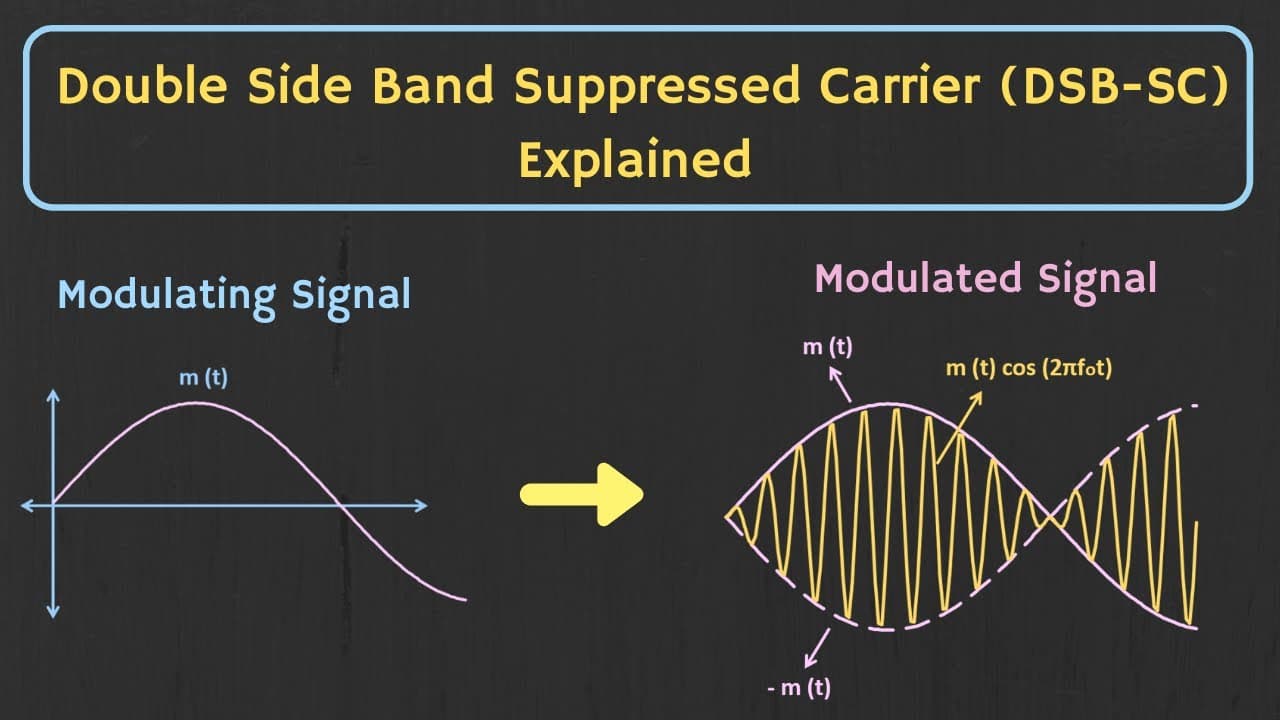
Double Sideband Suppressed Carrier (DSB-SC) modulation is a type of amplitude modulation where the carrier signal is suppressed, and only the sidebands are transmitted. This method requires twice the bandwidth of the original signal but eliminates the need for a discrete carrier, making it efficient for certain applications. Demodulation involves using a multiplier and a low-pass filter to retrieve the original message signal.
Transcript
Hey friends, welcome to the YouTube channel ALL ABOUT ELECTRONICS. So, in this video, we will talk about the amplitude modulation. And particularly, we will learn about the double sideband suppressed carrier. So, this amplitude modulation is one form of Carrier Communication. And before we jump into this amplitude modulation, we should be aware abo... Read More
Key Insights
- DSB-SC modulation is a form of amplitude modulation where the carrier signal is suppressed.
- The bandwidth of a DSB-SC modulated signal is twice that of the original message signal.
- In DSB-SC, both upper and lower sidebands carry the same information but are transmitted together.
- DSB-SC modulation requires a carrier frequency greater than or equal to the bandwidth of the message signal.
- Demodulation of DSB-SC involves using a multiplier and a low-pass filter to retrieve the original signal.
- Synchronous or coherent demodulation requires the local carrier signal to be in sync with the modulated signal's carrier.
- DSB-SC modulation increases receiver complexity due to the need for synchronization.
- Broadcast systems often use amplitude modulation with a carrier to reduce receiver costs.
Install to Summarize YouTube Videos and Get Transcripts
Explore YouTube Video Summarizer or Get YouTube Transcript Extractor
Questions & Answers
Q: What is Double Sideband Suppressed Carrier (DSB-SC) modulation?
Double Sideband Suppressed Carrier (DSB-SC) modulation is a type of amplitude modulation where the carrier signal is suppressed, and only the sidebands are transmitted. This approach requires twice the bandwidth of the original message signal but eliminates the need for a discrete carrier frequency, making it efficient for certain applications.
Q: How does DSB-SC modulation affect bandwidth?
In DSB-SC modulation, the bandwidth of the modulated signal is twice that of the original message signal. This is because both the upper and lower sidebands are transmitted, each carrying the same information, effectively doubling the required bandwidth compared to the baseband signal.
Q: Why is the carrier signal suppressed in DSB-SC modulation?
The carrier signal is suppressed in DSB-SC modulation to improve efficiency by reducing the power wasted on transmitting a carrier that does not carry information. Instead, only the sidebands, which contain the actual message, are transmitted, allowing for more efficient use of bandwidth and power.
Q: What is required for demodulating a DSB-SC signal?
Demodulating a DSB-SC signal requires a multiplier and a low-pass filter. The received modulated signal is multiplied with a locally generated carrier signal, and the result is passed through a low-pass filter to retrieve the original message signal. This process is known as synchronous or coherent demodulation.
Q: What challenges arise with DSB-SC modulation in terms of receiver design?
DSB-SC modulation increases receiver complexity due to the need for precise synchronization between the locally generated carrier signal and the modulated signal's carrier. This synchronization ensures that the frequency and phase match, which can be challenging if the signal experiences frequency and phase shifts during transmission.
Q: How does DSB-SC modulation compare to amplitude modulation with a carrier?
DSB-SC modulation is more efficient in terms of power usage as it suppresses the carrier, but it requires complex receivers due to synchronization needs. In contrast, amplitude modulation with a carrier includes the carrier signal, simplifying receiver design, which is preferred for broadcast systems where receiver cost is a concern.
Q: What is synchronous or coherent demodulation in DSB-SC?
Synchronous or coherent demodulation in DSB-SC involves using a local oscillator to generate a carrier signal that matches the frequency and phase of the modulated signal's carrier. This precise synchronization allows for accurate retrieval of the original message signal but increases receiver complexity and cost.
Q: Why is DSB-SC modulation suitable for point-to-point communication?
DSB-SC modulation is suitable for point-to-point communication because it efficiently uses bandwidth and power by suppressing the carrier. However, the complexity and cost of the receiver are justified in such systems where the transmitter and receiver costs are comparable, unlike in broadcast systems where simpler, cheaper receivers are preferred.
Summary & Key Takeaways
-
Double Sideband Suppressed Carrier (DSB-SC) modulation is an amplitude modulation technique where the carrier is suppressed, and only sidebands are transmitted, requiring twice the bandwidth of the modulating signal. This method eliminates the need for a discrete carrier frequency, making it efficient for certain applications.
-
Demodulation of DSB-SC involves using a multiplier and a low-pass filter, enabling the retrieval of the original message signal. Synchronous demodulation requires the local carrier signal to match the modulated signal's frequency and phase, increasing receiver complexity.
-
DSB-SC modulation is efficient for point-to-point communication but complex for broadcast systems due to synchronization needs. Amplitude modulation with a carrier is preferred for broadcast applications to reduce receiver costs, allowing for less expensive receivers.
Read in Other Languages (beta)
Share This Summary 📚
Summarize YouTube Videos and Get Video Transcripts with 1-Click
Try YouTube Summary with ChatGPT & Claude or YouTube Transcript Generator
Explore More Summaries from ALL ABOUT ELECTRONICS 📚

Summarize YouTube Videos and Get Video Transcripts with 1-Click
Try YouTube Summary with ChatGPT & Claude or YouTube Transcript Generator