Introduction to Diode: What is Diode ? V-I characteristics of the Diode Explained
TL;DR
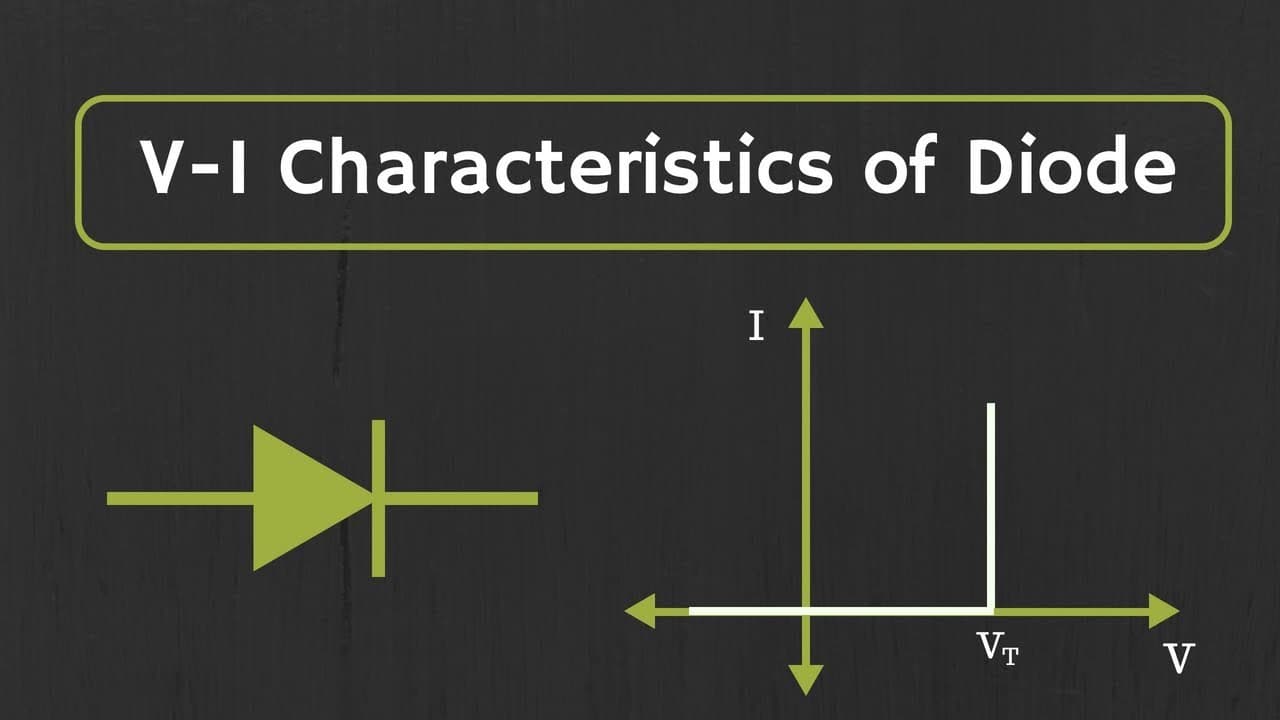
This video explains what diodes are, their V-I (voltage-current) characteristics, and introduces the concept of equivalent circuits.
Transcript
Hey friends, welcome to the YouTube channel ALL ABOUT ELECTRONICS. So, in this video and the subsequent videos, we will learn about the diode. And these are the following topics that we will cover in the series of videos. And in this particular video, we will learn that what is a diode, and how the V-I characteristics of the diode will look like. A... Read More
Key Insights
- 🔬 The diode is a two-terminal semiconductor device that allows the flow of current in only one direction, depending on the polarity of the applied voltage.
- 🔌 The symbol of the diode indicates the direction in which current can flow, with the anode and cathode being the two terminals.
- 📏 The V-I characteristics of a diode are non-linear, with the diode allowing current only after the applied voltage crosses a threshold voltage.
- 💡 By approximating the diode as an ideal diode, we can analyze circuits and find the voltage and current flowing through the diode.
- 🧮 In the first approximation, the diode acts as a closed switch for positive voltages and an open switch for negative voltages, depending on the applied voltage.
- ⚖️ The second approximation introduces the concept of diode resistance, which limits the current flowing through the circuit.
- 📈 The diode curve shows the piecewise linear characteristics of the diode, with a forward region where the diode conducts and a reverse region where the diode has very small current.
- 🛑 The breakdown region should be avoided, and the maximum allowable forward current and maximum breakdown voltage are important parameters to consider from the datasheet of a diode.
Install to Summarize YouTube Videos and Get Transcripts
Explore YouTube Video Summarizer or Get YouTube Transcript Extractor
Questions & Answers
Q: What is the purpose of a diode in a circuit?
The purpose of a diode in a circuit is to allow current to flow in one direction while blocking it in the reverse direction. This is useful for rectifying AC voltage to DC voltage or for protecting electronic components from reverse current flow.
Q: What are the different regions of operation for a diode?
The different regions of operation for a diode are the forward region, where the diode conducts current when the voltage is above the threshold voltage, and the reverse region, where the diode blocks current flow when the voltage is below the threshold voltage.
Q: What is the significance of the threshold voltage in a diode?
The threshold voltage in a diode is the voltage at which the diode starts conducting current. It determines the minimum voltage required for current flow in the forward direction.
Q: What is the breakdown region of a diode, and why should it be avoided?
The breakdown region of a diode is the region where the diode fails to block current flow in the reverse direction. This region should be avoided because it can lead to damage or malfunctioning of the diode.
Q: How can the V-I characteristics of a diode be used to analyze a circuit?
By knowing the V-I characteristics of a diode, the voltage and current flowing through the diode in a circuit can be determined. This information is essential for analyzing the behavior of the circuit and making accurate calculations.
Q: What does the resistance of a diode in an equivalent circuit represent?
The resistance of a diode in an equivalent circuit represents the resistance offered by the semiconductor material from which the diode is made. It becomes significant in circuits where the Thevenin's equivalent resistance is comparable to the diode resistance.
Q: Why are some diodes specifically designed to operate in the breakdown region?
Some diodes, known as Zener diodes, are designed to operate in the breakdown region. They are used in applications that require voltage regulation or voltage reference, where a specific breakdown voltage is desired.
Summary & Key Takeaways
-
Diodes are two-terminal semiconductor devices that allow current to flow in only one direction.
-
The V-I characteristics of diodes are non-linear, with an exponential increase in current as the voltage across the diode increases.
-
Diodes can be approximated as ideal diodes, which act as closed switches when the voltage is positive and open switches when the voltage is negative.
-
Equivalent circuits for diodes can be used to analyze circuits containing diodes.
-
The resistance of a diode can be neglected in most circuits, but in some cases, it needs to be considered.
Read in Other Languages (beta)
Share This Summary 📚
Summarize YouTube Videos and Get Video Transcripts with 1-Click
Try YouTube Summary with ChatGPT & Claude or YouTube Transcript Generator
Explore More Summaries from ALL ABOUT ELECTRONICS 📚


Summarize YouTube Videos and Get Video Transcripts with 1-Click
Try YouTube Summary with ChatGPT & Claude or YouTube Transcript Generator