Problem No 7 Based on Work Energy Principle WEP in Engineering Mechanics
TL;DR
Solve a problem involving work energy principle for a collar sliding along a circular rod with a spring attachment.
Transcript
hi friends we'll solve problem on work energy principle see what is given a collar of mass 1 kg is attached to a spring and slides without friction along a circular rod which lies in a horizontal plane the spring is undeformed when the caller is at b knowing that the caller is passing through the point d with a speed of 1.8 meters per second determ... Read More
Key Insights
- 🏋️ The work done by weight is zero when the collar slides along the circular track in a horizontal plane.
- 😥 The undeformed length of the spring at point B is equal to the difference between the radius and the distance O.
- 🌸 The deformation at position D is calculated using the difference between the length of the spring at D and the undeformed length of the spring.
- 🎅 The deformation at position C is calculated using the difference between the length of the spring at C and the undeformed length of the spring.
- 💦 The work done by forces is calculated using the deformations at positions D and C in the work energy principle formula.
- 😥 The velocity of the collar at point D is given in the problem.
- 🔙 The velocities of the collar at points C and B are calculated using the work energy principle.
Install to Summarize YouTube Videos and Get Transcripts
Explore YouTube Video Summarizer or Get YouTube Transcript Extractor
Questions & Answers
Q: What is the work done by weight when the collar slides along the circular track?
The work done by weight is zero because there is no displacement in the vertical direction on the horizontal plane.
Q: What is the undeformed length of the spring when the collar is at point B?
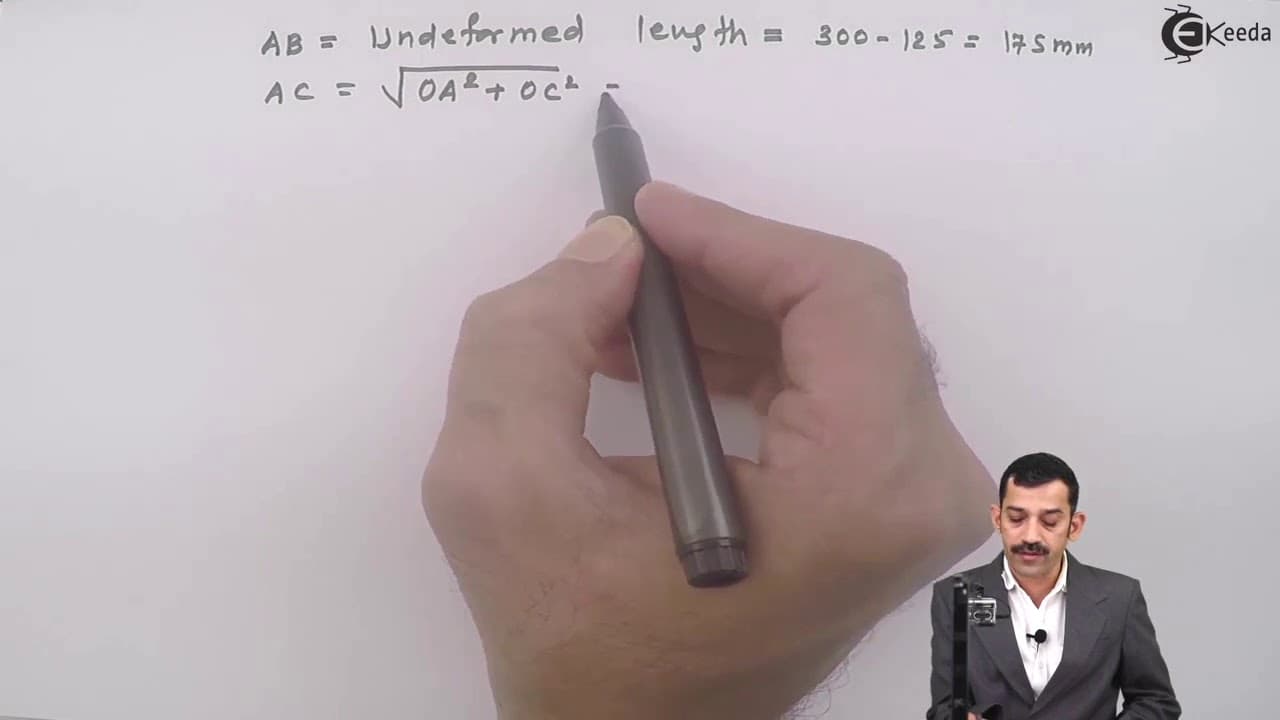
The undeformed length of the spring at point B is equal to the difference between the radius and the distance O, which is 175 mm.
Q: How do you find the length of the spring when the collar passes through point C?
Using the Pythagorean theorem, the length of the spring at point C is equal to the square root of the sum of the squares of the radii and the distance O, which is 325 mm.
Q: What is the velocity of the collar at point D?
The velocity of the collar at point D is given as 1.8 meters per second.
Q: How do you calculate the deformation at position D?
The deformation at position D is equal to the length of the spring at D minus the undeformed length of the spring, which is 250 mm.
Q: How do you calculate the deformation at position C?
The deformation at position C is equal to the length of the spring at C minus the undeformed length of the spring, which is 200 mm.
Q: What is the formula for the work done by forces in the work energy principle?
The formula for the work done by forces is (1/2)k(xd^2 - xc^2), where k is the stiffness of the spring and xd and xc are the deformations at positions D and C, respectively.
Q: What are the velocities of the collar at points C and B?
The velocity of the collar at point C is calculated using the work energy principle and is found to be 3.64 meters per second. The velocity of the collar at point B is also calculated using the work energy principle and is found to be 4.344 meters per second.
Summary & Key Takeaways
-
A collar of mass 1 kg slides along a circular rod in a horizontal plane with a spring attachment.
-
The collar passes through points D, C, and B with known velocities and distances.
-
Using the work energy principle, the speed of the collar at points C and B is determined.
Read in Other Languages (beta)
Share This Summary 📚
Summarize YouTube Videos and Get Video Transcripts with 1-Click
Try YouTube Summary with ChatGPT & Claude or YouTube Transcript Generator
Explore More Summaries from Ekeeda 📚





Summarize YouTube Videos and Get Video Transcripts with 1-Click
Try YouTube Summary with ChatGPT & Claude or YouTube Transcript Generator