Current Source
TL;DR
The video discusses the internal resistance of current sources and how it affects the current delivered to a load.
Transcript
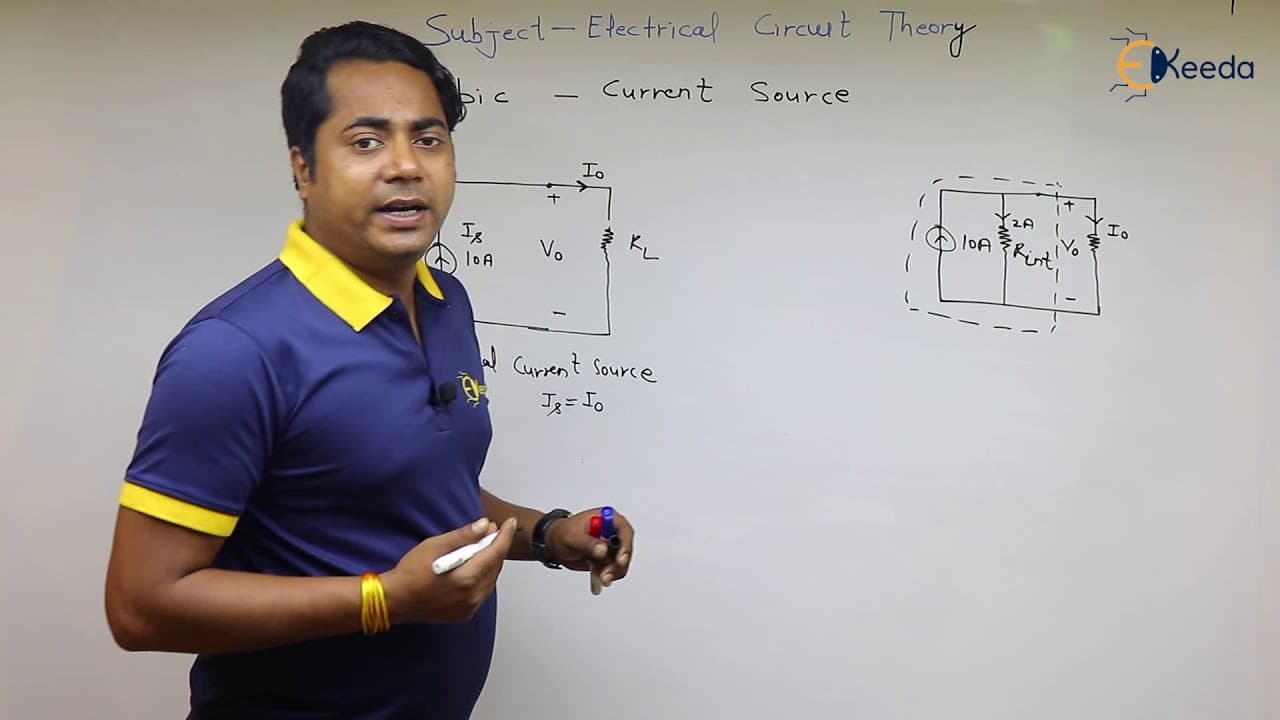
hello friends we are going to study current source and here we are going to find out what will be the internal resistance for a current source and how much amount of current it will deliver on load terminal coming to the topic we are going to discuss about practical source first let us assume we are generating an ampere this is your current source ... Read More
Key Insights
- 🚚 An ideal current source delivers the same current as the load, while a practical current source delivers less due to internal resistance.
- 💦 The internal resistance of a current source causes a voltage drop and decreases the current delivered to the load.
- 😂 The relationship between the generated current and the voltage across the internal resistance can be expressed using the equation I_naught = -1 / RS * V_naught + is.
Install to Summarize YouTube Videos and Get Transcripts
Explore YouTube Video Summarizer or Get YouTube Transcript Extractor
Questions & Answers
Q: What is the difference between an ideal and a practical current source?
An ideal current source delivers the exact current generated to the load, while a practical current source has internal resistance, resulting in a decrease in the current delivered to the load.
Q: How does the internal resistance affect the current delivered to the load?
The internal resistance causes some of the generated current to be lost as it flows through the resistance, resulting in a lower current reaching the load.
Q: What is the equation that relates the generated current and the voltage across the internal resistance?
The equation is I_naught = -1 / RS * V_naught + is, where I_naught is the generated current, RS is the internal resistance, V_naught is the voltage across the internal resistance, and is is a constant.
Q: Why is the practical current source considered a non-linear element?
The practical current source is considered non-linear because the relationship between the generated current and the voltage across the internal resistance is not a straight line, but rather described by the equation mentioned earlier.
Summary & Key Takeaways
-
In an ideal current source, the current generated is equal to the load current.
-
Practical current sources have internal resistance, causing a decrease in the current delivered to the load.
-
The relationship between the generated current (I_naught) and the voltage across the internal resistance (V_naught) can be described using the equation I_naught = -1 / RS * V_naught + is.
Read in Other Languages (beta)
Share This Summary 📚
Summarize YouTube Videos and Get Video Transcripts with 1-Click
Try YouTube Summary with ChatGPT & Claude or YouTube Transcript Generator
Explore More Summaries from Ekeeda 📚

Summarize YouTube Videos and Get Video Transcripts with 1-Click
Try YouTube Summary with ChatGPT & Claude or YouTube Transcript Generator