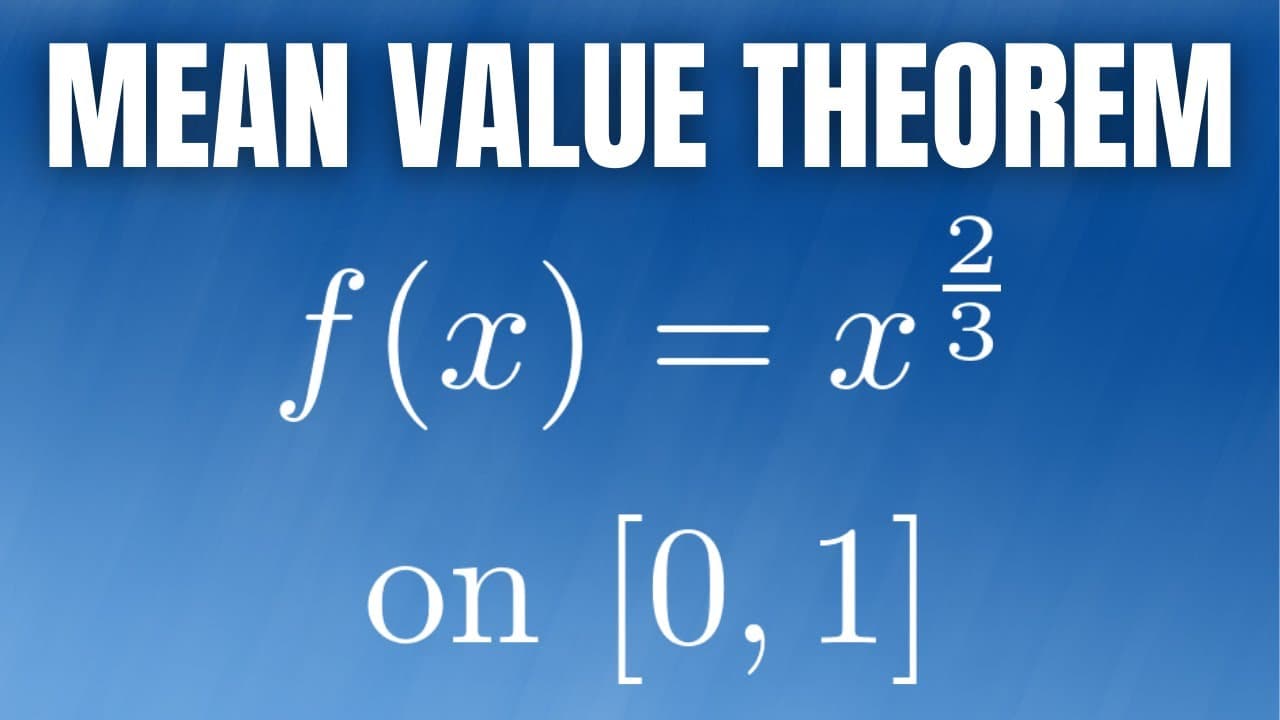
Mean Value Theorem Example: f(x) = x^(2/3) on [0,1]
TL;DR
The mean value theorem applies to the given function, and the value of c is 8/27.
Transcript
hi in this problem we're being asked if the mean value theorem applies and if it does find the value of c our function is f of x equals x to the two thirds and our interval is zero one let's go ahead and work through this solution so the mean value theorem has two requirements one the function should be continuous on the closed interval in this cas... Read More
Key Insights
- 😚 The mean value theorem requires the function to be continuous on the closed interval and differentiable on the open interval.
- 😚 Non-differentiable points within the closed interval, such as cusps, do not affect the application of the mean value theorem.
- ☠️ The mean value theorem relates the instantaneous rate of change of a function at a specific point to the average rate of change over an interval.
- ☠️ The value of c represents a point within the open interval where the instantaneous rate of change of the function is equal to the average rate of change over the interval.
- 😥 The mean value theorem allows for the determination of specific points on a function where the rates of change are equal.
- 0️⃣ The function used in the example has a cusp at zero, but it does not affect the application of the mean value theorem.
- 😀 The procedure to find the value of c involves calculating the derivative of the function, determining the values of f(a) and f(b), and solving for c.
Install to Summarize YouTube Videos and Get Transcripts
Explore YouTube Video Summarizer or Get YouTube Transcript Extractor
Questions & Answers
Q: What are the requirements for the mean value theorem to apply?
The function should be continuous on the closed interval and differentiable on the open interval, excluding any non-differentiable points on the closed interval.
Q: What is the purpose of finding the value of c using the mean value theorem?
The value of c represents a point within the open interval where the instantaneous rate of change of the function is equal to the average rate of change over the interval.
Q: Why does the mean value theorem not require differentiability at zero?
The mean value theorem only requires differentiability on the open interval, excluding the endpoints. It allows for non-differentiable points or cusps within the closed interval.
Q: How is the value of c calculated using the mean value theorem?
The value of c can be found by setting the derivative of the function at c equal to the average rate of change of the function over the interval, which is given by (f(b) - f(a))/(b - a).
Summary & Key Takeaways
-
The mean value theorem requires the function to be continuous on the closed interval, which is satisfied in this case.
-
The function should also be differentiable on the open interval, which is true except at zero where it has a cusp.
-
Using the mean value theorem, the value of c can be found by equating the instantaneous rate of change to the average rate of change over the interval.
Read in Other Languages (beta)
Share This Summary 📚
Summarize YouTube Videos and Get Video Transcripts with 1-Click
Try YouTube Summary with ChatGPT & Claude or YouTube Transcript Generator
Explore More Summaries from The Math Sorcerer 📚


Summarize YouTube Videos and Get Video Transcripts with 1-Click
Try YouTube Summary with ChatGPT & Claude or YouTube Transcript Generator