How to Create a 4D OpenSimplex Noise Loop GIF
TL;DR
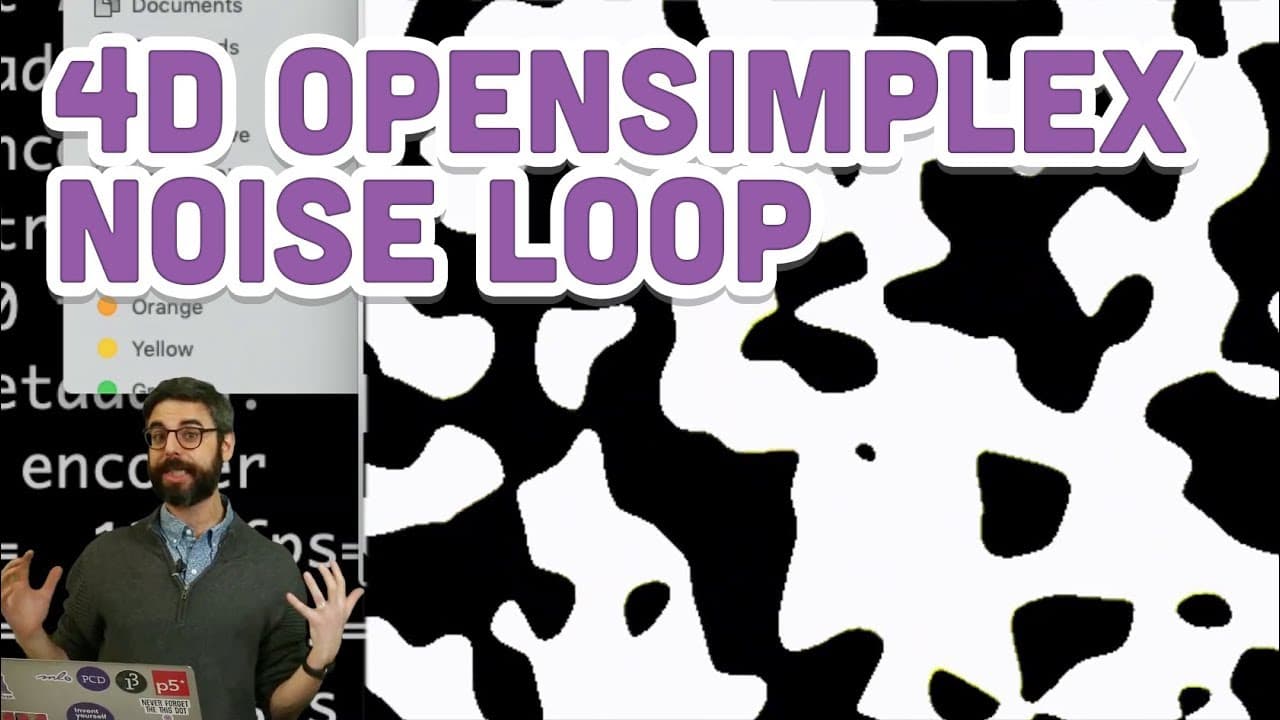
To create a seamless looping GIF using 4D OpenSimplex Noise, implement the noise algorithm and use polar coordinates to manipulate the z-axis. This approach allows you to animate in a circular path, ensuring the last frame matches the first for a smooth transition. OpenSimplex Noise provides a visually pleasing alternative to traditional Perlin noise, enhancing the overall animation quality.
Transcript
(horn toots) - Hello, welcome to a coding challenge entitled 4D Open Simplex Noise Loop. That's got to be a click bait title if I ever heard one, right? (laughs) Anyway, let me thank somebody. The artist Etienne Jacob, who I've referred to in like the last 307 coding challenge videos that I've made, because I keep doing this topic over and over aga... Read More
Key Insights
- ❓ Open Simplex Noise offers a smoother and more visually pleasing noise algorithm compared to traditional Perlin noise.
- ❓ Implementing a 4D noise algorithm is necessary for creating seamless looping animations.
- 😍 The use of polar coordinates and mapping values to the u-offset and v-offset allows for circular movements in a 3D space.
Install to Summarize YouTube Videos and Get Transcripts
Explore YouTube Video Summarizer or Get YouTube Transcript Extractor
Questions & Answers
Q: What is the main difference between Open Simplex Noise and Perlin noise?
Open Simplex Noise has a smoother and more visually pleasing character compared to Perlin noise. It lacks the directional artifacts and jerky movements often associated with traditional noise algorithms.
Q: How is the noise animation loop created using Open Simplex Noise?
To create a looping effect, the z-axis is transformed into a circular path using polar coordinates. The u-offset and v-offset values are generated by mapping the noise function to the cosine and sine of an angle based on the desired percentage of the loop.
Q: Why is a 4D noise implementation necessary for creating a loop?
The fourth dimension is needed to ensure a seamless loop. By using a 4D noise algorithm, the last frame of the animation matches the first frame, allowing for a continuous loop without any visible gaps or changes.
Q: Can Open Simplex Noise be used in real-time software or media art installations?
Yes, Open Simplex Noise can be used in real-time scenarios. The use of the fourth dimension is only necessary when rendering the animation to a looped GIF. In real-time applications, the third dimension alone can provide smooth and visually appealing results.
Summary & Key Takeaways
-
The video discusses the use of Open Simplex Noise and its differences from classic Perlin noise.
-
The goal of the coding challenge is to make a noisy scene loop seamlessly as a GIF.
-
The video explains the process of implementing 4D noise and using polar coordinates to create a looping effect.
Read in Other Languages (beta)
Share This Summary 📚
Summarize YouTube Videos and Get Video Transcripts with 1-Click
Try YouTube Summary with ChatGPT & Claude or YouTube Transcript Generator
Explore More Summaries from The Coding Train 📚




Summarize YouTube Videos and Get Video Transcripts with 1-Click
Try YouTube Summary with ChatGPT & Claude or YouTube Transcript Generator